
Medically Reviewed & Authored by Dr. Pranay Shah (MS Obs. & Gyn.), Founder, Director & Chief Fertility and IVF Specialist at Wellspring IVF & Women’s Hospital, Satellite, Ahmedabad. Last Updated: October 2026.
Clinical Summary: No natural remedy can open a blocked fallopian tube. Castor oil packs, herbal flushes, turmeric and vaginal steaming cannot dissolve scar tissue inside the tube, and there is no evidence that they improve pregnancy rates. The first step is to find out where and why the tube is blocked, using an HSG or laparoscopy. Some blockages near the uterus can be cleared, while badly damaged or fluid-filled tubes (hydrosalpinx) are best bypassed with IVF.
Anatomy of the Fallopian Tube: Why It Is Not Just a Hollow Pipe
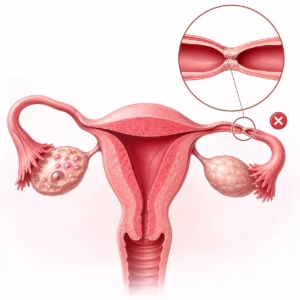
A widespread misconception among fertility patients is viewing the fallopian tube as a rigid conduit that simply needs “drain cleaning.” In human reproductive biology, the fallopian tube (oviduct) is an exquisitely complex, dynamic organ measuring roughly 10 to 12 cm in length with four distinct anatomical segments:
- Interstitial / Cornual Segment: The narrowest portion (inner lumen <1 mm) traversing the thick muscular wall of the uterine fundus.
- Isthmus: A muscular segment that acts as a functional sphincter, controlling sperm transit toward the ovary and delaying embryo passage until the uterine lining is receptive.
- Ampulla: The widest and longest segment (representing over half the tube’s length), where natural fertilization between sperm and oocyte occurs.
- Infundibulum and Fimbriae: Delicate, highly vascular, finger-like projections that gently hover over the ovary, actively capturing the ovulated egg and sweeping it into the tubal lumen.
Internally, the tubal lumen is lined with specialised ciliated columnar epithelial cells and secretory cells. These microscopic cilia beat synchronously toward the uterus thousands of times per minute, creating a coordinated fluid current that propels the non-motile egg and early dividing embryo toward the uterine cavity. When infection, endometriosis, or surgical trauma damages these delicate cilia or fuses the fimbriae together, mechanical patency alone cannot restore function. Even if a tube is forced open, absent or scarred cilia cannot transport an embryo, resulting in persistent infertility or life-threatening ectopic pregnancies.
Proximal vs. Distal Tubal Obstruction: Understanding the Site of Blockage
When evaluating blocked fallopian tubes and tubal factor infertility, the site of obstruction dictates the biological prognosis and treatment pathway:
Anatomical Parameter | Proximal Tubal Occlusion (PTO) | Distal Tubal Occlusion (DTO) / Hydrosalpinx |
|---|---|---|
Location of Blockage | At the uterotubal junction or isthmus (near the uterus) | At the ampulla, infundibulum, or fimbrial end (near the ovary) |
Typical Biological Causes | Amorphous proteinaceous debris, viscous mucus plugs, cornual muscle spasm during HSG, or salpingitis isthmica nodosa | Prior Pelvic Inflammatory Disease (PID), Chlamydia, Pelvic Tuberculosis (Genital TB), severe pelvic adhesions, or endometriosis |
Impact on Tubal Architecture | Tube usually retains normal external shape and healthy distal ciliated epithelium | Distal ends fuse shut, trapping secretions; tube distends into a fluid-filled sac (hydrosalpinx) |
Diagnostic Findings on HSG | Contrast dye fails to enter the tube at the uterine corner; zero tubal outline seen | Dye fills and distends the tube like a club or sausage; no peritoneal spill observed |
Evidence-Based Medical Treatment | Selective hysteroscopic or fluoroscopic tubal cannulation (clears debris in 70%–80% of cases) | Laparoscopic salpingectomy or proximal tubal clipping prior to IVF; natural conception is rarely safe |
Efficacy of “Natural Remedies” | Zero scientific evidence; transient relief in unverified cases is usually due to spontaneous resolution of cornual spasm | Completely ineffective; herbs cannot dissolve fibrotic scar tissue or open closed fimbriae |
Primary Fertility Recommendation | Tubal cannulation or direct IVF | IVF Treatment after managing toxic hydrosalpinx fluid |
The Myth of “Natural Remedies”: What Science and Physiology Say
Patients frequently present to our clinic after spending six to twelve months attempting unproven home remedies discovered on social media. Below is an objective, evidence-based critique of the most heavily marketed “natural tubal opening” therapies:
Castor Oil Packs & Abdominal Massage
- The Internet Claim: Applying warm castor oil packs over the lower abdomen improves pelvic circulation, breaks down scar tissue, and melts adhesions.
- The Physiological Reality: Castor oil contains ricinoleic acid, which exerts mild topical anti-inflammatory effects on the skin and can stimulate superficial cutaneous blood flow. However, castor oil cannot penetrate through the skin, subcutaneous fat, abdominal wall musculature, and peritoneal cavity to physically enter the fallopian tube lumen. Intraluminal fibrotic scar tissue consists of dense cross-linked collagen bundles that cannot be dissolved by transdermal oils.
Herbal Remedies (Turmeric, Dong Quai, Ginger, and Garlic)
- The Internet Claim: High doses of systemic anti-inflammatory herbs dissolve pelvic scar tissue and clear tubal blockages.
- The Physiological Reality: While curcumin (turmeric) and ginger possess mild systemic anti-inflammatory and antioxidant properties in vitro, they cannot reverse established anatomical scarring. Once fibrous connective tissue organizes inside the tubal wall, systemic dietary antioxidants have no mechanism to lyse dense fibrous bands. Furthermore, unregulated herbal concoctions carry risks of heavy metal contamination and liver toxicity.
Vaginal Steaming (“Yoni Steaming”)
- The Internet Claim: Steaming the vagina with herbs cleanses the uterus and unblocks fallopian tubes.
- The Physiological Reality: Steam introduced into the vagina cannot pass through the tightly closed cervical canal into the uterus or reach the fallopian tubes. Attempting vaginal steaming poses severe risks of second-degree mucosal burns, altered vaginal pH, destruction of protective Lactobacillus flora, and ascending pelvic infections that can worsen tubal disease.
The Hidden Danger of Delaying Medical Care
The greatest hazard of chasing unproven natural remedies is not merely financial expenditure; it is loss of biological time. Ovarian reserve (AMH and egg quality) declines continuously with age. Spending two years drinking herbal teas while approaching age 35 to 40 often reduces a woman’s cumulative chance of conception from both surgical treatment and assisted reproduction.
The Indian Clinical Reality: Pelvic Tuberculosis & Silent Hydrosalpinx
In India, tubal factor infertility presents distinct clinical features compared to Western populations. While Chlamydia trachomatis is the predominant cause of tubal damage in Western countries, Pelvic Genital Tuberculosis (Female Genital TB) remains an exceptionally common, silent cause of tubal obstruction across Gujarat and India:
- Mycobacterium tuberculosis spreads hematogenously or lymphatically from a primary pulmonary or abdominal focus, settling silently in the fallopian tubes in over 90% of genital TB cases.
- It destroys the delicate endosalpingeal folds, creates dense intraluminal caseation, and transforms the tubes into rigid, non-peristaltic, fibrous conduits (often visualized as “lead pipe” tubes or “beaded” salpingitis isthmica nodosa on HSG).
- Even after a full 6-to-9-month course of Anti-Tubercular Therapy (ATT) eradicates the active bacterial infection, the residual anatomical fibrotic damage and ciliary destruction are permanent.
The Toxic Threat of Hydrosalpinx on IVF Success
When the fimbrial end of the tube closes completely, sterile watery fluid accumulates inside, forming a hydrosalpinx. Landmark research published in the Cochrane Database of Systematic Reviews and endorsed by the American Society for Reproductive Medicine (ASRM) proves that untreated hydrosalpinx fluid halves IVF implantation and pregnancy rates and doubles early miscarriage rates:
- Mechanical Flushing: Fluid accumulated under pressure in the tube periodically refluxes backward into the uterine cavity, mechanically washing away transferred blastocysts before they can attach.
- Embryotoxicity & Inflammatory Cytokines: Hydrosalpinx fluid contains toxic cellular debris, prostaglandins, and inflammatory cytokines (TNF-alpha, interleukins) that poison developing embryonic cells.
- Impaired Endometrial Receptivity: Refluxing fluid degrades integrin beta-3 and leukemia inhibitory factor (LIF) on the uterine lining, closing the window of implantation.
Before performing an embryo transfer, Dr. Pranay Shah performs a diagnostic laparoscopy to either remove the damaged tube (laparoscopic salpingectomy) or disconnect it at the cornual junction (proximal tubal clipping), completely restoring IVF implantation rates to normal.
Evidence-Based Clinical Solutions: From Tubal Cannulation to IVF Bypass
Modern reproductive medicine offers precise, minimally invasive solutions based on the exact anatomical diagnosis:
- Selective Hysteroscopic Tubal Cannulation:
If an HSG reveals a proximal tubal obstruction (at the cornual junction), Dr. Pranay Shah performs an outpatient diagnostic hysteroscopy. Under direct camera visualization inside the uterine cavity, a micro-catheter and ultra-fine guidewire are threaded directly into the tubal ostium, gently flushing out viscous mucus plugs or cellular debris. Over 70% to 80% of proximal obstructions achieve immediate patency, enabling couples to attempt natural conception or IUI. - Laparoscopic Adhesiolysis and Fimbrioplasty:
For women with mild pelvic adhesions secondary to prior pelvic surgery or mild endometriosis, minimally invasive laparoscopy allows micro-surgical freeing of the fimbrial ends and ovaries, restoring spontaneous ovum pick-up capabilities. - In Vitro Fertilization (IVF) — The Complete Anatomical Bypass:
When both fallopian tubes are severely scarred, non-functional, damaged by genital tuberculosis, or surgically removed, IVF treatment is the definitive gold-standard solution. IVF was invented specifically for tubal factor infertility in 1978: eggs are retrieved directly from the ovaries via ultrasound aspiration, fertilized with sperm in our cleanroom embryology laboratory, cultured to the Day 5 blastocyst stage, and placed directly into the uterus—completely bypassing the fallopian tubes.
At Wellspring IVF & Women’s Hospital in Ahmedabad, we combine advanced endoscopic surgery and state-of-the-art embryology under one roof, ensuring patients receive an honest, individualized diagnosis without wasted time.
Frequently Asked Questions (FAQ)
Can an HSG test itself open a blocked fallopian tube?
Yes, in specific cases. During a Hysterosalpingography (HSG) test, water-soluble or oil-based radiopaque contrast dye is injected through the cervix under gentle pressure. If the “blockage” is simply a minor mucus plug or loose cellular debris, the fluid pressure of the dye can flush the obstruction clear. Many women experience a slight increase in spontaneous fertility during the 3 to 6 months immediately following a normal HSG.
Does having one open fallopian tube mean I can still get pregnant naturally?
Yes. If one tube is healthy, mobile, and patent with normal ciliary architecture, natural conception or intrauterine insemination (IUI) is entirely possible, provided your partner’s semen analysis is normal and you ovulate regularly.
Can fallopian tubes become blocked again after laparoscopic surgery?
Yes. While surgery can successfully clear adhesions or open fimbrial ends, the body’s natural healing process can form recurrent scar tissue over time, especially in patients with chronic pelvic inflammatory conditions or active endometriosis. This is why couples are advised to attempt conception actively within the first 6 to 12 months following tubal surgery.
Scientific Citations & References
- Practice Committee of the American Society for Reproductive Medicine. (2021). Role of tubal surgery in the era of assisted reproductive technology: a committee opinion. Fertility and Sterility, 115(5), 1143–1150.
- Tsiami, A., et al. (2016). Surgical treatment for hydrosalpinx prior to in-vitro fertilization: a Cochrane systematic review. Cochrane Database of Systematic Reviews, (10), CD002125.
- National Institute for Health and Care Excellence (NICE). (2013, updated 2026). Fertility problems: assessment and treatment (Clinical Guideline CG156). London: National Institute for Health and Care Excellence.
- Sharma, J. B., et al. (2021). Female genital tuberculosis: an update on diagnosis and management. Indian Journal of Medical Research, 154(1), 22–34.