

Published: Jun 11, 2026| Medically reviewed by: Dr. Pranay Shah, MS (Obs. & Gyn.), GMC Reg. No. G-18311 — Founder, Director & Chief Fertility Consultant, Wellspring IVF & Women’s Hospital, Ahmedabad | Last medically reviewed: 25 October 2026
A single In Vitro Fertilisation (IVF) cycle is a coordinated 3-to-6-week medical and embryological process structured around six biological checkpoints: (1) individualised controlled ovarian stimulation (9–11 days), (2) final oocyte maturation triggering at an exact 34–36 hour interval, (3) transvaginal ultrasound-guided oocyte retrieval (OPU), (4) laboratory sperm preparation and fertilisation via IVF or ICSI, (5) 5-to-6-day low-oxygen blastocyst culture, and (6) ultrasound-guided embryo transfer followed by luteal progesterone support. Understanding how follicles and embryos progress across each checkpoint helps couples navigate treatment with realistic expectations.
Most online brochures describe an IVF cycle as if it were an assembly line: take hormone injections for ten days, collect eggs, mix them with sperm, put an embryo back, and wait two weeks for a pregnancy test. Anyone who has actually walked through a treatment cycle knows that reality is far more nuanced. Between the first Day 2 baseline ultrasound and the morning of your pregnancy blood test, your reproductive specialist and embryology team make dozens of real-time physiological adjustments based on how your ovaries respond, how your estrogen rises, and how your embryos divide inside the incubator.
While our companion patient calendar covers the day-by-day IVF clinic visit schedule and logistics, this clinical guide explains why each of the six core steps in a single IVF treatment cycle in Ahmedabad is designed the way it is, what the normal biological “attrition funnel” looks like from retrieved eggs to Day 5 blastocysts, and how Dr. Pranay Shah, widely trusted as a Specialist IVF doctor in India for evidence-based reproductive medicine, tailors every step at Wellspring IVF & Women’s Hospital, our leading fertility center in Ahmedabad.
The Big Picture: The 6-Stage Biological & Attrition Funnel in a Single IVF Cycle
One of the most stressful surprises for first-time IVF couples is learning that 12 follicles on an ultrasound do not equal 12 Day-5 embryos. Human reproduction has a natural biological filter at every checkpoint. Based on the 2025 Updated ESHRE Guideline on Ovarian Stimulation for IVF/ICSI (PMC13061131), the Vienna Consensus on ART Laboratory Performance Indicators (ESHRE), and published oocyte-to-blastocyst attrition cohorts (Fertility Science & Research, 2025), here is how a typical cohort progresses across the six stages:
IVF Cycle Stage | Typical Cycle Window | Primary Clinical or Laboratory Goal | Expected Biological Benchmark (Standard Prognosis Cohort) | Example Cohort Funnel (Starting with 14 Antral Follicles) |
|---|---|---|---|---|
Step 1: Controlled Ovarian Stimulation (COS) | Cycle Days 2 to 11 (~9–11 days of injections) | Recruit multiple antral follicles to grow synchronously to 17–20 mm while preventing premature ovulation. | 75% – 85% of baseline antral follicles reach mature pre-ovulatory size (>=16–18 mm). | 12 follicles grow to mature size on ultrasound. |
Step 2: Final Oocyte Maturation Trigger | Night of Day 11 or 12 (Exactly 34–36 hours before OPU) | Resume meiosis I -> Metaphase II (MII) nuclear maturity and loosen the egg-cumulus complex from the follicle wall. | 75% – 85% of aspirated oocytes are nuclear-mature Metaphase II (MII) eggs ready for sperm injection. | 10 to 11 eggs retrieved -> 8 to 9 mature (MII) eggs. |
Step 3: Oocyte Pick-Up (OPU / Egg Retrieval) | Day 13 or 14 (15–20 minute procedure under IV sedation) | Aspirate follicular fluid gently at controlled negative pressure (100–120 mmHg) and transfer oocytes immediately to 37°C media. | 80% – 95% oocyte recovery rate from mature follicles >=16 mm. | 8 to 9 mature MII eggs handed directly into the ISO Class 5 lab. |
Step 4: Sperm Preparation & Fertilisation (IVF / ICSI) | Day 13/14 (Afternoon of OPU) to Day 1 check (16–18 hrs later) | Select motile, morphologically normal sperm and achieve normal two-pronuclear (2PN) fertilisation. | 70% – 80% normal fertilisation rate of mature MII oocytes via ICSI (Vienna Consensus competency/benchmark). | 6 to 7 fertilised zygotes (2PN) confirmed on Day 1 morning. |
Step 5: Extended Culture to Day 5/6 Blastocyst | Lab Days 1 to 5/6 (116–140 hours in 5% O2 incubator) | Support cleavage division (Day 3) through embryonic genome activation to expanded blastocyst (Day 5/6). | 45% – 60% of fertilised 2PN zygotes reach a transferable or freezable Day 5/6 blastocyst. | 3 to 4 high-grade blastocysts ready for transfer or vitrification. |
Step 6: Embryo Transfer & Luteal Phase Support | Day 5 (Fresh Transfer) or Subsequent Synchronised FET Cycle | Place 1 (or 2) blastocysts into the mid-fundal cavity under ultrasound guidance + sustain progesterone until Day 14 beta-hCG. | 50% – 65% clinical pregnancy / live birth probability per high-grade blastocyst transfer (<35 yrs). | 1 blastocyst transferred + 2 to 3 vitrified for future siblings. |
Step 1: Baseline Assessment & Controlled Ovarian Stimulation (Days 2 to 11)
In an unstimulated menstrual cycle, your brain’s pituitary gland releases just enough Follicle-Stimulating Hormone (FSH) to allow one dominant follicle to mature, while the other 8 to 20 small follicles recruited that month quietly undergo atresia (natural reabsorption). Controlled Ovarian Stimulation (COS) does not “use up next year’s eggs”—it simply rescues the cohort of follicles that were already destined to fade away in that specific month by supplying exogenous gonadotropins (recombinant FSH and/or LH/hMG).
Before a single injection is prescribed on Day 2 or Day 3 of your period, Dr. Pranay Shah performs a baseline transvaginal 3D ultrasound and hormone check (Estradiol, LH, Progesterone) to verify that the ovaries are quiet (no residual functional cysts) and the uterine lining has shed cleanly. Your stimulation dose is never picked from a generic weight chart; in alignment with the 2025 ESHRE Ovarian Stimulation Guideline (PubMed: 41732035), it is calibrated to your Antral Follicle Count (AFC), Anti-Müllerian Hormone (AMH), age, body mass index, and any prior cycle response:
- High Responders & Women with PCOS: Require conservative, low-dose recombinant FSH protocols with a GnRH antagonist blocker to prevent recruitment of 25+ follicles and eliminate the risk of Ovarian Hyperstimulation Syndrome (OHSS).
- Diminished Ovarian Reserve / Low AMH: May benefit from tailored mild stimulation, dual stimulation (DuoStim), or specific adjuvant priming—covered in depth on our dedicated page for individualised IVF protocols for low AMH.
Around Day 5 or Day 6 of stimulation (once lead follicles reach 13–14 mm), a second daily injection (a GnRH antagonist such as Cetrorelix or Ganirelix, or oral progestin in a freeze-all PPOS cycle) is added to prevent your pituitary gland from releasing a premature LH surge that would release the eggs before retrieval day.
Step 2: Follicular Monitoring & The Precision “Trigger Shot” (34 to 36 Hours Before OPU)
Between Days 6 and 11, you visit the clinic 3 to 4 times for brief transvaginal follicular scans and serum hormone checks. When at least two to three lead follicles reach 17 to 20 mm in diameter, the ovaries are ready for the final oocyte maturation trigger (PMC12746871).
Why is the clock time of your trigger injection (for example, 9:30 PM on Tuesday for a 9:00 AM retrieval on Thursday) treated as a medical emergency if delayed by even two hours?
- Resuming Meiosis (GV -> MI -> MII): Inside a growing follicle, the human egg is frozen in an immature state called Prophase I (Germinal Vesicle stage) containing 46 duplicated chromosomes. A sperm cannot fertilise an egg in this state. The trigger shot mimics the natural mid-cycle LH surge, instructing the egg to extrude half of its genetic material into the first polar body and reach Metaphase II (MII)—the only stage capable of fertilisation.
- Detaching the Egg from the Follicle Wall: The trigger dissolves the tight hyaluronic acid bonds anchoring the egg-cumulus complex to the inner wall of the follicle so it floats freely in the follicular fluid. If OPU is performed too early (<33 hours), the eggs remain stuck to the follicle wall or are immature (MI/GV). If performed too late (>38 hours), the follicles may rupture spontaneously before the needle arrives.
- Choosing the Safer Trigger (Agonist vs. hCG): Under the 2025 ESHRE Guideline (PMC13061131), if a patient has a high follicle count (>15–18 follicles) or elevated estradiol, replacing a traditional hCG trigger with a GnRH Agonist trigger (Leuprolide/Triptorelin) combined with a planned freeze-all strategy reduces the incidence of severe Ovarian Hyperstimulation Syndrome (OHSS) to near zero (PMC13082988).
Step 3: Ultrasound-Guided Oocyte Pick-Up (OPU) — A 20-Minute Day-Care Procedure
Thirty-four to thirty-six hours after your trigger shot, you arrive at the clinic fasting for 6 hours. Oocyte Pick-Up (OPU) involves no abdominal incisions, no stitches, and no endotracheal intubation:
- A senior consultant anaesthesiologist administers short-acting intravenous sedation (typically Propofol) so you sleep comfortably through the 15-to-20-minute procedure.
- Using a sterile transvaginal ultrasound probe fitted with a fine 17-gauge aspiration needle guide, Dr. Pranay Shah passes the needle directly through the upper vaginal wall into each ovarian follicle.
- A calibrated vacuum pump set to gentle, controlled negative pressure (100–120 mmHg) aspirates the follicular fluid into pre-warmed 37°C test tubes, which are passed immediately through a heated hatch directly into our adjacent ISO Class 5 embryology cleanroom.
- Within 2 hours of waking up—after having light refreshments and receiving your immediate total egg count—you walk out of the hospital and rest at home for the remainder of the day.
Step 4: Sperm Preparation & Fertilisation in the Lab (Conventional IVF vs. ICSI vs. IMSI)
While the female partner is in OPU, the male partner provides a fresh semen sample (or a previously cryopreserved sample—or surgically retrieved testicular sperm via TESA or PESA sperm retrieval in cases of obstructive/non-obstructive azoospermia—is warmed). In the andrology laboratory, raw semen is never placed directly onto eggs; seminal plasma contains prostaglandins, white blood cells, dead sperm, and bacteria that would damage oocytes. Using density-gradient centrifugation, swim-up, or microfluidic sorting, the embryologist isolates a clean population of rapidly progressive, morphologically normal spermatozoa.
Approximately 2 to 4 hours after egg retrieval, the outer cloud of cumulus cells is gently stripped (denuded) using hyaluronidase enzyme so Senior Embryologist Divyesh Bhalodia can inspect each egg’s nuclear maturity (confirming the presence of the first polar body in MII oocytes). Fertilisation then proceeds via one of three pathways:
- Conventional IVF Insemination: Placing ~50,000 to 100,000 motile prepared sperm around each egg in a micro-droplet to allow natural penetration (used when semen parameters are completely normal and there is no history of fertilisation failure).
- Intracytoplasmic Sperm Injection (ICSI): Using high-precision micromanipulators under 400x inverted magnification to immobilise a single healthy sperm and inject it directly into the cytoplasm of each mature MII egg. ICSI is essential for male factor infertility, low oocyte cohorts, frozen-warmed oocytes, and cycles planning PGT-A.
- Intracytoplasmic Morphologically Selected Sperm Injection (IMSI): Using ultra-high magnification (up to 6,000x–6,600x) to inspect the sperm head for subtle nuclear vacuoles before injection—beneficial in selected couples with severe teratozoospermia, elevated sperm DNA fragmentation, or prior ICSI arrest.
Exactly 16 to 18 hours after insemination (Day 1 morning), the embryologist checks every dish for the appearance of two pronuclei (2PN)—one female pronucleus and one male pronucleus sitting side-by-side inside the zygote—confirming normal fertilisation (StatPearls NCBI NBK562266).
Step 5: Undisturbed Embryo Culture to Day 5 Blastocyst
From Day 1 to Day 5 (or Day 6), the fertilised zygotes reside inside benchtop low-oxygen (5% O2, 6% CO2, 89% N2) incubators that mimic the microenvironment of the human fallopian tube:
- Day 2 (44 hours): The embryo divides into 4 cells.
- Day 3 (68 hours): The embryo reaches 6 to 8 cells and activates its own embryonic genome.
- Day 4 (92 hours): Cells flatten and fuse tightly into a compacted morula.
- Day 5 / Day 6 (116–140 hours): A fluid cavity opens inside the embryo, differentiating it into a blastocyst with a fetus-forming Inner Cell Mass and a placenta-forming Trophectoderm.
Transferring at the Day 5 blastocyst culture stage allows natural self-selection of the most metabolically competent embryos and yields significantly higher live birth rates per transfer than Day 3 cleavage transfers (Vienna Consensus, ESHRE). Surplus high-grade blastocysts are immediately cryopreserved at -196°C in liquid nitrogen for future use.
Step 6: Embryo Transfer (Fresh vs. Frozen) & Luteal Phase Progesterone Support
The final clinical decision before transfer is whether to perform a fresh IVF embryo transfer on Day 5 or vitrify the entire cohort and perform a synchronised frozen embryo transfer (FET) in a subsequent month:
- When a Fresh Day 5 Transfer Is Ideal: In normal or low-responder patients whose stimulation estradiol levels remain moderate (<2,500–3,000 pg/mL), whose trigger-day serum progesterone has not risen prematurely (<1.5 ng/mL), and whose endometrial lining shows a healthy 8–12 mm trilaminar pattern.
- When a “Freeze-All” + Subsequent FET Is Safer and More Successful: In women with PCOS or high follicle counts (to eliminate late-onset OHSS completely), when late-follicular progesterone rises above 1.5 ng/mL (which advances the uterine lining out of sync with a fresh embryo), when a uterine polyp or hydrosalpinx needs surgical correction first, or when embryos are biopsied for PGT-A.
What Happens During the Embryo Transfer Procedure?
Unlike egg retrieval, embryo transfer requires no anaesthesia and feels very similar to a routine Pap smear:
- You arrive with a moderately full urinary bladder, which naturally straightens the angle between the cervix and the body of the uterus and provides a clear acoustic window for abdominal ultrasound.
- While an assistant holds a transabdominal ultrasound probe on your lower tummy so you can watch the entire screen in real time, Dr. Pranay Shah gently passes a soft, flexible outer guide catheter through the cervix.
- The embryologist loads the selected blastocyst into a microscopic droplet of culture media inside an ultra-soft inner catheter, brings it from the lab window, and threads it through the guide catheter.
- Under continuous ultrasound vision, the droplet containing your blastocyst is deposited gently into the upper-middle uterine cavity (~1.5 cm below the fundus). The embryologist immediately checks the catheter under the microscope to confirm the embryo is not retained. You rest for 15 to 20 minutes and go home the same morning.
Luteal Phase Support & The Day 14 Beta-hCG Test
Because follicle aspiration removes many of the granulosa cells that normally produce progesterone after ovulation—and because pituitary suppression drugs temporarily quiet your natural LH pulse—every fresh and programmed frozen IVF cycle requires Luteal Phase Support (LPS) with progesterone (vaginal micronized progesterone pessaries, oral dydrogesterone, and/or intramuscular/subcutaneous progesterone injections) starting after retrieval (ESHRE Ovarian Stimulation Guideline).
Exactly 12 to 14 days after a blastocyst transfer, a quantitative serum beta-hCG blood test confirms pregnancy. (We strongly advise against taking home urine pregnancy tests on Day 5 or Day 6 post-transfer, as residual hCG from a trigger shot can cause a false positive, while diluted urine early on can cause a false negative).
Frequently Asked Questions
How many days of work do I need to take off during a single IVF cycle?
Most working professionals do not need to take two weeks off work. Follicular ultrasound scans on Days 2, 6, 8, and 10 take 20 to 30 minutes each. You only need 1 full day off on the day of Oocyte Pick-Up (OPU) (due to intravenous sedation) and 1 day (or half-day) on the morning of Embryo Transfer. After embryo transfer, normal desk work, walking, and light household activities can be resumed immediately; strict 14-day bed rest is medically proven not to increase pregnancy rates and can increase stress and clot risk.
Are daily hormone injections very painful, and do I have to come to the hospital every day for them?
Modern recombinant gonadotropin injections come in pre-filled, dial-a-dose pens using ultra-fine 31-gauge microneedles (similar to insulin pens) that are injected subcutaneously into the pinch of skin around the lower abdomen. Most patients feel only a tiny pinch lasting two seconds. You can either take them at home after a nurse demonstration or visit our Satellite clinic daily.
Why does the total cost of a single IVF cycle vary between two couples at the same clinic?
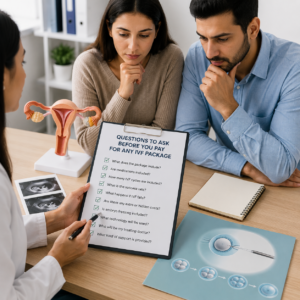
Because the laboratory steps and medication doses are tailored to your biology. A 27-year-old woman with tubal blockage and a high AMH may need only 1,500 IU of total gonadotropins over 9 days, whereas a 38-year-old woman with low AMH may require 3,000+ IU of high-purity gonadotropins, ICSI/IMSI, and blastocyst pooling. For a complete, itemised breakdown of what is included in a cycle, review our transparent guide to IVF treatment cost in Ahmedabad and our checklist of 10 questions to ask before paying for any IVF package.
What happens if zero eggs are retrieved on OPU day (“Empty Follicle Syndrome”)?
True Empty Follicle Syndrome (where follicles grow normally on scan, estradiol rises appropriately, and the trigger shot was injected correctly at the right time, yet no oocytes are recovered) is exceedingly rare (<1% of cycles). Most apparent cases are caused by an improperly administered or mistimed trigger injection, or severe ovarian ageing in extremely low reserve. At Wellspring IVF, checking pre-OPU LH/hCG levels when indicated and aspirating one ovary first allows immediate rescue re-triggering if a technical trigger issue is detected before the second ovary is aspirated.
Plan Your IVF Cycle with Clarity in Ahmedabad
Understanding the biology behind each step transforms IVF from an intimidating black box into a transparent, collaborative medical partnership. To discuss your fertility reports, ovarian reserve, and personalised cycle roadmap, book an appointment with Dr. Pranay Shah at Wellspring IVF & Women’s Hospital, Ahmedabad.
- Hospital Address: Titanium City Center Mall, 440, 100 Feet Anandnagar Road, near Sachin Tower, Satellite, Ahmedabad, Gujarat 380015 (Registered Level 2 ART Clinic No. GS/AHD/024)
- Telephone & WhatsApp: +91 90999 46050
- OPD Timings: Monday to Saturday, 10:00 AM to 4:00 PM
References
- Ovarian Stimulation Guideline Group, Bosch E, Broer S, Griesinger G, Grynberg M, Humaidan P, et al. ESHRE guideline: ovarian stimulation for IVF/ICSI: an update in 2025. Human Reproduction. 2026;41(4):498–529. (PubMed: 41732035 | ESHRE Guideline Portal).
- ESHRE Special Interest Group of Embryology and Alpha Scientists in Reproductive Medicine. The Vienna consensus: report of an expert meeting on the development of ART laboratory performance indicators. Human Reproduction Open. 2017;2017(2):hox011.
- Choe J, Shanks AL. In Vitro Fertilization. In: StatPearls [Internet]. Treasure Island (FL): StatPearls Publishing; Updated April 2026.
- From Oocyte to Blastocyst: A Comparison of IVF Embryo Attrition Rates Based on Ovarian Reserve and Stimulation Protocol. Fertility Science and Research. 2025.
- Optimal timing for triggering oocyte maturation during in vitro fertilization cycles. PMC12746871 & PMC12581242. 2025.
- Oocyte maturation triggering in high responders in IVF treatment: OHSS prevention and freeze-all strategies. Frontiers in Endocrinology / PMC13082988. 2025.