
Last medically reviewed by Dr. Pranay Shah: 24 November 2026.
Clinical Summary: Egg freezing to extend fertility lets a woman store mature eggs while she is younger, to be used later in IVF. The eggs are vitrified within seconds and kept in liquid nitrogen at −196°C. The chance of a baby depends mainly on your age when the eggs were frozen and how many were stored. Read more about egg freezing in Ahmedabad.
Why Does Age Affect Egg Quality More Than the Uterus?
A woman is born with her lifetime supply of approximately 1 to 2 million primordial follicles. By menarche, this number decreases to 300,000 to 400,000, and by age 37, roughly 25,000 follicles remain. However, numerical depletion is only half the biological equation; the more decisive factor in natural conception and assisted reproduction is oocyte cellular aging.
Unlike somatic cells that undergo regular mitotic turnover, human oocytes remain arrested in prophase of meiosis I from fetal development until the specific month they are recruited for ovulation. Over decades, cumulative oxidative stress and cellular degradation weaken the cohesin protein complexes maintaining chromosome pairs together. When an older oocyte resumes meiosis during the ovulatory surge, the meiotic spindle apparatus frequently missegregates chromosomes, leading to high rates of embryonic aneuploidy (chromosomal abnormality).
At age 30, roughly 25% to 30% of a woman’s retrieved eggs are aneuploid. By age 38, that fraction climbs to 50% to 60%, and by age 42, over 75% to 85% of ovulated oocytes carry chromosomal errors that cause implantation failure, early miscarriage, or genetic conditions.
Crucially, the human uterus does not experience the same cellular decline; healthy endometrial receptivity can be sustained with physiological hormone therapy well into a woman’s forties. By undergoing oocyte cryopreservation, a woman extracts her eggs at their current biological age, effectively freezing their genetic integrity and pausing the reproductive clock. Women diagnosed with accelerated follicular depletion or low AMH and diminished ovarian reserve benefit most critically from early intervention before the remaining ovarian pool drops below critical thresholds.
How Does Vitrification Differ From Slow Freezing?
For over two decades, cryopreservation was highly successful for human embryos and sperm, but notoriously ineffective for unfertilized human eggs. Because the mature metaphase II (MII) oocyte is the largest single cell in the human body with an exceptionally high water content, traditional slow-freezing methods (cooling at ~0.3°C to 1°C per minute) resulted in intracellular ice crystal formation. These sharp ice crystals sheared the delicate meiotic spindle apparatus and ruptured the oocyte plasma membrane upon thawing, yielding post-thaw survival rates below 40% to 50%.
The paradigm shifted entirely with the advent of ultra-rapid vitrification utilizing open or closed carrier systems such as Cryotop:
- Cooling Velocity Exceeding 20,000°C per Minute: Rather than allowing water molecules to align into crystalline lattices, ultra-rapid cooling transitions liquid water directly into an amorphous, glass-like solid state (vitrification) within milliseconds.
- Optimized Cryoprotectant Formulations: High-concentration permeating cryoprotectants (such as dimethyl sulfoxide [DMSO] and ethylene glycol) combined with non-permeating sucrose rapidly dehydrate the oocyte cytoplasm prior to liquid nitrogen submersion, preventing ice crystal nucleation.
- Pioneering Survival Statistics: Modern vitrification achieves post-thaw survival rates between 90% and 95%. Once warmed, surviving eggs exhibit fertilization rates of 70% to 80% when combined with ICSI treatment (Intracytoplasmic Sperm Injection)—rates virtually indistinguishable from freshly retrieved donor oocytes.
How Many Eggs Should You Freeze? Age-Stratified Live Birth Predictive Models
The single most common clinical misunderstanding among prospective egg-freezing patients is assuming that freezing 8 or 10 eggs guarantees a baby. In reproductive biology, an egg is a statistical probability, not an absolute guarantee. For a shorter answer on the target number of mature eggs to freeze, see our dedicated article.
To estimate the true live birth probability, reproductive endocrinologists utilize validated mathematical models developed by Goldman et al. (2017) and Cobo et al. (2016), which correlate maternal retrieval age and the number of mature metaphase II (MII) oocytes cryopreserved:
| Patient Age at Retrieval | Baseline AMH Range (ng/mL) | Recommended MII Eggs to Bank | Projected Chance of ≥1 Live Birth | Typical Number of Cycles Required |
|---|---|---|---|---|
| Under 35 Years | 2.0 – 4.0 | 12 – 15 MII eggs | 70% – 85% | 1 cycle (occasionally 2) |
| 35 to 37 Years | 1.5 – 2.5 | 15 – 20 MII eggs | 65% – 75% | 1 to 2 cycles |
| 38 to 40 Years | 0.8 – 1.8 | 20 – 30 MII eggs | 50% – 65% | 2 to 3 cycles |
| 41 to 42 Years | 0.3 – 1.0 | 30+ MII eggs | 30% – 45% | 3 to 4+ cycles |
Data synthesized from Cobo et al. (Fertility and Sterility, 2016) and Goldman et al. (Human Reproduction, 2017).
As explained on our page on egg freezing in Ahmedabad, biological efficiency drops non-linearly after age 37. While a 31-year-old woman may achieve an 80% cumulative live birth probability from 15 vitrified eggs, a 39-year-old woman may require 25 to 30 mature eggs to reach a comparable likelihood, simply because a higher percentage of eggs in the older cohort carry de novo chromosomal aneuploidies.
Should You Freeze Eggs or Embryos? Clinical and Legal Trade-Offs
When patients consult us at Wellspring IVF, many ask whether they should freeze unfertilized eggs or fertilize them immediately with partner or donor sperm to freeze blastocyst embryos.
| Parameter | Egg Freezing (Oocyte Cryopreservation) | Embryo Freezing (Blastocyst Cryopreservation) |
|---|---|---|
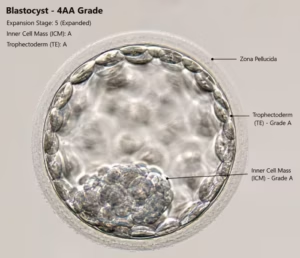
| Biological State | Unfertilized single MII cell (haploid) | 5- to 6-day fertilized blastocyst (diploid, 100–200 cells) |
| Cellular Resilience | Sensitive to temperature shifts; modern vitrification yields >90% survival | Extremely hardy multicellular structure; >95% to 98% post-thaw survival |
| Genetic Testing Ability | Cannot be biopsied for aneuploidy before fertilization | Trophectoderm biopsy allows PGT-A chromosomal verification prior to freezing |
| Personal Autonomy | Full personal reproductive autonomy; belongs exclusively to the woman | Governed by joint legal rights of both gamete contributors under Indian law |
| Partner Requirement | No partner or donor sperm required | Requires immediate semen sample from partner or registered donor sperm |
For unpartnered women or women wishing to preserve complete personal autonomy over their reproductive future, elective oocyte preservation provides uncompromised flexibility. However, for legally married couples planning to postpone family building by several years, embryo freezing (blastocyst vitrification) provides greater diagnostic visibility because embryos can be cultured to the blastocyst stage and genetically screened before cryopreservation.
What Happens During an Egg Freezing Cycle at Wellspring IVF?
A single oocyte cryopreservation cycle requires approximately 12 to 14 days from initial stimulation to retrieval:
- Comprehensive Baseline Evaluation (Cycle Day 2–3):
We conduct a high-resolution transvaginal ultrasound to establish your Baseline Antral Follicle Count (AFC) alongside serum Anti-Müllerian Hormone (AMH), FSH, estradiol, and infectious screening. - Controlled Ovarian Stimulation (10–12 Days):
In a natural cycle, the body selects and ovulates only one dominant follicle while the remaining cohort undergoes apoptosis (cellular death). Controlled ovarian stimulation rescues this resting cohort through daily subcutaneous injections of recombinant FSH and hMG. Serial follicular tracking ultrasounds and blood estradiol assays monitor follicular growth every 48 hours. - Ovulation Trigger:
Once 2 or more follicles achieve a diameter of ≥17–18 mm, an ovulation trigger (typically a GnRH agonist to prevent Ovarian Hyperstimulation Syndrome, or dual trigger) is administered precisely 35 to 36 hours prior to retrieval. - Ovum Pick-Up (OPU) Retrieval:
Under mild intravenous sedation in our cleanroom operating theatre, Dr. Pranay Shah uses transvaginal ultrasound-guided needle aspiration to aspirate follicular fluid directly from the ovaries. The procedure lasts 15 to 20 minutes, requires no abdominal incisions, and patients walk home within 2 hours. - Embryology Laboratory Vitrification:
Our senior embryologists strip the surrounding cumulus cells (denudation) to identify mature metaphase II (MII) oocytes. Within 2 hours of retrieval, these mature eggs undergo equilibration in cryoprotectant media and are flash-frozen on Cryotop strips before being secured in monitored liquid nitrogen storage tanks at -196°C.
You can review our full clinical facility and protocol specifications directly on our egg freezing treatment page.
What Does the ART Act 2021 Say About Egg Freezing in India?
India’s reproductive legal landscape was formalized under the Assisted Reproductive Technology (Regulation) Act, 2021 and its subsequent Rules, which govern ethical, legal, and operational standards across all ART banks and clinics:
- Permissible Storage Window (Section 28): The ART Act 2021 establishes that human gametes (oocytes and sperm) can be cryopreserved at a registered ART bank for an initial period of up to 10 years. Extensions beyond 10 years may be granted subject to clinical justification, National Board guidelines, and specific written consent.
- Social and Medical (Oncofertility) Indications: The law explicitly permits oocyte cryopreservation for both medical reasons (e.g., prior to chemotherapy, radiation, or ovarian surgery) and elective reproductive reasons (social egg freezing for women seeking to safeguard future fertility).
- Legal Age Limits: An adult woman must have completed 21 years of age to access ART services.
- Registered ART Bank Compliance: All cryopreserved gametes must be maintained within registered, government-licensed ART banks under strict barcoded tracking, dual witness identification, and continuous cryogenic temperature monitoring. Wellspring IVF is fully licensed and compliant with all statutory National and State ART Board regulations.
What Should You Expect to Pay for Egg Freezing in Ahmedabad?
The total investment for an oocyte cryopreservation cycle in Ahmedabad generally comprises three primary components:
- Pre-Cycle Diagnostics & Monitoring: Ultrasound scans, hormonal profiles (AMH, estradiol, LH), and viral screening panels.
- Gonadotropin Stimulation Medications: Tailored recombinant and urinary gonadotropin dosages adjusted to your specific ovarian response.
- Surgical Retrieval, Cleanroom Vitrification & Cryo-Storage: Sedation, cleanroom OPU retrieval, embryologist denudation, Cryotop vitrification consumables, and initial cryogenic storage.
At Wellspring IVF & Women’s Hospital in Ahmedabad, we emphasize complete financial transparency with zero hidden laboratory markups or sudden mid-cycle add-ons, ensuring patients can plan their family preservation with complete peace of mind.
For additional fertility education, explore our Treatment Hub, learn more about IVF Treatment, review PGT-A Testing, visit our Fertility Videos, and browse our Blog Centre.
Frequently Asked Questions (FAQ)
Does egg freezing deplete my future ovarian reserve earlier?
No. In an unmedicated menstrual cycle, your body naturally recruits a cohort of 10 to 30 follicles, but selects only one for ovulation while the rest starve and degenerate. Ovarian stimulation simply provides the hormonal signals to nourish and rescue the follicles already destined for atresia in that single month. It does not touch your future pool or bring menopause earlier.
What is the ideal age to freeze my eggs?
From a purely biological perspective, the sweet spot is between 28 and 35 years of age. During this window, egg quantity (AMH/AFC) and chromosomal quality are high, meaning most women can bank 15 to 20 mature eggs in 1 to 2 cycles. While women aged 36 to 40 can and do freeze eggs successfully, they often need 2 to 3 stimulation cycles to achieve comparable cumulative live birth probabilities.
Can an unmarried woman legally freeze her eggs in India?
Yes. Under India’s ART (Regulation) Act, 2021, single (unmarried) women aged 21 to 50 can legally freeze their eggs independently; married women follow standard ART Act written consent requirements.
Scientific Citations & References
- Cobo, A., et al. (2016). Oocyte vitrification as an efficient option for elective fertility preservation. Fertility and Sterility, 105(3), 755–764. PubMed
- Goldman, R. H., et al. (2017). Predicting the likelihood of live birth for elective oocyte cryopreservation: a counseling tool for physicians and patients. Human Reproduction, 32(4), 853–859. PubMed
- Rienzi, L., et al. (2017). Oocyte, embryo and blastocyst cryopreservation in ART: systematic review and meta-analysis comparing slow-freezing versus vitrification. Human Reproduction Update, 23(2), 139–155. PubMed
- The Assisted Reproductive Technology (Regulation) Act, 2021. Ministry of Law and Justice, Government of India. Gazette of India, Act No. 42 of 2021, Section 28 (Gamete Storage and Cryopreservation Provisions).
Where Can You Read More From Official Sources?
Independent guidance on egg freezing and the Indian legal position. Outcomes vary between patients.