
Thin Endometrium Treatment in Ahmedabad: Causes, Assessment and Treatment
Thin Endometrium Treatment in Ahmedabad | Wellspring IVF & Women's Hospital
What Is a Thin Endometrium?
The endometrium is the lining of the uterine cavity. It thickens through the first half of the cycle under the influence of estrogen, then matures under progesterone into the tissue an embryo attaches to. Thin endometrium is the term used when it fails to reach the expected thickness — most commonly defined as less than 7 mm, measured by transvaginal ultrasound in the mid-luteal phase, or on the day of trigger or progesterone start in a treatment cycle.
In plain terms: the lining is the surface the embryo has to land on. A thin lining means less of that surface has developed than expected. It does not mean there is none.
Three things about that 7 mm figure are worth understanding before you attach any weight to it.
It is a convention, not a biological boundary. Published studies use 7 mm, 7.5 mm and 8 mm, and the definition of “thin” varies between them. There is no consensus threshold.
The measurement itself varies. Endometrial thickness depends on when in the cycle it is measured, on the ultrasound plane and machine, and on the operator. A 6.8 mm on one scan and a 7.2 mm on another can be the same lining.
It is a gradient, not a switch. In a systematic review and meta-analysis of 67 studies, live birth rates rose continuously with increasing thickness across the whole range rather than stepping up at any one cut-off, in both fresh and frozen transfer cycles [Ultrasound in Obstetrics & Gynecology, 2025].
Does a Thin Lining Actually Reduce the Chance of Pregnancy?
Yes, on average — but considerably less absolutely than most women are led to believe.
A meta-analysis found that women with a lining under 7 mm had a significantly lower live birth rate than women above 7 mm, with an odds ratio of 0.47 [ESHRE, 2023]. That is a real reduction and it should not be dismissed.
But the same body of evidence contains three findings that change how the number should be used:
Finding | What it means for you |
|---|---|
Live birth rates plateau — after roughly 10–12 mm in fresh transfer cycles, and after roughly 7–10 mm in frozen transfer cycles, across an analysis of 96,000 autologous embryo transfers [Fertility and Sterility, 2022] | Thicker is not indefinitely better. Chasing a large number past the plateau achieves nothing. |
In a meta-analysis of women with a thin lining, the positive predictive value for pregnancy in the next cycle was 77% but the negative predictive value was only 48% [ESHRE, 2023] | A thin lining is a poor predictor of failure. It is roughly a coin toss. |
After controlling for confounding factors, the independent association between thickness and outcome has been reported as weak; one large study found thickness did not predict implantation for transfers of genetically tested euploid blastocysts [ESHRE, 2023] | Some of what thickness appears to measure may actually be embryo quality and age travelling alongside it. |
In plain terms: a thin lining shifts the odds against you. It does not close the door, and it is not a reason on its own to abandon a cycle.
There is one association worth knowing about beyond conception: thin endometrium in fresh IVF cycles has been linked in meta-analysis to a higher incidence of hypertensive disorders of pregnancy and small-for-gestational-age babies. That is a reason for appropriate obstetric monitoring later, not a reason for alarm now.
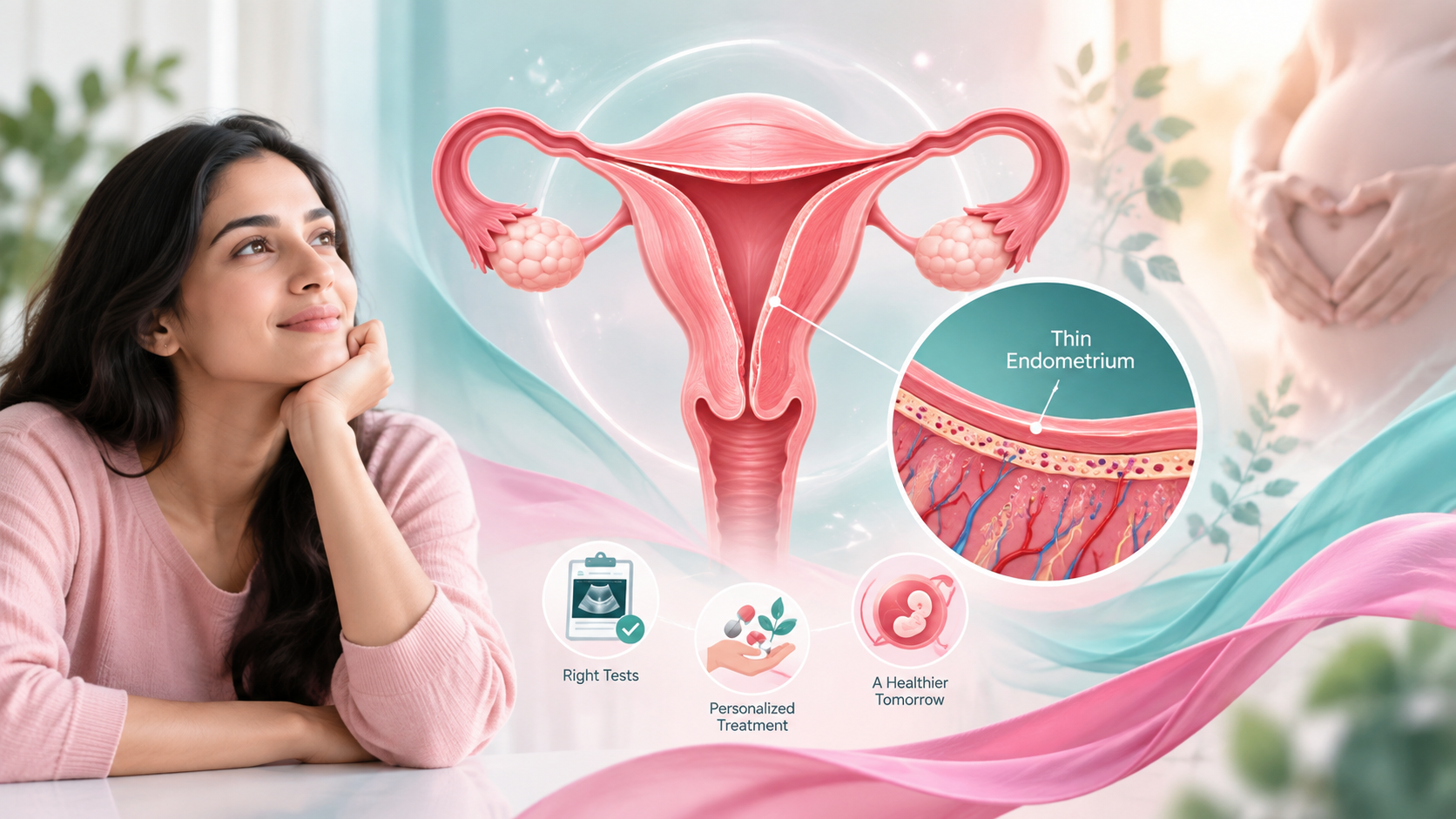
“The number on the scan report causes more distress in my clinic than almost any other single measurement. A woman is told her lining is 6.4 mm and she hears that her cycle has failed before it has started. What the evidence actually shows is a gradient — her chance is lower than it would be at 9 mm, and it is a long way from zero. My job in that consultation is usually to give a realistic figure back, not to promise I can change the number.”
– Dr. Pranay Shah, MS (ObGy), Director & Chief Fertility Consultant
What Causes a Thin Endometrium?
The endometrium can be thin because it has been damaged, because it is not receiving or responding to enough estrogen, or for no identifiable reason at all.
Damage to the basal layer
The basal layer regenerates the lining each cycle. Once it is destroyed, the tissue above it cannot rebuild.
- Intrauterine adhesions and Asherman’s syndrome — scarring inside the cavity, most often following dilatation and curettage, particularly repeated procedures, curettage performed after a delivery or a septic miscarriage, or surgery for retained products
- Uterine surgery — myomectomy entering the cavity, hysteroscopic resection, uterine artery embolisation
- Endometritis — including chronic low-grade infection
- Pelvic radiotherapy
Genital tuberculosis — a cause that must be considered in Indian patients
This deserves separate treatment because it is under-considered in some clinics and over-diagnosed in others.
Genital tuberculosis is a recognised cause of female infertility, and its prevalence in infertility clinics differs enormously by setting: reported at under 1% in high-income countries and between roughly 3% and 26% across low- and middle-income countries [Indian Journal of Tuberculosis]. In India it is a genuine differential in a woman with unexplained tubal damage, menstrual changes such as scanty or absent periods, or a persistently thin and unresponsive lining.
Genital TB typically reaches the genital tract from a primary focus elsewhere, usually the lung. It affects the fallopian tubes in the great majority of cases and the endometrium in a substantial proportion, and it is a recognised cause of severe intrauterine adhesions with obliteration of the cavity. Where the tubes are involved, the relevant assessment is described on the blocked fallopian tubes page.
The diagnostic caution matters as much as the diagnosis. Genital TB is paucibacillary — very few organisms are present — which is precisely why it is difficult to confirm and why single tests mislead. Comparative studies of the available modalities conclude that no single test accurately diagnoses genital tuberculosis [Journal of Obstetrics and Gynecology of India, 2022]. Diagnosis rests on a composite of history, imaging, laparoscopic and hysteroscopic findings, endometrial histopathology, and molecular testing such as CBNAAT or PCR — not on any one of them alone.
This is clinically important in both directions. A single positive endometrial PCR is not, by itself, a sufficient basis for six months of anti-tubercular therapy, which is a significant undertaking with real side effects. Equally, a negative chest X-ray does not exclude genital TB. Diagnostic laparoscopy and hysteroscopy together often contribute more to the diagnosis than any laboratory test.
Hormonal and iatrogenic causes
- Clomiphene citrate — its anti-estrogenic effect on the endometrium is well recognised and is reversible on stopping
- Prolonged combined oral contraceptive use
- Inadequate estrogen exposure or poor absorption during endometrial preparation for a frozen transfer
- Reduced uterine blood flow
Idiopathic
In a proportion of women, the lining is simply thin with no identifiable cause and no history of instrumentation. Where it also fails to respond to adequate estrogen, it is described as refractory or unresponsive thin endometrium.
How Is It Assessed?
Measuring the thickness is the easy part. Establishing why it is thin is the part that changes management.
Assessment | What it is looking for |
|---|---|
Transvaginal ultrasound, correctly timed | Thickness, pattern, and whether the lining responds across the cycle |
Doppler assessment of uterine and sub-endometrial flow | Perfusion, where available |
Hysteroscopy | Intrauterine adhesions, Asherman’s syndrome, scarred or pale atrophic endometrium — the single most informative investigation when the lining stays thin despite adequate estrogen |
Endometrial sampling with histopathology | Chronic endometritis, granulomatous inflammation suggesting tuberculosis |
Molecular testing (CBNAAT / PCR) on endometrial sample | Genital tuberculosis, interpreted alongside other findings and never alone |
Review of the endometrial preparation itself | Estrogen route, dose, duration and absorption; clomiphene exposure in previous cycles |
Careful history | Curettage, uterine surgery, septic miscarriage, TB contact or past treatment, menstrual changes such as reduced flow or amenorrhoea |
A reduction in menstrual flow, or periods that have stopped, in a woman with a thin lining is a significant finding. It points toward the basal layer having been damaged, and it should prompt hysteroscopy rather than another cycle of higher-dose estrogen.
What Treatment Actually Works?
Treatment falls into three groups, and they should be pursued in this order.
1. Treat the cause where there is one
This is where real gains are made.
Cause | Treatment |
|---|---|
Intrauterine adhesions / Asherman’s syndrome | Hysteroscopic adhesiolysis, with measures to prevent re-adhesion and post-operative estrogen |
Chronic endometritis | Antibiotic treatment |
Confirmed genital tuberculosis | Anti-tubercular therapy under a standard regimen. Structural damage already done is not reversed by treatment, so expectations should be set accordingly |
Clomiphene effect | Change the ovulation induction agent |
Inadequate estrogen exposure | Correct the regimen — see below |
2. Optimise estrogen exposure
Ensuring adequate estradiol exposure — by augmenting oral therapy with transdermal patches or vaginal preparations — remains the mainstay of management for a thin lining, and reviewing the estradiol regimen is a recommended step when the endometrium is noted to remain thin [ESHRE, 2023]. Absorption differs substantially between women, which is why the route matters and not only the dose.
Where the lining remains thin despite an adjusted regimen, hysteroscopy to exclude adhesions or Asherman’s syndrome is the recommended next step — not escalating estrogen further.
Other reasonable options at this stage include deferring to a frozen embryo transfer rather than proceeding with a fresh transfer on a poor lining, using a natural or modified natural cycle in an ovulating woman, and freezing embryos to allow the cavity to be investigated and treated without losing the cycle.
3. The adjuncts — where the evidence actually sits
This is the group most heavily marketed, and the honest summary is that they can change the millimetres more readily than they change the babies.
Intervention | Current evidence position |
|---|---|
Intrauterine platelet-rich plasma (PRP) | Low to very low certainty. A Cochrane review of autologous PRP in assisted reproduction found the evidence insufficient to determine effects on live birth and miscarriage [Cochrane, 2024]. Meta-analyses more consistently show an increase in thickness than an increase in live birth. PRP is also used intraovarian rather than intrauterine, for a different indication and with a different evidence base — see ovarian rejuvenation with PRP. |
Granulocyte colony-stimulating factor (G-CSF), intrauterine or subcutaneous | Uncertain. Published studies show conflicting results, and comparisons against PRP are very low certainty. Not recommended as a routine intervention in the context of repeated implantation failure. |
Intrauterine hCG infusion | Increases thickness in network meta-analysis; effect on live birth not established [Gynecological Endocrinology, 2024] |
Peripheral blood mononuclear cell (PBMC) infusion | Insufficient evidence |
Vaginal sildenafil, pentoxifylline, vitamin E, low-dose aspirin | Small studies, inconsistent results, no reliable effect on live birth |
Stem cell therapy for refractory thin endometrium | Experimental. Should be offered only within a research protocol, not as a service |
The distinction that matters: almost all of these are evaluated on whether they add millimetres. Thickness is a surrogate. If an intervention adds 1.5 mm and does not change the live birth rate, it has changed the report and not the outcome. Any of these may be discussed in a specific case, particularly where the lining is refractory and the alternative is cycle cancellation — but they should be presented as uncertain, and their cost should be part of that conversation.
“I am not against using PRP in a woman whose lining has repeatedly refused to respond and who understands exactly what the evidence is. What I will not do is present it as a treatment that works, because the trials do not show that yet. If a couple decides to try it with clear eyes, that is a reasonable decision. If they are told it will fix the problem, they have been sold something.”
– Dr. Pranay Shah, MS (ObGy), Director & Chief Fertility Consultant
What If the Lining Never Responds?
Refractory thin endometrium — a lining that will not thicken despite adequate estrogen, a corrected cause and an assessed cavity — is one of the genuinely difficult problems in reproductive medicine. There is currently no intervention that reliably restores it.
Realistic options at that point include proceeding with transfer on a thinner lining, accepting a reduced but real chance; freezing embryos and continuing to investigate; and, in a small number of women where the cavity has been damaged to the point that it cannot support a pregnancy, discussing gestational surrogacy, which in India is permitted only under the Surrogacy (Regulation) Act framework with the required statutory certification.
That last option belongs to a small minority. It is mentioned because women in this situation are frequently not told it exists until very late.
How Is Thin Endometrium Managed at Wellspring IVF?
Wellspring IVF & Women’s Hospital is an ART-registered centre (Reg. GS/AHD/024) in Satellite, Ahmedabad, led by Dr. Pranay Shah, MS (ObGy), with more than 15 years in fertility practice and over 6,000 successful IVF outcomes. Consultation, ultrasound, hysteroscopy and the embryology unit are in one facility.
The approach:
- Confirm the measurement before acting on it. Correctly timed, on a consistent plane, in the context of the preparation regimen used.
- Ask why, before asking how thick. History of curettage, uterine surgery, septic miscarriage, reduced menstrual flow, TB contact or treatment.
- Consider genital tuberculosis where the clinical picture fits — and diagnose it on a composite of findings, never on a single positive PCR.
- Assess the cavity where the lining is unresponsive. Hysteroscopy, rather than a further escalation of estrogen.
- Correct the regimen before adding anything to it. Route and absorption of estradiol first.
- Discuss adjuncts honestly, or not at all. Where PRP or G-CSF is considered, the uncertainty and cost are stated in writing before anything is agreed.
- Keep the embryos safe. Freezing and investigating properly is usually better than transferring into a cavity nobody has looked at, and it is discussed as part of the wider female infertility evaluation.
What Are the Limitations You Should Understand?
- Thickness is a surrogate, not the outcome. Adding millimetres has not been shown to reliably add live births.
- A thin lining predicts failure poorly. The negative predictive value in published data is roughly a coin toss.
- Damage to the basal layer is not reversible. Adhesiolysis can restore a cavity; it cannot regrow destroyed regenerative tissue.
- Anti-tubercular therapy does not undo structural damage. It treats active infection. Scarring already present remains.
- No adjunct is established. PRP, G-CSF, sildenafil, pentoxifylline and stem cells are all at low or very low certainty for live birth.
- Embryo quality and age still dominate. A thin lining is one variable among several, and rarely the largest.
When Should You See a Specialist?
Seek assessment if your lining has been reported below 7 mm on more than one cycle; if a transfer has been cancelled or deferred because of it; if your periods have become noticeably lighter or have stopped, particularly after a curettage, a miscarriage or uterine surgery; if you have a history of tuberculosis or treated TB contact; or if you have been advised to start anti-tubercular therapy on the basis of a single test result and want that reviewed.
Bring the actual scan reports with the thickness and the day of cycle, the endometrial preparation you were on, and any hysteroscopy or histopathology reports. A thin-lining assessment without those is guesswork.
Talk to Dr. Shah About Thin Endometrium Treatment
Your Fertility Consultant

Dr. Pranay Shah

Divyesh Bhalodia

Urmi Chauhan
What Our Patients Say


A special thank you to Dr. Pranay Shah for his confidence, guidance, and the way he explained everything so patiently. His positive approach gave me so much strength, and today I am blessed with my baby.
Thank you to each and every member of the hospital for taking such great care of me and supporting me throughout this journey. Forever grateful. 💕

He is, without a doubt, the most patient doctor I have ever met. Of course, treatment can be done by many. What truly sets him apart is his maturity, the way he pauses, explains, comforts, and most importantly, seeks your permission before moving forward. You never feel rushed. You never feel unheard. You feel respected.
And the staff deserves equal appreciation. They handle even the most anxious and impatient moments with such calm grace and dignity that you slowly find your own heartbeat settling down. It feels less like a clinic and more like a safe space.
I wholeheartedly recommend him to anyone who overthinks, seeks reassurance, or simply needs a doctor who believes comfort is the first step of healing. With him, care begins long before the treatment does.

Highly recommend for their expertise, kindness and dedication. "Turned out dream into reality"



Our gratitude also extends to everyone in your clinic who offered a smile, reassurance, technical support, or a listening ear along the way. We feel incredibly blessed to have chosen your practice for our journey, and we will always cherish the precious gift you helped us receive.
Thank you, from the bottom of our hearts, for making our dream a reality.
800+ Positive Google Reviews
Frequently Asked Questions
Can I get pregnant with a thin endometrium?
Yes. A lining below 7 mm reduces the average chance of live birth but does not prevent pregnancy, and in published data a thin lining predicts failure poorly — the negative predictive value is around 48%, close to a coin toss. Many women with thin linings conceive, both naturally and through IVF.
What is the minimum lining thickness needed for embryo transfer?
There is no universally agreed minimum. Different centres use 6 mm, 7 mm or 8 mm as a threshold for deferring, and the underlying relationship between thickness and live birth is continuous rather than a cut-off. The decision should account for the lining, the embryos available, the cycle type and whether the cavity has been assessed.
Can a thin endometrium be permanently thickened?
Where there is a treatable cause — adhesions, endometritis, a clomiphene effect, inadequate estrogen absorption — correcting it can produce a lasting improvement. Where the basal layer has been destroyed, no treatment reliably regenerates it. This distinction is why establishing the cause matters more than escalating the dose.
Does PRP work for a thin lining?
The evidence is not yet sufficient to say so. A Cochrane review of autologous platelet-rich plasma in assisted reproduction found the evidence insufficient to determine its effect on live birth or miscarriage. Meta-analyses more consistently show an increase in endometrial thickness than an improvement in live birth, and thickness is a surrogate measure rather than the outcome that matters.
Should I be tested for genital tuberculosis?
Testing is reasonable where the clinical picture fits — unexplained tubal damage, reduced or absent periods, or a persistently unresponsive lining, particularly in a high-burden setting. However, no single test accurately diagnoses genital tuberculosis, so a diagnosis should rest on a composite of history, imaging, laparoscopic and hysteroscopic findings, histopathology and molecular testing.
I was advised anti-TB treatment after one positive PCR. Should I take it?
That is a reasonable question to ask your clinician. Genital tuberculosis is paucibacillary and single tests are unreliable in both directions, so a full course of anti-tubercular therapy is a significant undertaking to begin on one result alone. A second opinion reviewing the complete picture, rather than the single report, is appropriate before starting.
Does a thin lining cause miscarriage?
Thin endometrium has been associated in meta-analysis with somewhat higher pregnancy loss in fresh cycles, and also with a higher incidence of hypertensive disorders of pregnancy and small-for-gestational-age babies. These are associations, not established causes, and they are a reason for appropriate obstetric monitoring rather than a reason to avoid pregnancy.
Related Conditions & Treatments at Wellspring IVF
Related Insights & Articles
 Published: 8 September 2026 Medically reviewed by Dr. Pranay Shah, MS (ObGy), Director & Chief Fertility Consultant Last medically reviewed:…September 8, 2026
 Causes and Symptoms of Miscarriage: Understanding Pregnancy Loss and Future Fertility Direct Answer A miscarriage is the spontaneous loss of…June 11, 2026
 Most men receive their semen analysis report as a printout of numbers — without anyone explaining what those numbers mean.…June 5, 2026


Speak to our Fertility Specialist
Your path to parenthood hasn't run out of options. It’s time for answers, not guesswork.