

Published: 24 November 2026
Medically reviewed by Dr. Pranay Shah, MS (ObGy)
Last medically reviewed: 24 November 2026
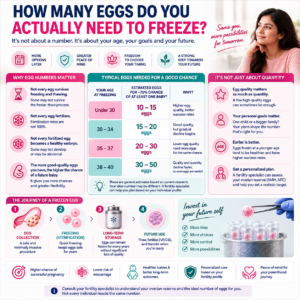
How many eggs to freeze has no single answer, and any clinic that gives you one number without asking what odds you want is skipping the most important part of the conversation. The published models express the answer as a probability. Roughly 10 mature eggs give a 34-year-old about a 75% chance of at least one live birth. A 37-year-old needs about 20 for the same chance, and a 42-year-old about 61. The number you need depends on your age on the day of retrieval and on the probability you are willing to accept.
Almost every article on this subject answers with a tidy age band and a round number. Those numbers come from somewhere, but they are usually repeated without their source, without their assumptions and without the probability they were calculated for. That last omission matters most, because “how many eggs do I need?” is an incomplete question. Ten eggs at 34 buys a 75% chance. It does not buy a baby.
Here is what the three most-cited datasets say, where they disagree, why they disagree, and what the numbers cannot tell you. If you are weighing egg freezing and want to understand the arithmetic behind the advice you are given, this is that arithmetic.
Why “How Many Eggs?” Has No Single Answer
The number of eggs required depends on three things: how many survive warming, how many of the survivors fertilise and reach the blastocyst stage, and how many of those blastocysts are chromosomally normal. The first two are fairly stable across ages. The third collapses with age and drives the whole calculation.
Each step is probabilistic, so the output is too. A model can give the number of eggs that yields a 50% chance, a 70% chance or a 90% chance, and the three numbers differ greatly at the same age. Presenting one of them as “the number of eggs you need” hides the choice being made on your behalf.
The American Society for Reproductive Medicine’s ethics committee is explicit that this uncertainty must be disclosed and not smoothed over. Its 2024 opinion on planned oocyte cryopreservation states that patients should understand that the “medical benefits are uncertain and harms that are not fully understood may emerge”, and it warns clinicians against “overstatements that may invite or allow misplaced confidence”.
Mature Eggs, Not Eggs Retrieved: The Distinction That Changes the Number
Every published model counts mature (metaphase II, or MII) oocytes. Only mature eggs can be fertilised, and only mature eggs are normally vitrified.
The number quoted after a retrieval is often the total number of follicles aspirated, which includes immature eggs that cannot be used. Maturity rates in reported series commonly sit around 75 to 85% of eggs retrieved. A woman told that “we collected 14 eggs” may have 11 or 12 mature eggs in storage.
This is more than a technicality. If you compare a retrieved-egg count with a model built on mature eggs, you overestimate your position by roughly one egg in five. Ask specifically how many mature eggs were vitrified, and use that figure when you read any table, including the ones below.
What the Published Models Show
Three bodies of evidence dominate this field. They were built differently and answer slightly different questions.
Goldman and colleagues, 2017: a counselling model
Published in Human Reproduction, this is a statistical model and no series of women who actually returned to use frozen eggs. The authors used 520 first fresh ICSI cycles to calculate the probability that a mature oocyte becomes a blastocyst at each age. They combined that with age-specific euploidy rates from about 14,500 array-CGH results, and assumed 95% warming survival below age 36 (85% at 36 and above) and a 60% live birth rate per euploid blastocyst transferred.
Their headline output is the reason the paper is cited so widely: for a 75% chance of at least one live birth, a woman aged 34 needs about 10 mature eggs, a woman aged 37 about 20, and a woman aged 42 about 61.
Doyle and colleagues, 2016: a clinic series
This analysis was built on vitrified and warmed autologous oocytes in real cycles and did not rely on a model. Its estimates for a 70% chance of one live birth are 14 mature eggs at ages 30 to 34, 15 at 35 to 37, and 26 at 38 to 40.
Cobo and colleagues, 2018: the largest outcome series
This study followed 6,362 women across 7,044 vitrification cycles and reported cumulative live birth rates by the number of oocytes actually used. It is the closest thing to a real-world answer, because these are outcomes in women who came back.
Source and probability target | Age at freezing | Mature (MII) eggs estimated |
|---|---|---|
Goldman et al., 2017, statistical model; 75% chance of at least one live birth | 34 / 37 / 42 | About 10 / 20 / 61 |
Doyle et al., 2016, clinic series; 70% chance of at least one live birth | 30 to 34 / 35 to 37 / 38 to 40 | 14 / 15 / 26 |
ASRM Ethics Committee, 2024, “reasonable chance” of one child | 38 | 25 to 30 |
Read the table by column and not by row. The Goldman and Doyle figures are not directly comparable, because one is calculated for a 75% chance and the other for 70%.
Cumulative Live Birth Rate by Number of Eggs Stored
The Cobo data can be read the other way round. In place of asking how many eggs you need for a given chance, you can ask what chance a given number of eggs delivers. These are the figures for women who vitrified at 35 or younger.
Mature eggs vitrified | Cumulative live birth rate (age 35 or younger at freezing) |
|---|---|
5 | 15.8% |
8 | 32.0% |
10 | 42.8% |
15 | 69.9% |
24 | 94.4% |
The same study reported markedly lower figures in women who vitrified after 35: 5.9% with five oocytes and 17.3% with eight, against 15.8% and 32.0% in the younger group. The curve also flattens. Beyond about 24 eggs in the younger group there is little left to gain, which is useful to know before committing to a further stimulation cycle.
Why the Three Sources Disagree
They disagree because they measure different things and rest on different assumptions.
- Modelled versus observed. Goldman’s figures are calculated forward from fresh-cycle biology and assumed warming survival. Cobo’s are counted backwards from women who actually returned. A model can be internally consistent and still be wrong about how a real laboratory performs.
- The assumed live birth rate per euploid blastocyst. Goldman assumed 60%. Move that assumption a few points and every number in the table shifts.
- Warming survival varies between laboratories. Reported survival in large series clusters in the low-to-mid 80s per cent, and Cobo reported 83.9% in elective patients, though individual series range widely. Goldman’s own authors wrote that “individual IVF clinics may need to modify our model based on their own thaw survival and live birth rates”.
- Cohort composition. Goldman’s cycles were predominantly male-factor and tubal-factor patients, with diminished ovarian reserve excluded. That population differs from a typical elective freezing cohort.
None of this makes the models useless. It means they work as a range and a direction of travel and should never be read as a promise.
How Many Stimulation Cycles Does That Imply?
The models give a target in eggs. Turning that into cycles is an individual calculation, because the yield from one stimulation varies enormously between women of the same age.
Two measurements predict yield before you start: the antral follicle count on a baseline scan and the anti-Müllerian hormone level. A woman with good ovarian reserve may reach a 15-egg target in one cycle at 33, and a woman of the same age with reduced reserve may need two or three. That is why a realistic cycle estimate can be given only after baseline testing, and an estimate offered before those tests is guesswork.
The practical consequence is that anyone freezing eggs should be counselled about a possible second cycle before the first one starts and not after a disappointing result.
Does a Cancer Diagnosis Change the Number?
The evidence suggests outcomes are somewhat lower after freezing at the time of a cancer diagnosis, though age explains much of the difference. In the Cobo series, cumulative live birth rate per patient among women aged 35 or younger was 68.8% in elective patients against 42.1% in oncofertility patients. The authors reported that after correcting for age there was no statistically significant association between malignant disease and reproductive outcome.
Two practical points follow. Stimulation before cancer treatment is usually time-limited, so the number of eggs banked is often whatever a single cycle produces and may fall short of what a model recommends. And ESHRE’s female fertility preservation guideline advises that women “should also be informed that success rates after cryopreservation of oocytes at the time of a cancer diagnosis may be lower than in women without cancer”.
The Number Almost Nobody Quotes: How Many Women Use Their Frozen Eggs
Most do not, at least within the follow-up periods published so far. In the Cobo cohort, 12.1% of elective patients and 7.4% of oncofertility patients had returned to attempt pregnancy. A longer follow-up of 10 to 15 years reported a higher return rate of 38.1%, with 58.9% never using their oocytes.
This is no argument against freezing eggs. It reflects the fact that many women who freeze go on to conceive without needing the stored eggs at all, which is the best possible outcome. But it belongs in the counselling conversation, and it rarely appears in clinic marketing. The ASRM opinion notes that “the younger the age at which individuals bank their oocytes, the less likely they will be utilized given that there is more time for their life plan to unfold”, and it reports that about 49% of women in one study felt some regret about the decision, most often where fewer eggs were retrieved than they had been led to expect.
That last finding is the strongest argument for honest numbers at the outset.
What These Models Cannot Tell You
Four limits are worth holding onto.
- They are not prospective. No model here was validated by following women forward from freezing to birth, and Goldman’s authors named this explicitly as a limitation.
- Older age groups are thinly represented. The figures for women over 38 rest on smaller numbers than the figures for women under 35 and should be treated as less certain.
- They predict at least one live birth. If you want two children from stored eggs, the required number rises substantially, and the models handle that far less well.
- Clinic-specific results matter more than published averages. ASRM’s position is that centres should disclose their own live birth rates and not rely on national or published statistics. It is a fair question to ask before you commit.
When to Discuss Egg Freezing With a Fertility Specialist
Timing matters more than any other modifiable factor, because the number of eggs required rises steeply after the mid-thirties while the number obtainable per cycle falls. A conversation is reasonable if you are in your late twenties or thirties and do not expect to try to conceive for several years, if a family history suggests early ovarian ageing, if you have a condition such as endometriosis or a genetic risk that may affect reserve, or if you are about to start treatment that may damage the ovaries.
Anyone facing gonadotoxic treatment should be referred urgently, before that treatment starts. When eggs are used later, they are thawed, fertilised and transferred through a standard IVF treatment pathway. Where a partner is already identified, some couples consider embryo freezing instead, which changes the arithmetic and carries different legal and personal implications.
Frequently Asked Questions
How many eggs are needed to have one baby later?
It depends on your age at freezing and on the probability you want. Published estimates run from about 10 mature eggs at 34 for a 75% chance of at least one live birth, to 25 to 30 at 38 for a reasonable chance of one child, to about 61 at 42. Age-related recommendations specific to Wellspring’s protocol are set out on the egg freezing page.
What percentage of frozen eggs survive thawing?
Large modern vitrification series report survival in the low-to-mid 80s per cent overall — 83.9% in elective patients in the Cobo series — with higher figures in younger women. Survival varies between laboratories, so ask your clinic for its own rate.
How many egg freezing cycles are usually needed?
There is no standard number. It depends on your target and on how many mature eggs a single stimulation produces, which is predicted by antral follicle count and AMH. Women with a lower ovarian reserve and women freezing after 37 more often need two or more cycles.
Is there a point at which freezing more eggs stops helping?
Yes. The cumulative live birth curve flattens. In women who froze at 35 or younger, the Cobo data showed 94.4% cumulative live birth with 24 oocytes, so the gain from each additional egg beyond that point is small.
Do frozen eggs deteriorate in storage?
There is no evidence that correctly vitrified oocytes deteriorate with time in liquid nitrogen. Storage duration in India is governed by the ART (Regulation) Act, 2021 and its Rules, and should be confirmed with your clinic at the time of freezing.
Should I look at my clinic’s numbers or the published ones?
Both. Published models tell you what is biologically plausible at your age. Your clinic’s own warming survival and live birth figures tell you what is likely in the laboratory that will actually handle your eggs. ASRM’s position is that centres should disclose the latter.
The Practical Takeaway
Ask three questions before you freeze. What probability is this number calculated for? Is it mature eggs or eggs retrieved? And what are this laboratory’s own warming survival and live birth rates? A clinic that can answer all three is giving you a number you can use. A single round figure with no probability attached is not an answer. It summarises one, and the part that was left out is the part you needed.
Egg freezing is a well-established option with a substantial and growing evidence base. It is no insurance policy, and the honest version of the counselling is more useful than the reassuring one.
Speak to a Fertility Specialist
If you are considering freezing your eggs and want a realistic assessment based on your own ovarian reserve rather than a general age band, you can discuss your individual situation with a fertility specialist at Wellspring IVF & Women’s Hospital, Ahmedabad.
Phone: +91 9099946050
OPD hours: Monday to Saturday, 10:00 AM to 4:00 PM
References
- Goldman RH, Racowsky C, Farland LV, Munné S, Ribustello L, Fox JH. Predicting the likelihood of live birth for elective oocyte cryopreservation: a counseling tool for physicians and patients. Human Reproduction. 2017;32(4):853–859. https://doi.org/10.1093/humrep/dex008
- Cobo A, García-Velasco J, Domingo J, Pellicer A, Remohí J. Elective and Onco-fertility preservation: factors related to IVF outcomes. Human Reproduction. 2018;33(12):2222–2231. https://doi.org/10.1093/humrep/dey321
- Walker Z, Lanes A, Ginsburg E. Oocyte cryopreservation review: outcomes of medical oocyte cryopreservation and planned oocyte cryopreservation. Reproductive Biology and Endocrinology. 2022;20(1):10. https://doi.org/10.1186/s12958-021-00884-0
- Doyle JO, Richter KS, Lim J, Stillman RJ, Graham JR, Tucker MJ. Successful elective and medically indicated oocyte vitrification and warming for autologous in vitro fertilization, with predicted birth probabilities for fertility preservation according to number of cryopreserved oocytes and age at retrieval. Fertility and Sterility. 2016;105(2):459–466.e2. doi:10.1016/j.fertnstert.2015.10.026
- Ethics Committee of the American Society for Reproductive Medicine. Planned oocyte cryopreservation to preserve future reproductive potential: an Ethics Committee opinion. Fertility and Sterility. 2024;121(4):604–612. ASRM practice guidance
- ESHRE Guideline Group on Female Fertility Preservation. ESHRE guideline: female fertility preservation. Human Reproduction Open. 2020;2020(4):hoaa052. https://doi.org/10.1093/hropen/hoaa052