
Ovarian Rejuvenation with PRP Treatment
What Is Intraovarian PRP?
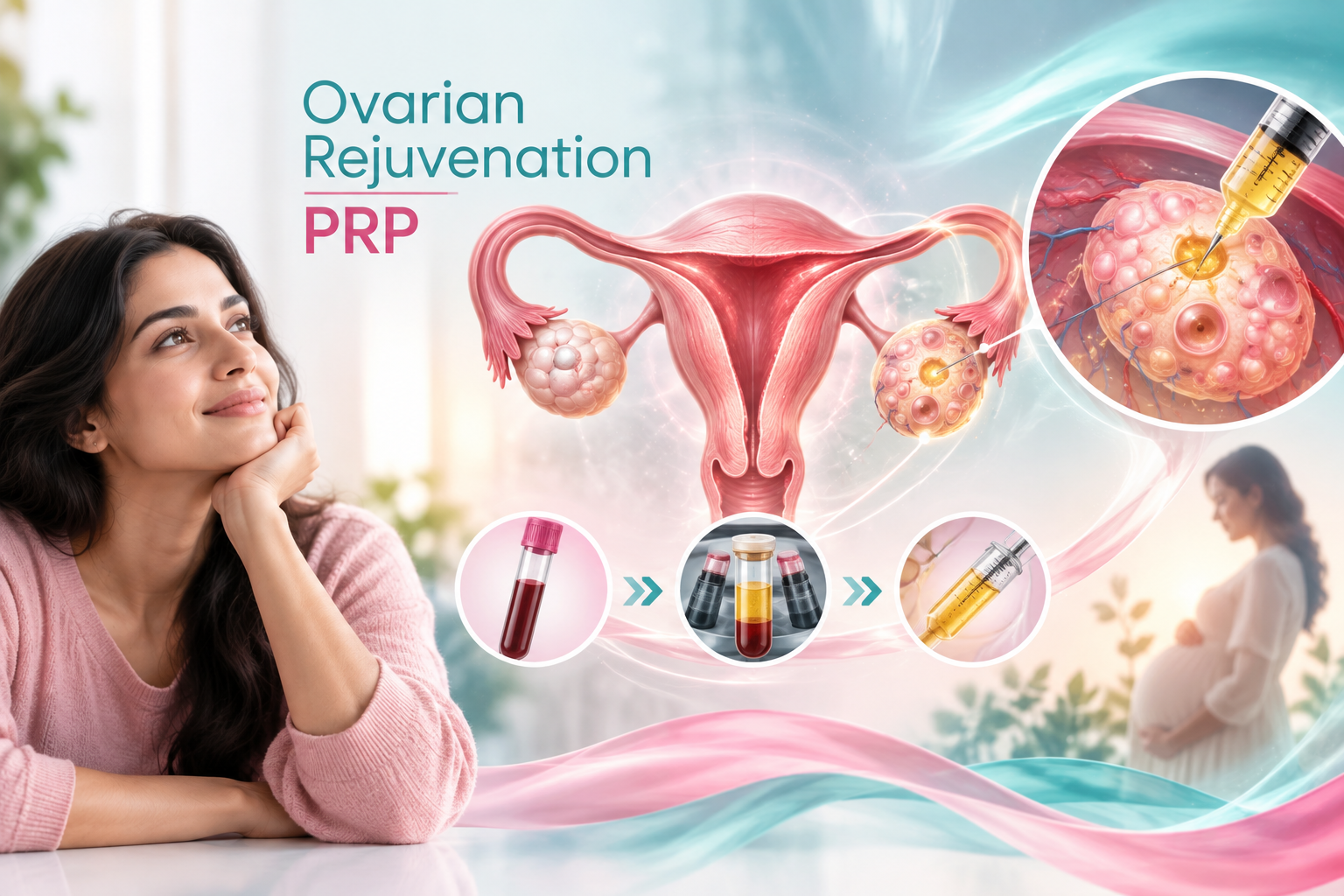
Platelet-rich plasma is prepared from the patient’s own blood. A sample is drawn, spun in a centrifuge to concentrate the platelets, and the resulting plasma is injected — in this application, into the ovarian tissue, usually transvaginally under ultrasound guidance, in a procedure similar in access to egg collection.
The rationale is that platelets release growth factors — including vascular endothelial growth factor, platelet-derived growth factor and insulin-like growth factor — which may improve the local ovarian environment and, in theory, activate dormant primordial follicles that have not yet begun to grow.
In plain terms: the idea is not to make new eggs. It is to try to wake up follicles that are already present but inactive. Whether that happens in a clinically meaningful way in humans is exactly what remains unproven.
A woman is born with her full complement of oocytes and no treatment creates new ones. Any account of ovarian rejuvenation that implies otherwise is describing something that does not happen.
Ovarian Rejuvenation Is Not One Thing — And the Difference Matters in India
“Ovarian rejuvenation” is used loosely to describe at least three different interventions, which have different evidence bases and, in India, different legal positions.
Intervention | What it involves | Regulatory position in India |
|---|---|---|
Autologous intraovarian PRP | The patient’s own concentrated platelets, minimally manipulated | Not regulated as a new drug. Its use is a clinical judgement, but its efficacy for this indication is not established |
Stem cell therapy — mesenchymal stem cells, bone marrow-derived cells | Cellular products, often substantially manipulated | Clinical use of stem cells outside approved trials — other than for approved haematopoietic indications — is investigational under the ICMR–DBT National Guidelines for Stem Cell Research, and such products can fall under new-drug regulation requiring CDSCO oversight [Journal of Law and the Biosciences, 2025] |
Exosome and growth-factor products | Cell-free preparations | Investigational |
If you have been offered “ovarian rejuvenation”, the first question to ask is which of these is actually being proposed, and if it involves stem cells, whether it is being done inside an approved clinical trial. This page is about autologous PRP only.
What Does the Evidence Actually Show?
This is the section that matters, and the answer is uncomfortable for everyone selling this treatment.
On ovarian reserve markers
Uncontrolled studies — case series and before-and-after designs without a control group — consistently report improvements in AMH, antral follicle count and FSH after intraovarian PRP. A systematic review and meta-analysis of PRP in women with diminished ovarian reserve confirmed that pattern [systematic review and meta-analysis, 2026].
Those findings need to be read carefully. AMH and antral follicle count fluctuate naturally between cycles. In a study design with no control group, women who happen to improve are the ones who continue, and normal biological variation looks like treatment effect. This is a well-recognised weakness, not a technicality.
On pregnancy and live birth — the outcome that matters
The same systematic review concluded that evidence from randomised controlled trials does not demonstrate a consistent benefit in pregnancy and live birth, and that well-designed randomised trials with standardised protocols are needed before clinical recommendation [systematic review and meta-analysis, 2026].
Randomised data specifically: a randomised trial of intraovarian PRP reported that PRP administration was not associated with an increase in the percentage of euploid blastocysts or with a higher pregnancy rate [Human Reproduction, 2025]. Randomised findings in this field are not uniform, and results differ between trials — which is itself a signal that the effect, if there is one, is not large or reliable.
Separately, a Cochrane review of autologous PRP across assisted reproduction concluded that the available evidence is of very low certainty [Cochrane, 2024].
Where the reviewers land
A 2026 systematic review proposing a clinical framework for PRP concluded that it may have a potential role in activating dormant follicles in a selected subset of women with poor ovarian response, but that current evidence remains limited and heterogeneous, supporting its use only within structured clinical or research protocols [Archives of Gynecology and Obstetrics, 2026].
In plain terms: the numbers on your reports may go up. Nobody has yet shown that the number of babies goes up. Those are different claims, and only the second one is the reason anyone would have this done.
The evidence summary
Claim you may have heard | Status |
|---|---|
PRP can improve AMH and antral follicle count | Reported, but overwhelmingly from studies without control groups |
PRP improves pregnancy rates | Not consistently demonstrated in randomised trials |
PRP improves live birth rates | Not demonstrated |
PRP improves embryo euploidy | A randomised trial found no increase |
PRP restores ovarian reserve | No. Reserve is finite and PRP does not create oocytes |
PRP reverses menopause | No. There is no established treatment that reverses menopause |
PRP is an established fertility treatment | No. Reviewers recommend use only within structured clinical or research protocols |
“A woman with an AMH of 0.3 will be told by someone that her ovaries can be rejuvenated. I understand completely why she wants that to be true, and I am not willing to tell her it is. What I can tell her is what the trials show, what her realistic options are, and that if she decides to try PRP knowing all of that, I will not pretend it is more than it is and I will not build a package around it.”
– Dr. Pranay Shah, MS (ObGy), Director & Chief Fertility Consultant
Who Might Reasonably Consider Ovarian PRP Treatment — And Who Should Not
Given the evidence, the honest position is that intraovarian PRP is a considered option in a narrow group, not a treatment for low ovarian reserve generally.
It may reasonably be discussed with a woman who:
- has poor ovarian response or diminished ovarian reserve, with a documented history of poor response to well-conducted stimulation
- has already had her stimulation protocol properly optimised, without success
- has declined or does not wish to proceed to donor eggs, and wants to exhaust autologous options
- understands, in writing, that live birth benefit is not established
- is not being asked to delay a treatment with a better evidence base in order to try it
It should not be offered to a woman who:
- has not yet had an adequate, individualised stimulation cycle
- has normal ovarian reserve
- is post-menopausal and being offered restoration of fertility
- has been given a success rate for the procedure, because no reliable one exists
- is being sold it as part of a package alongside IVF
Before PRP is discussed at all, the interventions with a stronger evidence base should have been tried. For a woman with low reserve, that means correct diagnosis and assessment on the low AMH and diminished ovarian reserve pathway, and a properly individualised IVF protocol for low AMH — approaches such as protocol adjustment and embryo pooling have a clearer rationale and a better-established place than PRP does.
Where autologous options are genuinely exhausted, donor egg IVF has substantially better and more predictable outcomes. That is a difficult conversation and it is one that should happen early rather than after several years and several unproven interventions. For a younger woman whose reserve is declining but who is not yet trying to conceive, egg freezing preserves what exists rather than attempting to recover what does not.
What Does the Procedure Involve?
Where PRP is undertaken, the sequence is:
- Assessment and counselling, including written informed consent that states the intervention is not of established benefit
- Blood draw, typically 20–60 ml depending on the preparation system
- Centrifugation to produce the platelet concentrate
- Transvaginal ultrasound-guided injection into the ovarian tissue, under sedation or anaesthesia, using access similar to oocyte retrieval
- Reassessment of reserve markers after an interval, and a decision about proceeding to stimulation
Risks
The procedure uses the patient’s own blood, so transmission and immune-reaction risks are minimal. The access route carries the risks of any transvaginal ovarian puncture: bleeding, infection, injury to adjacent structures, and the risks of sedation or anaesthesia. There are no long-term safety data specific to intraovarian PRP.
The most significant risk is not physical. It is spending money and, more importantly, time on an unestablished intervention at an age when time is the variable that matters most.
How Is This Approached at Wellspring IVF?
Wellspring IVF & Women’s Hospital is an ART-registered centre (Reg. GS/AHD/024) in Satellite, Ahmedabad, led by Dr. Pranay Shah, MS (ObGy), with more than 15 years in fertility practice and over 6,000 successful IVF outcomes.
Our position on intraovarian PRP is deliberately restrictive:
- It is not offered as a routine treatment for low AMH. Diagnosis, protocol optimisation and a properly conducted stimulation cycle come first.
- It is never bundled into an IVF package. Bundling an unestablished intervention into a priced package removes the patient’s ability to decline it.
- No success rate is quoted for it, because none can be quoted honestly.
- Written informed consent states that live birth benefit is not established and that reviewers recommend its use within structured clinical or research protocols.
- It is not offered to post-menopausal women as a means of restoring fertility.
- Where it is undertaken, outcomes are recorded — reserve markers, cycle response and clinical outcome — so that what we tell the next patient is based on something.
- Stem-cell ovarian rejuvenation is not offered outside an approved clinical trial, consistent with the national guidelines.
If you have been quoted for ovarian rejuvenation elsewhere, a consultation that reviews your reserve assessment and your previous stimulation cycles is a reasonable step before committing to it.
“The question I am really being asked in these consultations is not about PRP. It is whether there is any way to avoid the donor egg conversation. Sometimes there is — a protocol has not been optimised, or a cycle was poorly timed, and there is genuine room to do better with her own eggs. Sometimes there is not, and delaying that conversation by two years to try one unproven thing after another costs her the years she still had. I would rather have the hard conversation early than sell the comfortable one.”
– Dr. Pranay Shah, MS (ObGy), Director & Chief Fertility Consultant
What Are the Limitations You Should Understand?
- PRP does not create oocytes. Ovarian reserve is fixed at birth and declines. Nothing reverses that.
- Improvement in AMH is not the outcome you want. AMH is a marker of reserve, not of fertility, and it varies naturally between cycles.
- Most positive reports come from uncontrolled studies. Without a control group, natural variation and selection effects are indistinguishable from treatment effect.
- Randomised evidence has not shown a consistent live birth benefit.
- There is no standardised protocol. Preparation methods, platelet concentrations, injection volumes and timing differ between centres, which is one reason results are inconsistent.
- There are no long-term safety data specific to this application.
- Time spent is not recoverable. For a woman in her late thirties or forties, months spent on an unproven intervention have a real cost.
When Should You Seek a Specialist Opinion?
Seek a review if you have been told your AMH is low and offered ovarian rejuvenation before a stimulation cycle has been attempted; if you have been quoted a success rate for ovarian PRP; if you have been offered “stem cell ovarian rejuvenation” outside a registered clinical trial; if PRP has been included in a package price you were not given the option to remove; or if you are being encouraged to postpone a donor egg discussion in order to try further autologous interventions.
Bring your AMH and FSH results with dates, antral follicle counts, and the full details of any previous stimulation cycles including the protocol, doses and the number of oocytes retrieved. The previous cycle record usually answers more than any new test.
Talk to Dr. Shah About Ovarian Rejuvenation PRP Treatment
Your Fertility Consultant

Dr. Pranay Shah
Divyesh Bhalodia
Urmi Chauhan
What Our Patients Say


A special thank you to Dr. Pranay Shah for his confidence, guidance, and the way he explained everything so patiently. His positive approach gave me so much strength, and today I am blessed with my baby.
Thank you to each and every member of the hospital for taking such great care of me and supporting me throughout this journey. Forever grateful. 💕

He is, without a doubt, the most patient doctor I have ever met. Of course, treatment can be done by many. What truly sets him apart is his maturity, the way he pauses, explains, comforts, and most importantly, seeks your permission before moving forward. You never feel rushed. You never feel unheard. You feel respected.
And the staff deserves equal appreciation. They handle even the most anxious and impatient moments with such calm grace and dignity that you slowly find your own heartbeat settling down. It feels less like a clinic and more like a safe space.
I wholeheartedly recommend him to anyone who overthinks, seeks reassurance, or simply needs a doctor who believes comfort is the first step of healing. With him, care begins long before the treatment does.

Highly recommend for their expertise, kindness and dedication. "Turned out dream into reality"



Our gratitude also extends to everyone in your clinic who offered a smile, reassurance, technical support, or a listening ear along the way. We feel incredibly blessed to have chosen your practice for our journey, and we will always cherish the precious gift you helped us receive.
Thank you, from the bottom of our hearts, for making our dream a reality.
800+ Positive Google Reviews
Frequently Asked Questions
Does ovarian PRP actually work?
It depends what is meant by work. Uncontrolled studies report improvements in AMH and antral follicle count. Randomised trials have not demonstrated a consistent benefit in pregnancy or live birth, and a Cochrane review of PRP in assisted reproduction found the evidence to be of very low certainty. Reviewers currently recommend its use only within structured clinical or research protocols.
Can PRP increase my AMH?
Reported increases in AMH after intraovarian PRP come mainly from studies without control groups. AMH fluctuates naturally between cycles, so an increase after a procedure does not establish that the procedure caused it. More importantly, AMH is a marker of ovarian reserve rather than of the ability to conceive, so a higher number does not by itself mean a better chance of a baby.
Can ovarian rejuvenation reverse menopause?
No. There is no established treatment that restores fertility after menopause. A woman’s oocytes are formed before birth and are not replaced, and no current intervention has been shown to create new ones. Any offer to reverse menopause and restore natural fertility is not supported by evidence.
Is ovarian PRP the same as stem cell therapy?
No. PRP uses a concentrate of the patient’s own platelets and is minimally manipulated. Stem cell therapies use cellular products and, in India, clinical use of stem cells outside approved trials for indications other than approved haematopoietic ones is investigational. If you are offered “ovarian rejuvenation”, ask specifically which is being proposed.
Is ovarian PRP safe?
The material is the patient’s own blood, so transmission and immune risks are minimal. The injection route carries the risks of any transvaginal ovarian puncture — bleeding, infection, injury to nearby structures — plus the risks of sedation. There are no long-term safety data specific to intraovarian PRP, which is a gap rather than a reassurance.
Should I try PRP before considering donor eggs?
That depends on your reserve, your age and what has already been tried. Where stimulation has not yet been properly optimised, there is often room to do better with your own eggs first. Where autologous options are genuinely exhausted, donor egg IVF has substantially better and more predictable outcomes, and delaying that conversation to try unproven interventions has a real cost in time.
Why do some clinics report excellent results with ovarian rejuvenation?
Most published positive reports come from case series without control groups, where women who respond continue and normal biological variation is indistinguishable from treatment effect. Clinic-reported figures are usually not adjusted for age, reserve or the treatment given alongside. A result quoted without a control group and a denominator should be treated with caution.
Related Conditions & Treatments at Wellspring IVF
Related Insights & Articles
 Ovarian Rejuvenation: How New Treatments May Help Women Conceive Direct Answer Ovarian rejuvenation refers to experimental fertility treatments designed to…September 24, 2025
- Why IVF Fails: What to Do If Your IVF Cycle Is Unsuccessful Direct Answer IVF failure can occur for many…May 1, 2025
- How to Increase IVF Success Rates in Low AMH Patients Direct Answer Low AMH does not automatically mean IVF will…April 30, 2025
Speak to our Experienced Fertility Doctor
Low reserve doesn't mean your options are gone. It's time for transparent answers and a strategy grounded in reality.