
Published: 22 October 2026 Medically reviewed by Dr. Pranay Shah, MS (Obs. & Gyn.), Director & Chief Fertility Consultant, Wellspring IVF & Women’s Hospital, Ahmedabad Last medically reviewed: 22 October 2026
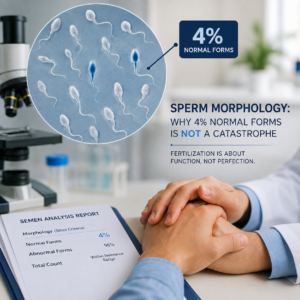
Sperm morphology of 4% normal forms is the lower reference limit and no pass mark. It is low for a reason: even men who conceive naturally produce a large majority of imperfectly shaped sperm. Morphology scored by strict criteria is one of the least reliable and least predictive numbers on a semen report, and on its own it rarely changes which treatment is appropriate.
Few figures on a fertility report cause as much needless alarm. A man reads “normal forms: 3%”, decides that 97% of his sperm are defective, and concludes he is almost certainly infertile. Neither conclusion holds. Here is where the 4% figure came from, what the evidence shows about morphology and pregnancy, and what a low result should and should not change.
What does “4% normal forms” actually mean?
Morphology is the share of sperm in a sample whose head, midpiece and tail all fall within a narrowly defined ideal shape. An embryologist or andrologist measures it on a stained slide, classifying a set number of sperm, usually 200, one at a time. Your report should always be interpreted by an IVF specialist in the context of your full history. Semen reports are interpreted against WHO 2021 reference values at the best IVF clinic in Ahmedabad.
The key is what counts as “normal”. The classification is deliberately unforgiving. A sperm with a very slightly tapered head, a marginally thickened midpiece or a minor tail irregularity is scored abnormal even though it may fertilise an egg perfectly well. The number therefore tells you how many sperm are close to a textbook ideal and says nothing about how many are functional. A result of 4% does not mean that 96% of sperm are damaged or incapable.
Morphology is one of nine or more parameters on a standard report, and it is the one most often over-interpreted in isolation. Our guide to reading a semen analysis report shows how the other parameters fit together.
Where the 4% figure came from
The lower reference limits used by laboratories worldwide come from the WHO Laboratory Manual for the Examination and Processing of Human Semen, 6th edition, published in July 2021. They are not thresholds that divide fertile men from infertile ones. They are the 5th centile of a reference population of men whose partners conceived within twelve months, meaning the value below which only the lowest-scoring 5% of recently fertile men fell.
In their critical review of the 6th edition in Life, Boitrelle and colleagues note that the reference data combine 3,589 fertile men whose partners achieved pregnancy within twelve months, drawing on the 5th edition cohort and on new data collected between 2010 and 2020. Their central caution is worth quoting: “the reference thresholds alone are meaningless and that multiple criteria must be applied to establish a diagnosis of male infertility.” The 6th edition itself moves towards the language of “decision limits” and does not set one for morphology.
The honest reading of “4%” is that it statistically describes a fertile population and marks no biological point at which fertility stops. A man at 3% sits inside the range occupied by some men who conceived naturally within a year.
What are Kruger strict criteria?
Strict criteria, often called Kruger or Tygerberg criteria after the group that developed them, are the standard method for scoring morphology and the one the WHO manual specifies. Any sperm that is not clearly normal in every respect is classed as abnormal, and borderline forms count against the sample.
That is why the normal range looks so alarming. The method was designed as a sensitive laboratory measure and was never meant as a patient-facing score. Applying an intentionally severe classification and then presenting the result as a percentage invites exactly the misreading this article tries to correct.
It also has a practical consequence. Because the judgement is visual and category-based, it is hard to standardise. The 2024 narrative review of isolated teratozoospermia in Translational Andrology and Urology states that “assessment of sperm morphology continues to be one of the most challenging assessments due to its very subjective nature,” causing “difficulties in standardization.” The same review records that the 4% cut-off “was criticized as being too low, resulting in poor prediction of ART outcomes.”
Claim versus evidence
| What patients are commonly told | What the evidence shows |
|---|---|
| “Only 4% of your sperm are normal, so 96% are defective.” | Strict criteria classify any sperm that is not near-perfect as abnormal. Most men who conceive naturally score in single digits. The percentage describes conformity to an ideal shape, not damage. |
| “Low morphology means you cannot conceive naturally.” | The 2024 Translational Andrology and Urology review reports that “up to 30% of couples with men with absolute teratozoospermia (0% normal forms) could still conceive spontaneously.” |
| “Abnormal morphology is rare and indicates a serious problem.” | The same review found isolated teratozoospermia in 35.9% of 103 fertile control men, against 11.9% of infertile men, so it was more common in the fertile group. |
| “Low morphology means you need ICSI.” | The review’s conclusion is direct: “in men with isolated teratozoospermia IVF is sufficient and there is no need for ICSI just because of isolated teratozoospermia.” |
| “Morphology reliably predicts whether IVF will work.” | A meta-analysis summarised in that review “found no significant decrease in the likelihood of pregnancy” with isolated teratozoospermia during IVF. |
| “A supplement or a diet will raise the percentage and fix the problem.” | Where a specific reversible factor exists, such as heat exposure, smoking, an untreated varicocele or a genital infection, addressing it is reasonable. No supplement has been shown to convert a morphology result into a live birth, and morphology alone is rarely the barrier. |
| “The number is precise, so a fall from 4% to 2% is meaningful deterioration.” | Morphology scoring is subjective and varies between observers and laboratories. Small differences between reports, particularly from different laboratories, should not be treated as clinical change. |
Does low morphology mean IVF or ICSI is needed?
Not by itself, and this is where the evidence has moved furthest from common practice.
For IUI, the older evidence found a signal. The structured literature review by Van Waart and colleagues in Human Reproduction Update (2001) reported a “significant improvement in pregnancy rate above 4% threshold for strict criteria”, with a risk difference of -0.07 (95% CI -0.11 to -0.03; P < 0.001) between men below and above that threshold. The effect is real and modest, and more recent work has been inconsistent. The 2024 review notes that one study found significantly different IUI outcomes between men below 4% and above 9% normal forms, while others found “no statistically significant difference” in IUI pregnancy rates whatever the severity of the morphology result.
For IVF and ICSI, the recent evidence is clearer and largely reassuring. A 2025 secondary analysis of a multi-centre randomised controlled trial in Human Reproduction examined 1,064 couples with normal sperm count and motility, randomised to intracytoplasmic sperm injection or conventional IVF. Low morphology alone rarely means you need IVF; your doctor will look at the whole report. Median normal morphology was 3% in both groups. Live birth after the first embryo transfer was 34.6% with ICSI and 31.2% with conventional IVF (relative risk 1.11, 95% CI 0.90 to 1.37), with no significant interaction between morphology and treatment effect (P = 0.181). The authors concluded that sperm morphology “has limited value as a biomarker to identify” couples who benefit more from ICSI than from conventional IVF.
A large retrospective series presented at ESHRE in 2024 and published as a conference abstract in Human Reproduction pointed the same way. Across 5,254 completed cycles, cumulative live birth with isolated teratozoospermia versus normal morphology was 35.8% against 37.8% in IVF and 38.1% against 33.2% in ICSI, and neither difference reached statistical significance.
In practice, an isolated low morphology result is not on its own a reason to escalate from IVF to ICSI. Where ICSI is truly indicated, the indication almost always comes from something else on the report or in the history.
How much can you trust a single morphology result?
Less than most other numbers on the report, for three reasons.
It is a subjective visual assessment. Two competent technicians scoring the same slide can reach different percentages, and two laboratories with different staining and classification practice can differ further. That is why the 2024 review calls standardisation an unresolved problem.
It varies between samples from the same man. Semen parameters shift with illness, fever, abstinence interval and collection technique, so one result is a snapshot.
It is measured against a limit drawn from a specific reference population. Boitrelle and colleagues go so far as to suggest that laboratories consider developing individualised reference values that account for population differences, and drop reliance on one universal cut-off.
For all three reasons, the AUA/ASRM guideline’s general position on semen testing applies with particular force: “at least two SAs, ideally obtained at least one month apart, are important to obtain” before an abnormal result is acted on.
When does abnormal morphology genuinely matter?
Morphology is not meaningless. It matters in three specific situations.
When it is part of a pattern. Low morphology together with low count and reduced sperm motility, the combination often shortened to OAT, describes a testis under strain and warrants a full evaluation. In that setting the morphology figure marks a wider problem and is not the problem itself.
When morphology is at or near zero. Absolute teratozoospermia is uncommon and deserves specific attention, particularly to exclude defined structural syndromes.
When a recognised structural defect affects all sperm. Globozoospermia, in which round-headed sperm lack the acrosome, is the clearest example. It is a distinct entity and no low score on a spectrum, and it has its own management considerations.
| Morphology result | How it is best read | What it usually changes |
|---|---|---|
| At or above 4% normal forms | Within the reference range derived from recently fertile men | Nothing. Attention belongs on the other parameters and on the female evaluation. |
| 1 to 3%, all other parameters normal | Isolated teratozoospermia, common, and found in a substantial proportion of fertile men | Repeat the analysis after at least a month. Rarely changes treatment on its own. |
| Low morphology with low count and/or low motility | A combined abnormality, not a morphology problem | Full male evaluation directed at the underlying cause. |
| 0% normal forms, or a described structural defect such as globozoospermia | A defined entity requiring specific assessment | Specialist andrology review and individualised planning. |
What to actually do with a 3% result
The sensible sequence is short.
- Read the whole report and not one line. Volume, concentration, total motile count, vitality and leukocytes together carry far more information than morphology alone.
- Repeat the analysis after at least a month, ideally at the same laboratory so the two results are comparable.
- Deal with anything genuinely reversible found on history or examination, such as smoking, heavy heat exposure, an untreated infection, a clinically significant varicocele or anabolic steroid use.
- Evaluate the female partner in parallel. Treatment decisions rest on the couple’s combined picture and on the woman’s age, and one male parameter does not decide them.
- Do not accept an escalation of treatment justified by morphology alone. If ICSI is recommended, ask what the indication is besides the morphology percentage.
When specialist evaluation is appropriate
A morphology result below the reference limit does not itself require urgent action. The clinical situation around it is what warrants review: twelve months of unprotected intercourse without conception, or six months when the woman is over 35; an abnormal result across more than one parameter; a history of undescended testes, testicular surgery, torsion, mumps orchitis, chemotherapy or anabolic steroid use; or a repeat sample that stays abnormal. Structured assessment is described on our page on male fertility evaluation.
Frequently asked questions
Why is only 4% normal sperm morphology considered normal? Because 4% is the 5th centile of a reference population of men whose partners conceived within twelve months, not a biological threshold. Strict criteria classify any sperm that is not near-perfect as abnormal, so even fertile men score in single digits. The figure describes conformity to an ideal shape, not the proportion of sperm that work. Does poor morphology mean IVF is needed? Usually not on its own. A 2025 secondary analysis of a randomised trial in Human Reproduction found that morphology had limited value in identifying which couples benefit from ICSI over conventional IVF, and a 2024 narrative review concluded that isolated teratozoospermia is not by itself an indication for ICSI. Treatment decisions rest on the full picture, including the female partner’s evaluation. What is Kruger strict criteria? Kruger, or Tygerberg, strict criteria are the standard method for scoring sperm morphology, adopted by the WHO manual. Sperm are classified individually and any that is not clearly normal in head, midpiece and tail is counted as abnormal. The method is deliberately severe, which is why normal reference values appear so low. Can sperm morphology be improved? Where a specific reversible factor is identified — smoking, significant heat exposure, an untreated genital infection, a clinically significant varicocele, anabolic steroid use — addressing it may improve semen parameters generally. No supplement has been shown to convert a morphology percentage into a live birth, and claims that a product will do so should be treated with scepticism. My morphology was 2% at one laboratory and 5% at another. Which is right? Both may be technically correct. Morphology scoring is a subjective visual assessment and varies between observers and laboratories, which is why the 2024 review describes standardisation as an ongoing problem. Comparing results from a single laboratory over time is more informative than comparing across laboratories.
The takeaway
Four per cent is a statistic drawn from fertile men, read through a deliberately strict classification and measured by a method that is hard to standardise. It deserves to be read alongside the rest of the report and not as a verdict. Isolated low morphology is common in men who conceive naturally, does not reliably predict IVF outcome, and is not by itself a reason to move to ICSI. The pattern across all parameters, the history behind it and the couple’s overall situation deserve the attention.
Couples who have a semen analysis showing low morphology and want it interpreted in context can discuss their report with a fertility specialist at Wellspring IVF & Women’s Hospital, an ART-registered IVF clinic in Ahmedabad, Gujarat, on +91 9099946050. OPD hours are Monday to Saturday, 10:00 AM to 4:00 PM.
References
- World Health Organization. WHO Laboratory Manual for the Examination and Processing of Human Semen, 6th edition. Geneva: World Health Organization; 27 July 2021. ISBN 978-92-4-003078-7. https://www.who.int/publications/i/item/9789240030787
- Boitrelle F, Shah R, Saleh R, Henkel R, Kandil H, Chung E, Vogiatzi P, Zini A, Arafa M, Agarwal A. The Sixth Edition of the WHO Manual for Human Semen Analysis: A Critical Review and SWOT Analysis. Life 2021;11(12):1368. doi:10.3390/life11121368. https://www.mdpi.com/2075-1729/11/12/1368
- Atmoko W, Savira M, Shah R, Chung E, Agarwal A. Isolated teratozoospermia: revisiting its relevance in male infertility: a narrative review. Translational Andrology and Urology 2024;13(2):260–273. doi:10.21037/tau-23-397. https://tau.amegroups.org/article/view/121952/html
- Pham TD, Dang VQ, Ho VNA, Tran CT, Nguyen DTP, Vuong LN, Ho TM, Mol BW, Wang R. Intracytoplasmic sperm injection versus conventional in vitro fertilization in infertile couples with normal total sperm count and motility: does sperm morphology matter? Human Reproduction 2025;40(1):23–29. doi:10.1093/humrep/deae252. https://academic.oup.com/humrep/article/40/1/23/7901372
- Van Waart J, Kruger TF, Lombard CJ, Ombelet W. Predictive value of normal sperm morphology in intrauterine insemination (IUI): a structured literature review. Human Reproduction Update 2001;7(5):495–500. doi:10.1093/humupd/7.5.495. https://academic.oup.com/humupd/article-abstract/7/5/495/651196
- Zhang X, McAuliffe D, Ugne G, et al. P-062 The impact of isolated teratozoospermia on cumulative live birth rates in IVF and ICSI treatment: a retrospective analysis of 5254 completed cycles. Human Reproduction 2024;39(Supplement_1):deae108.438 (conference abstract). doi:10.1093/humrep/deae108.438. https://academic.oup.com/humrep/article/39/Supplement_1/deae108.438/7703652
- Schlegel PN, Sigman M, Collura B, et al. Diagnosis and treatment of infertility in men: AUA/ASRM guideline part I. Fertility and Sterility 2021;115:54–61. American Society for Reproductive Medicine. https://www.asrm.org/practice-guidance/practice-committee-documents/diagnosis-and-treatment-of-infertility-in-men-auaasrm-guideline-part-i-2020/