

Published: 1 October 2026
Medically reviewed by Dr. Pranay Shah, MS (ObGy), Director & Chief Fertility Consultant, Wellspring IVF & Women’s Hospital, Ahmedabad
Last medically reviewed: 1 October 2026
ICSI is recommended where conventional insemination cannot work or has already failed: sperm obtained surgically, frozen–thawed eggs, significantly abnormal semen parameters, and a previous cycle with failed or very poor fertilisation. Where semen parameters are normal, current NICE and ASRM guidance and the randomised evidence agree that ICSI does not improve the chance of a live birth.
ICSI is usually presented as the more advanced option — the newer technique, the one where the embryologist places a single sperm directly inside the egg rather than leaving fertilisation to happen on its own. Presented that way, it sounds like something you would want. It is also an additional laboratory charge on top of the cycle, which is why the question of whether you actually need it is worth twenty minutes of your attention before you sign a consent form.
The evidence on this is unusually clear, and it points in one direction. ICSI is essential for a defined group of couples and makes no measurable difference to live birth for everyone else. This article sets out where the line sits, what the guidelines say on each side of it, and what to ask before agreeing.
The one difference that matters for this decision
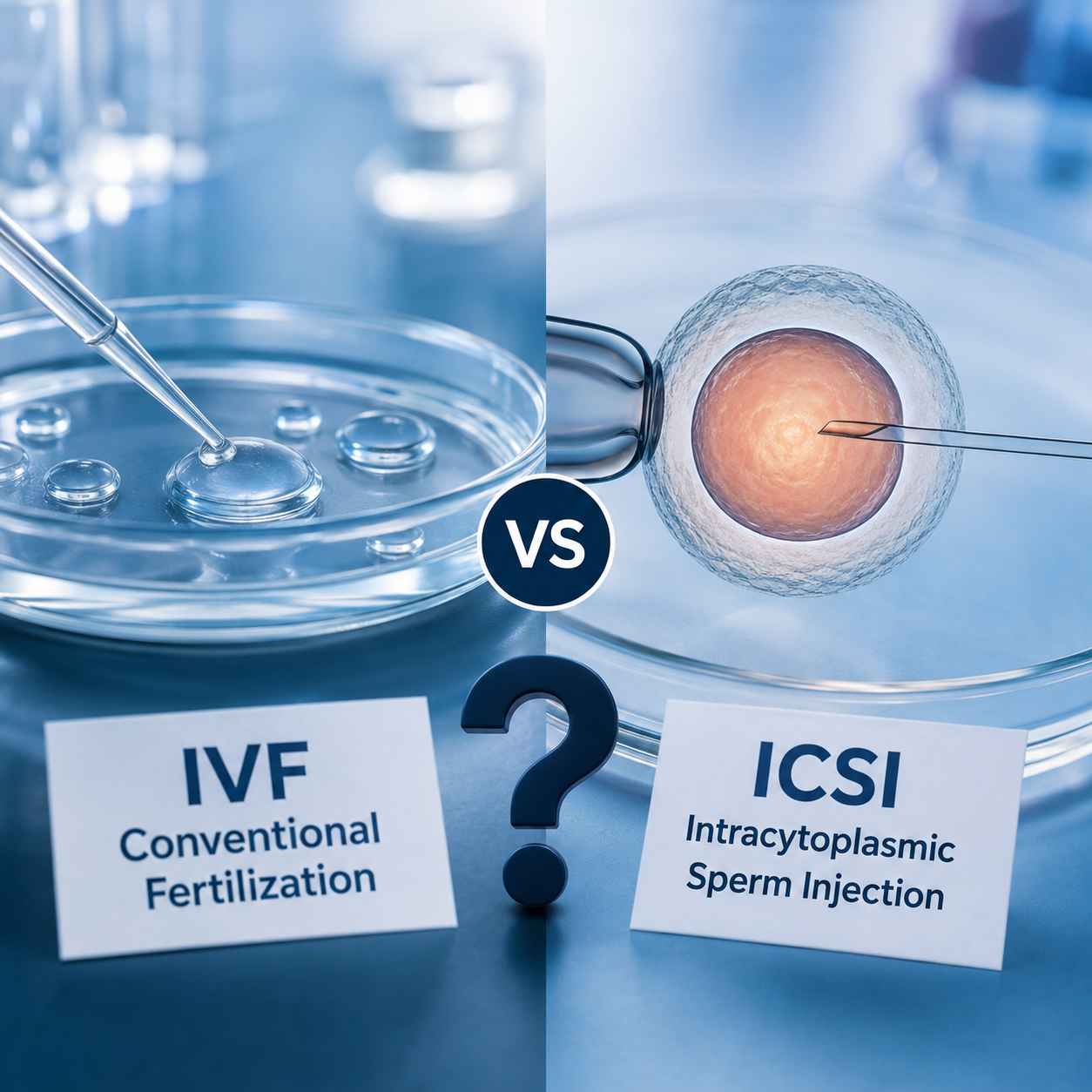
In conventional insemination, prepared sperm are placed with each egg and fertilisation happens by the sperm’s own binding and penetration. In ICSI treatment, the embryologist selects one sperm and injects it into the egg, bypassing that step entirely. The procedure itself, its steps and the technology involved are described on that page; what follows here is only the decision of when it should be used.
The practical consequence of the difference is the whole of the argument. ICSI removes the requirement that the sperm be able to reach, bind to and penetrate the egg. If that ability is absent or in doubt, ICSI solves a real problem. If it is intact, ICSI is solving a problem that does not exist.
When is ICSI necessary rather than optional?
ICSI is necessary where the sperm cannot be expected to fertilise the egg unaided, or where a previous cycle has demonstrated that it did not. Everything else is a judgement call, and in most of those judgement calls the current guidance is that ICSI should not be used. The table below sets out the situations in the order a clinic will actually meet them.
Table 1 — Indication-by-indication: is ICSI supported?
Clinical situation | Is ICSI indicated? | Basis |
Sperm obtained by surgical retrieval (TESA, PESA, TESE, micro-TESE) | Yes — offer | NICE NG257, recommendation 1.50.1: “Offer ICSI using surgically retrieved sperm or frozen–thawed oocytes” |
Frozen–thawed (vitrified) eggs being used | Yes — offer | NICE NG257, recommendation 1.50.1 |
Abnormal semen parameters | Consider, weighing severity | NICE NG257, recommendation 1.50.2: consider ICSI “if the partner with male reproductive organs has abnormal semen parameters, taking into account the severity” |
A previous IVF cycle with failed or very low fertilisation | Consider — the strongest conditional indication | NICE NG257, recommendation 1.50.2. ASRM 2026: ICSI “can increase fertilization rates when lower than expected or failed fertilization has previously occurred with conventional insemination” |
PGT-M — testing embryos for a single-gene condition | May benefit selected patients | ASRM 2026 lists PGT-M among the situations where ICSI may benefit select patients |
Normal semen parameters, no male factor | No | NICE NG257, recommendation 1.50.3: “Do not use ICSI for non-male factor fertility problems if the semen parameters are normal” |
Unexplained infertility | No | ASRM 2026: ICSI has been associated with increased fertilisation rates in some studies but “has not been shown to improve live birth outcomes” |
Advanced maternal age | No | ASRM 2026: fertilisation rates with conventional insemination in women over 35 are similar to those in younger women; no demonstrated benefit |
Low egg yield or diminished ovarian reserve | No | ASRM 2026: ICSI in this group “does not improve fertilization or live birth outcomes” |
PGT-A — testing embryos for chromosome number, without male factor | No | ASRM 2026: “the use of ICSI for PGT-A does not improve live birth rates, euploidy rates, or numbers of embryos” |
Routine ICSI applied to all eggs as a default | No | ASRM 2026: “Routine use of ICSI for nonmale factor infertility is not recommended” |
The two situations where ICSI is not a choice
NICE NG257, published on 31 March 2026 and replacing the previous CG156, uses the word offer for exactly two situations: surgically retrieved sperm, and frozen–thawed eggs. In both, conventional insemination is not a realistic alternative.
Sperm recovered by surgical sperm retrieval by TESA or PESA are few in number and often immotile or barely motile, because they have not completed the maturation that normally occurs during transit through the epididymis. There is neither the quantity nor the functional capability for conventional insemination. Eggs that have been vitrified and thawed present a different obstacle: the zona pellucida, the shell around the egg, hardens during freezing and thawing, and sperm that would have penetrated a fresh egg may not penetrate a thawed one. In both cases ICSI is not an enhancement — it is the only route to fertilisation.
Abnormal semen parameters: severity is the whole question
NICE does not say “abnormal semen analysis, therefore ICSI”. It says to consider ICSI, taking into account the severity. That qualifier is where most of the over-use in routine practice happens, because a report can be flagged abnormal on a single parameter that sits marginally below a reference limit.
The reference limits in current use come from the WHO laboratory manual for the examination and processing of human semen, sixth edition, published in 2021. They are the fifth centile of a reference population of men whose partners conceived within twelve months — they are not a boundary between fertile and infertile, and a single value fractionally below one of them describes a man whose sperm may still fertilise perfectly well by conventional insemination. Severe oligozoospermia, severe asthenozoospermia, or a combination of deficits across parameters is a different matter, and is where the case for ICSI becomes substantive.
Two practical points follow. First, a single abnormal sample should generally be repeated before it drives a treatment decision, because within-individual variation is large. Second, the decision belongs with the pattern and the severity, not with the word “abnormal” on a report — which is the same reasoning that applies across male-factor infertility generally.
Previous fertilisation failure: the strongest conditional indication
If a previous cycle produced no fertilisation, or a fertilisation rate far below what the egg number would predict, ICSI in the next cycle is well supported. Both NICE and the ASRM 2026 opinion identify it, and it is the one non-male-factor situation in which ASRM accepts that ICSI raises fertilisation rates in a way that matters.
The distinction worth holding on to is between total fertilisation failure — no eggs fertilised at all, which is unusual and is a clear indication — and a low fertilisation rate, which has many possible explanations including egg maturity and the number of eggs collected. A single cycle with three eggs and one fertilised is a weaker basis for the switch than a cycle with twelve eggs and none.
Is ICSI better than IVF for everyone?
No. Where there is no male factor, the randomised and registry evidence shows no advantage in live birth, and the largest registry analysis points marginally the other way.
The Cochrane systematic review of ICSI versus conventional insemination in couples where the male partner has a normal total sperm count and motility (Cutting and colleagues, 2023) pooled 1,539 couples and found a risk ratio for live birth of 1.11, with a 95 per cent confidence interval from 0.94 to 1.30 — an interval that comfortably includes no difference. The certainty of the evidence was rated low to moderate. The review’s conclusion was that neither method was superior for live birth or for the secondary outcomes examined, including multiple pregnancy, ectopic pregnancy, pre-eclampsia and prematurity.
Registry data point the same way at much larger scale. A 2026 analysis of the Canadian ART registry examined 140,252 egg-collection cycles between 2013 and 2022, of which about 75 per cent used ICSI — a proportion far in excess of the number of couples presenting with abnormal semen parameters. For non-male-factor infertility, the cumulative live birth rate was higher with conventional IVF than with ICSI, 38.5 per cent against 36.3 per cent. The difference is small, and registry comparisons cannot exclude the possibility that harder cases were selected into ICSI, but it is not the direction anyone expects if ICSI were an upgrade.
The ASRM 2026 committee opinion draws the conclusion plainly: routine use of ICSI for non-male-factor infertility is not recommended, and cost burden must be considered where the evidence for improved outcomes is limited or absent.
Does ICSI help when the semen analysis is normal?
It does not, and NICE states this as a negative recommendation rather than a preference. Recommendation 1.50.3 reads: “Do not use ICSI for non-male factor fertility problems if the semen parameters are normal.”
The mechanism explains why the trials come out the way they do. ICSI reliably raises the fertilisation rate per injected egg, and that is a real and measurable effect. But when sperm are normal, sperm binding and penetration were never the limiting step. What limits the outcome is the number of mature eggs collected, their quality, and how many of the resulting embryos develop and are chromosomally normal — and ICSI changes none of those. A higher fertilisation percentage that does not translate into more usable embryos does not translate into more babies either.
There is also an arithmetic point that surprises patients. Only mature eggs at metaphase II can be injected, so ICSI requires the eggs to be stripped of their surrounding cells first and immature eggs are excluded. Conventional insemination places sperm with all the collected eggs, some of which mature in the following hours. In a cycle with a small number of eggs, insisting on ICSI can mean fewer eggs are actually inseminated, not more. The injection itself also carries a small risk of the egg degenerating.
What is the argument for using ICSI anyway?
It deserves a fair statement, because it is not irrational. The argument is insurance: total fertilisation failure with conventional insemination is uncommon but devastating when it happens, an entire stimulation cycle is lost, and ICSI very largely prevents it. Where a couple has few eggs, or has travelled a long distance for treatment, or is funding the cycle themselves and cannot repeat it, the value they place on avoiding that outcome may be higher than the average.
That is a legitimate conversation to have. What it is not is a clinical indication, and it should not be presented as one. The honest framing is that ICSI in this setting buys reassurance against an uncommon event at a known additional cost and with no demonstrated gain in live birth — a trade-off the couple is entitled to make with the numbers in front of them. Some units offer split insemination, dividing the eggs between the two methods, where there is genuine uncertainty; the guidelines make no recommendation either way on this, and it should be agreed in advance rather than decided on the day.
How the decision is actually made on the day of egg collection
The semen sample produced on the day of egg collection is not always the sample that was analysed weeks earlier. Counts and motility fluctuate, and illness, fever or a change in abstinence interval in the intervening period can move a sample substantially. A laboratory may therefore reasonably recommend switching to ICSI on the morning of the procedure.
What should not happen is that the switch is made without a conversation that was anticipated in advance. Before the cycle starts, the plan should specify which method is intended, what would trigger a change, and who authorises it. That is a consent question as much as a clinical one, and it is much easier to settle before stimulation begins than at seven in the morning on the day of egg collection.
Questions worth asking before agreeing to ICSI
- Which of my results is the indication for ICSI — and where does it sit relative to the WHO reference limit?
- Has the semen analysis been repeated, or is this decision based on one sample?
- If the semen parameters are normal, on what basis is ICSI being recommended, given that NICE advises against it?
- What is the additional charge for ICSI, and is it included in the quoted package or added separately?
- What is this laboratory’s fertilisation rate with conventional insemination, and how often does total fertilisation failure occur here?
- If the sample on the day is different from the diagnostic sample, who decides on the switch and will I be contacted first?
- Will all the collected eggs be injected, or only the mature ones — and what happens to the rest?
A clinic that answers these directly is easy to work with. An answer along the lines of “we do ICSI for everyone, it is safer” is not an answer, and it is not what the current guidance supports.
When specialist assessment is appropriate
A fertility assessment is reasonable after twelve months of unprotected intercourse without conception, or after six months where the female partner is over 35 or where there is a known condition affecting either partner. Where the question is specifically about the method of fertilisation, assessment should include a properly performed semen analysis, repeated if abnormal, before any decision about IVF treatment and the insemination method is made.
Bring the actual laboratory reports, not a summary. The decision between ICSI and conventional insemination turns on specific numbers — concentration, total count, progressive motility, morphology and the reference limits printed alongside them — and it cannot be made from the word “low”.
Frequently asked questions
When is ICSI necessary rather than optional?
ICSI is necessary when sperm have been retrieved surgically or when frozen–thawed eggs are being used, because conventional insemination cannot work in either case. It should be considered where semen parameters are abnormal, weighing the severity, and where a previous cycle resulted in failed or very low fertilisation. In other situations it is optional and generally not recommended.
Is ICSI better than IVF for everyone?
No. The Cochrane review of couples with normal sperm count and motility found a live birth risk ratio of 1.11, with a confidence interval from 0.94 to 1.30, which includes no difference. Canadian registry data covering 140,252 cycles found cumulative live birth slightly higher with conventional IVF for non-male-factor patients. ASRM does not recommend routine ICSI without male factor.
Does ICSI help when the semen analysis is normal?
No. NICE recommendation 1.50.3 states directly that ICSI should not be used for non-male-factor fertility problems where the semen parameters are normal. ICSI raises the fertilisation rate per injected egg, but when sperm are normal, fertilisation was not the limiting step, and the higher percentage does not produce more usable embryos or more live births.
Does ICSI improve results if we are having PGT-A?
Not in the absence of male factor. The concern was that stray sperm attached to the egg could contaminate the genetic sample, but ASRM 2026 concludes that using ICSI for PGT-A does not improve live birth rates, euploidy rates or the number of embryos obtained. PGT-M, testing for a single-gene condition, is treated differently and is a situation where ICSI may benefit selected patients.
We are over 40 and have few eggs. Should we choose ICSI to be safe?
The evidence does not support it. ASRM 2026 states that ICSI for low egg yield, diminished ovarian reserve and advanced maternal age does not improve fertilisation or live birth outcomes, and that fertilisation rates with conventional insemination in women over 35 are similar to those in younger women. Requiring only mature eggs to be injected can also reduce the number inseminated.
Is ICSI less safe than conventional IVF?
Safety is not the reason current guidance advises against unnecessary ICSI. The Cochrane review found no meaningful difference between the two methods in multiple pregnancy, ectopic pregnancy, pre-eclampsia or prematurity. The argument against using ICSI where it is not indicated is that it adds cost and laboratory handling without any demonstrated gain in live birth.
The practical takeaway
ICSI is one of the genuinely transformative techniques in reproductive medicine, and for couples with severe male-factor infertility or surgically retrieved sperm it is the difference between having a treatment option and having none. That is precisely why it should not be applied indiscriminately: using it as a default for everybody obscures the group for whom it is indispensable, and charges the rest for something that does not change their outcome.
If you are being offered ICSI, ask which specific finding is the indication. If the honest answer is that there is no male factor and no previous fertilisation failure, the current position of both NICE and ASRM is that conventional insemination is the appropriate method.
Couples who want their semen analysis and treatment plan reviewed before deciding on the method of fertilisation can arrange a consultation with a fertility specialist at Wellspring IVF & Women’s Hospital, an ART-registered clinic in Ahmedabad led by Dr. Pranay Shah, MS (ObGy). Appointments can be made on +91 9099946050, on WhatsApp at the same number, during OPD hours of Monday to Saturday, 10:00 AM to 4:00 PM.
References
- National Institute for Health and Care Excellence. Fertility problems: assessment and treatment. NICE guideline NG257, published 31 March 2026, which updates and replaces CG156. Section 1.50, Intracytoplasmic sperm injection (ICSI). org.uk/guidance/ng257
- National Institute for Health and Care Excellence. Intracytoplasmic sperm injection (ICSI) — chapter of NICE guideline NG257, 2026. Chapter
- Practice Committee of the American Society for Reproductive Medicine. Intracytoplasmic sperm injection for nonmale factor indications: a committee opinion (2026). org
- Cutting E, Horta F, Dang V, van Rumste MME, Mol BWJ. Intracytoplasmic sperm injection versus conventional in vitro fertilisation in couples with males presenting with normal total sperm count and motility. Cochrane Database of Systematic Reviews, 2023, Issue 8, CD001301. Cochrane review
- Intracytoplasmic sperm injection for non-male factor infertility does not improve cumulative live birth rate: a Canadian assisted reproductive technologies registry (CARTR Plus) descriptive study. Frontiers in Reproductive Health, 2026. Full text
- World Health Organization. WHO laboratory manual for the examination and processing of human semen, sixth edition, 27 July 2021. int
- European Society of Human Reproduction and Embryology. ESHRE guidelines, consensus documents and recommendations — clinical guideline library. eu
This article is general medical information and is not a substitute for individual clinical assessment. The choice between ICSI and conventional insemination depends on your own semen analysis, treatment history and laboratory findings, and should be decided with your treating specialist.