
Published: 26 November 2026
Medically reviewed by Dr. Pranay Shah, MS (ObGy)
Last medically reviewed: 26 November 2026
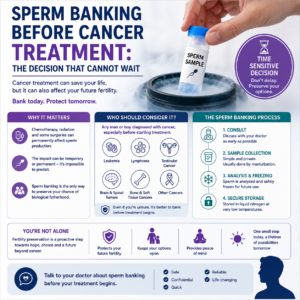
Sperm banking before cancer treatment should happen before any gonadotoxic therapy begins, and the collection itself takes under an hour. The European Association of Urology’s position is unambiguous: all males with cancer must be offered sperm cryopreservation before chemotherapy, radiotherapy or ablative surgery. Once treatment starts the window closes. Banking does not become impossible, but sperm collected afterwards may carry treatment-induced genetic damage that cannot be screened for.
This article is written for two readers. One is a man who has just been given a cancer diagnosis and is working out whether fertility preservation is worth the delay. The other is the oncologist, haematologist or surgeon who sees him first, and whose referral, or lack of one, decides whether the option ever reaches him. Nothing here should displace or postpone cancer treatment. The point is that in almost every case it does not have to.
Why the Window Closes So Fast
Spermatogenesis depends on a population of dividing spermatogonial stem cells. Chemotherapy and radiotherapy target dividing cells, which is exactly why they work against cancer and exactly why they damage the testis. Depending on the agent and the cumulative dose, the damage may be transient, prolonged or permanent.
The practical difficulty is that a man cannot know in advance which of the three he will get, and by the time the answer is clear the chance to bank untreated sperm has passed. Banking is therefore no judgement that infertility is likely. It keeps an option open at the cost of one appointment.
A second reason makes the timing non-negotiable. Chemotherapeutic agents and radiation can cause genetic changes in sperm. The 2026 ASRM committee opinion notes that these “may adversely affect reproductive outcomes and the health of the offspring”, and many centres therefore decline to cryopreserve sperm after treatment. Where post-treatment banking is offered at all, patients are counselled that the therapy “could introduce mutations into the sperm that may not be detectable with current or future preimplantation testing techniques”. Sperm banked before treatment carries no such uncertainty.
Does Chemotherapy Always Cause Infertility in Men?
No. Risk varies enormously with drug class and cumulative dose, and many men recover spermatogenesis. That same variation is why individual prediction is unreliable at the point of diagnosis.
The pattern in the literature is consistent: alkylating agents and procarbazine carry the highest risk of permanent azoospermia, while platinum-based and ABVD-type regimens more often cause temporary damage with recovery over years.
Treatment | Risk to spermatogenesis | Reported recovery |
|---|---|---|
Procarbazine-containing lymphoma regimens (for example COPP, MVPP) | Highest risk | Azoospermia exceeding 90%; recovery in under 3% at 10 years or more |
Cyclophosphamide, cumulative dose above 300 mg/kg | High, dose-dependent | Gonadal dysfunction in over 80% of postpubertal patients at this dose |
ABVD (doxorubicin, bleomycin, vinblastine, dacarbazine) | Lower | Recovery in 40% at a median of 27 months in one series, with further recovery on retesting |
Cisplatin-based regimens for testicular cancer | Moderate, usually temporary | Approximately 50% at 2 years and 80% at 5 years |
Testicular radiation, 0.2 Gy or less | Minimal | No significant effect on sperm counts |
Testicular radiation, 0.2 to 0.7 Gy | Transient | Recovery within 12 to 24 months |
Testicular radiation, 1.2 Gy and above | High | Recovery probability significantly reduced; permanent azoospermia increasingly likely |
Testicular radiation, 6 Gy or above | Highest | May cause permanent azoospermia |
Two threshold figures are worth knowing because they feed paediatric and adolescent risk stratification. ESHRE’s 2025 good practice recommendations note that azoospermia risk rises significantly at a cumulative cyclophosphamide equivalent dose of 12 g/m² or more, and with testicular radiotherapy of 1 Gy or more.
These figures describe populations and say nothing definite about any one man. A man in a lower-risk category can still be left permanently azoospermic, and a man in a higher-risk category can recover. The evidence supports counselling every man before treatment, with no attempt to choose who to counsel.
How Quickly Can Sperm Banking Be Arranged?
For a man who can produce an ejaculated sample, the answer is usually the same day or the next working day. The appointment covers consent, mandatory viral screening, sample production and laboratory processing, and it is measured in hours and not days. The sperm freezing page sets out the process at Wellspring.
ASRM’s 2026 guidance recommends banking multiple samples where time allows, because more stored vials support a wider range of future options, and intrauterine insemination needs far more motile sperm than ICSI does. Where treatment starts immediately, one sample is far better than none, and a single vial can be enough for ICSI.
Nothing about this should postpone oncological care. The 2026 ASRM committee opinion states plainly that chemotherapy should not be postponed and that fertility preservation must be arranged around treatment and never the other way round. In practice the constraint is administrative and has little to do with biology: the delay that costs men their fertility is almost always the delay in being told the option exists.
Sperm Quality Is Often Already Abnormal at Diagnosis
This point is most commonly missed, and it strengthens the case for banking.
Cancer itself impairs spermatogenesis before any treatment is given. In a review of fertility in men with testicular cancer, more than half of patients had oligozoospermia before any treatment, and testicular cancer was described as the most damaging of the common malignancies for pre-treatment sperm concentration and total count. Up to 85% show impaired parameters after unilateral orchidectomy, and a further 9% become azoospermic.
Two consequences follow. A disappointing semen analysis at diagnosis is a reason to bank promptly and, where possible, to bank more than one sample, because parameters are more likely to fall further than to improve. It is no reason to abandon banking. And a man with a low count at diagnosis may still have entirely usable sperm for ICSI, where a single spermatozoon is needed per egg. The threshold for “useful” is far lower than most patients assume, and questions about reading a semen report belong in a discussion of male-factor infertility and give no grounds to skip banking.
When There Is No Sperm in the Ejaculate: Onco-TESE
A minority of men are azoospermic at diagnosis, most often with testicular cancer. For them a specific option exists that is easily missed because it has to be planned before surgery and not after it.
Onco-TESE is surgical sperm retrieval performed at the same time as radical orchidectomy, using tissue from the affected or the contralateral testis. The EAU guideline recommends offering it to men with testicular cancer who have azoospermia or severe abnormalities of semen parameters, and rates the recommendation strong. It also notes that a semen analysis before orchidectomy identifies the men who need it.
Reported retrieval rates in contemporary series approach 70%. Any sperm recovered this way requires ICSI, since the numbers are far too small for insemination, and the general principles of surgical sperm retrieval apply, with the difference that the cancer operation dictates the timing. Our overview of how an IVF cycle is planned explains the steps that follow once sperm are available.
The operational message for referring surgeons is short: order a semen analysis before the orchidectomy and not after it.
Boys and Adolescents
An adolescent who can produce a semen sample should be offered semen cryopreservation on the same basis as an adult. ASRM’s 2026 guidance confirms that ejaculated semen cryopreservation is feasible and successful in most adult males and adolescents.
For prepubertal boys, and for adolescents who cannot produce a sample, the only option is testicular tissue cryopreservation. ESHRE’s 2025 good practice recommendations are clear that it remains experimental. It is increasingly offered before gonadotoxic treatment for possible future use, but clinical applications of cryopreserved testicular tissue remain to be proven. Families should be counselled on that basis, and it should not be described as an established treatment.
Where a minor’s gametes are frozen in India, the ART Rules require assent from the minor together with parental consent, recorded on the prescribed form.
What Indian Law Says About Storing Sperm for a Cancer Patient
The ART (Regulation) Act, 2021 and the ART (Regulation) Rules, 2022 govern cryopreservation in India, and they contain an oncofertility provision that is rarely mentioned.
Rule 13(1)(b) of the Rules, notified as G.S.R. 419(E) on 7 June 2022, permits storage of oocytes and sperm “for onco-fertility patients undergoing treatment and for other such conditions, for duration longer than ten years with the permission from the National Board”. The standard maximum storage period is ten years, and the oncofertility exception exists because a young cancer patient may need his sample well beyond that horizon.
The Rules also prescribe the consent documentation: Form 10 for gamete freezing, and Form 11 where a minor’s gametes are frozen with parental consent. Written informed consent is required before any sample is accepted into storage, and screening for HIV, hepatitis B, hepatitis C and syphilis is mandatory.
For a man in his twenties banking before treatment, the practical step is to raise long-term storage at the outset and to keep contact details current with the clinic, since storage depends on renewal.
What the Referring Clinician Needs to Do
The literature is consistent that the failure point in oncofertility is the referral and not the technology. The steps below are short enough to fit into a first oncology consultation.
Step | Action | Timing |
|---|---|---|
1 | Document that fertility risk was discussed, whatever the patient decides | First consultation |
2 | Estimate gonadotoxic risk from the planned regimen and cumulative dose | At treatment planning |
3 | Refer to a fertility unit for banking — same day where possible | Before cycle 1 |
4 | For suspected testicular cancer, order semen analysis before orchidectomy | Pre-operative |
5 | Where azoospermia is found, discuss onco-TESE with the operating surgeon | Before surgery |
6 | For prepubertal boys, refer for counselling on testicular tissue cryopreservation as an experimental option | Before treatment |
7 | Proceed with cancer treatment on schedule | Unchanged |
No step in that list requires treatment to be delayed.
The Referral Gap in India
Indian data are limited, but what exists points the same way. A cross-sectional survey of 46 general physicians and paediatricians in India, published in F1000Research in 2023, found that about 60% lacked adequate knowledge of the available fertility preservation options and that only 21 to 35% reported routinely discussing fertility preservation with cancer patients. The barriers named most often were financial burden, lack of patient awareness, lack of physician awareness and limited access to facilities.
That is a small survey and should be read as indicative and not definitive. It is consistent with international findings that uptake is low: in the testicular cancer literature, over 70% of men forgo banking, most often citing cost and the difficulty of making decisions in the first days after a diagnosis.
The remedy is structural. When a fertility service and an oncology service share a standing referral pathway, the conversation happens by default and no longer depends on chance.
Is Sperm Banked Before Treatment Safe to Use?
The available evidence is reassuring. In the testicular cancer literature there is no evidence that using cryopreserved sperm leads to adverse pregnancy outcomes or congenital malformations. Frozen and thawed sperm is used through standard routes: intrauterine insemination where numbers allow, and ICSI where they do not.
Men who have completed treatment and wish to try naturally should know that sperm aneuploidy levels take time to normalise. The EAU guideline notes that they often fall to pre-treatment levels 18 to 24 months after treatment, and that spermatogenesis usually recovers one to four years after chemotherapy. Contraceptive advice during that period should come from the treating oncology team.
When to Contact a Fertility Specialist
Immediately, and before treatment starts. That means when a gonadotoxic regimen is proposed, before an orchidectomy for suspected testicular cancer, before pelvic or total body irradiation, before stem cell transplant conditioning, and for any adolescent male facing the same treatments.
A single appointment preserves an option that cannot be recovered later. No clinical scenario exists in which it is better to wait and see.
Frequently Asked Questions
Should sperm be frozen before chemotherapy?
Yes, wherever it is feasible. The EAU guideline’s strong recommendation is that all males with cancer must be offered sperm cryopreservation prior to gonadotoxic agents or ablative surgery, and ASRM guidance states that collection should be performed before gonadotoxic therapy is administered.
Does chemotherapy always cause infertility in men?
No. Risk depends on the agent and the cumulative dose. Procarbazine-containing and high-dose cyclophosphamide regimens carry the highest risk of permanent azoospermia, while cisplatin-based regimens show recovery in roughly 50% at two years and 80% at five years. Individual outcome cannot be predicted reliably in advance.
How quickly can sperm banking be arranged before cancer treatment?
Usually within a day. Consent, mandatory viral screening, sample production and processing take hours, not weeks, and it does not require the cancer treatment schedule to change.
What if I cannot produce a sample because of stress or illness?
Tell the unit. Alternatives exist, including collection at home within a defined transport window where clinically appropriate, and surgical retrieval in selected cases. Difficulty producing a sample at the worst week of a man’s life is common and is not a reason to abandon the attempt.
Can sperm be frozen after chemotherapy has already started?
It is possible but is not equivalent. Many centres decline post-treatment cryopreservation because of the risk of treatment-induced genetic damage to sperm, and where it is offered patients must be counselled that such mutations may not be detectable by current testing. Banking before treatment avoids the question entirely.
How long can sperm be stored in India?
Ten years under the ART Rules, 2022, with a specific provision at rule 13(1)(b) permitting longer storage for oncofertility patients with the permission of the National Board. Raise this with your clinic at the time of freezing.
The Practical Takeaway
Sperm banking before cancer treatment is a short, low-risk, one-appointment procedure that preserves an option no later intervention can restore. The evidence does not say that every man treated for cancer becomes infertile. It says that nobody can tell in advance which men will, that sperm collected after treatment carries uncertainty that sperm collected before it does not, and that the commonest reason the option is lost is that nobody raised it in time.
For clinicians, the single highest-yield change is a standing rule: fertility discussed and documented at the first consultation, referral before cycle one, semen analysis before orchidectomy.
Speak to a Fertility Specialist
Men who have been advised to start chemotherapy, radiotherapy or surgery that may affect fertility, and clinicians who wish to arrange urgent pre-treatment banking for a patient, can contact Wellspring IVF & Women’s Hospital, Ahmedabad, where fertility preservation is provided under the care of Dr. Shah. If a banked sample is later used for ICSI, our itemised IVF package prices show what that cycle costs.
Phone: +91 9099946050
OPD hours: Monday to Saturday, 10:00 AM to 4:00 PM
References
- Practice Committee of the American Society for Reproductive Medicine. Fertility preservation in patients with medical indications: a committee opinion. Fertility and Sterility. 2026;125:247–259. ASRM practice guidance
- Ethics Committee of the American Society for Reproductive Medicine. Fertility preservation and reproduction in patients facing gonadotoxic therapies or gonadectomy: an Ethics Committee opinion. Fertility and Sterility. 2026;125:260–266. ASRM ethics opinion
- European Association of Urology. EAU Guidelines on Sexual and Reproductive Health — Male Infertility. uroweb.org
- Howell SJ, Shalet SM. Spermatogenesis after cancer treatment: damage and recovery. JNCI Monographs. 2005;2005(34):12–17. https://doi.org/10.1093/jncimonographs/lgi003
- ESHRE Working Group on Fertility Preservation in Boys; Mitchell RT, Eguizabal C, et al. ESHRE good practice recommendations on fertility preservation involving testicular tissue cryopreservation in children receiving gonadotoxic therapies. Human Reproduction. 2025;40(8):1391–1431. https://doi.org/10.1093/humrep/deaf106
- Parekh NV, Lundy SD, Vij SC. Fertility considerations in men with testicular cancer. Translational Andrology and Urology. 2020;9(Suppl 1):S14–S23. https://doi.org/10.21037/tau.2019.08.08
- Ministry of Health and Family Welfare, Government of India. The Assisted Reproductive Technology (Regulation) Rules, 2022, G.S.R. 419(E), 7 June 2022. artsurrogacy.gov.in
- Government of India. The Assisted Reproductive Technology (Regulation) Act, 2021 (Act No. 42 of 2021). India Code
- Tholeti P, Uppangala S, Jayaram RK, et al. Oncofertility awareness among primary care physicians in India. F1000Research. 2023;12:153. https://doi.org/10.12688/f1000research.126232.2