
Published: 12 November 2026
Last medically reviewed by Dr. Pranay Shah: 28 November 2026.
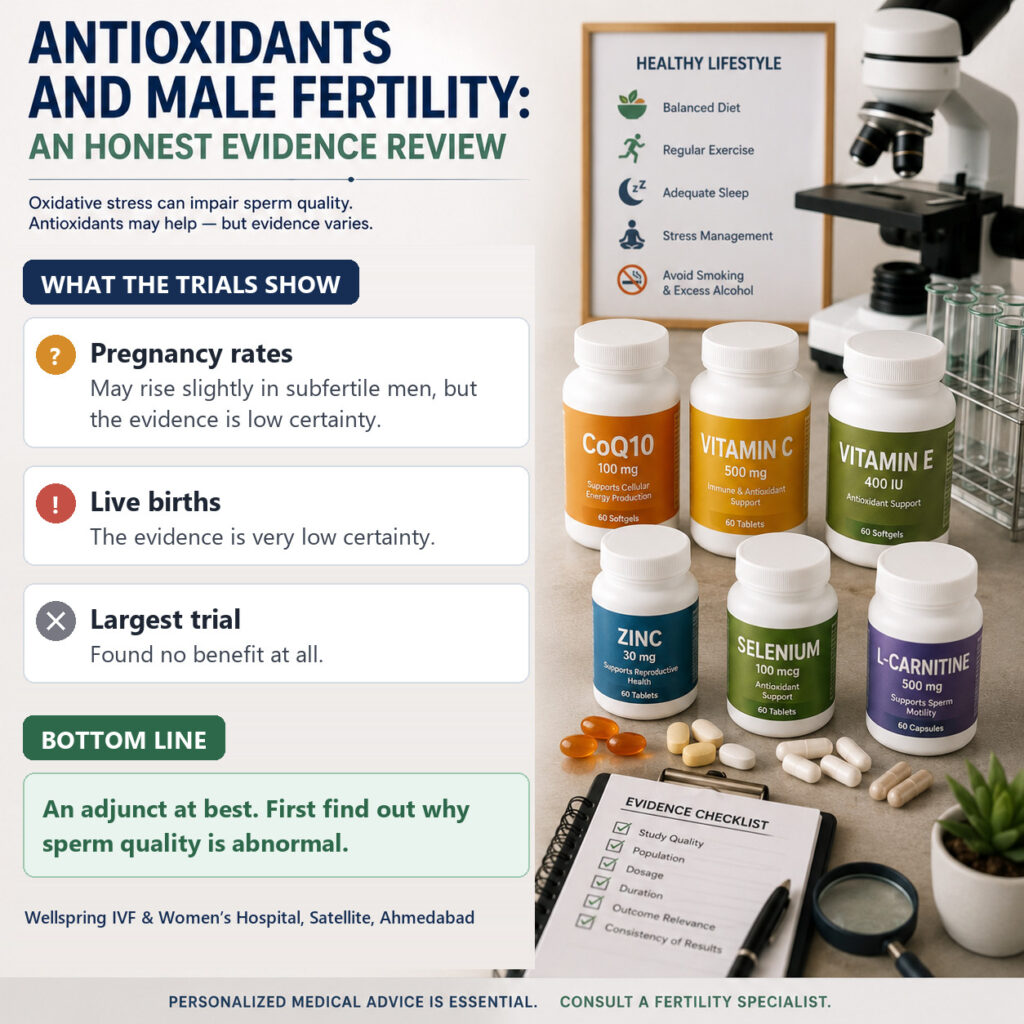
Antioxidants for male fertility may modestly raise clinical pregnancy rates in subfertile men, but that finding rests on low-certainty evidence, and the live-birth evidence is very low certainty. The AUA/ASRM guideline calls their clinical utility “questionable”. The largest single trial ever run found no benefit at all and a small rise in sperm DNA fragmentation. Antioxidants are an adjunct at best and are no substitute for finding out why sperm quality is abnormal.
Almost every man in India who gets an abnormal semen report is offered a supplement within days, from a pharmacy counter, a relative or an online advertisement. Most of these products are multi-ingredient antioxidant blends. The biology behind them is sound. The clinical evidence is much weaker than the packaging suggests, and weaker than most men are told. Here is what the trials and guidelines show, including where the evidence points the other way.
Why Antioxidants Were Ever Proposed for Sperm
Reactive oxygen species (ROS) are unstable oxygen-containing molecules made during normal metabolism. In semen they are not simply harmful. Physiological amounts are needed for sperm capacitation and for the acrosome reaction, two steps a sperm must complete before it can fertilise an egg.
Excess is the problem, and sperm are unusually vulnerable to oxidative damage for three structural reasons.
- Their membranes are rich in polyunsaturated fatty acids, the preferred target of lipid peroxidation. Damage here stiffens the membrane and impairs motility.
- They carry almost no cytoplasm. A cell keeps its own antioxidant enzymes in its cytoplasm, and a mature sperm has shed most of it, so it has little capacity to defend itself.
- Their DNA is tightly compacted and transcriptionally silent, so a sperm cannot repair DNA strand breaks the way a body cell can.
When ROS production outruns the antioxidant capacity of seminal plasma, the result is oxidative stress: membrane damage, reduced motility and DNA strand breaks. Supplementing antioxidants to restore the balance is therefore a reasonable idea. Whether it works in practice is a separate question that thirty years of trials have still not answered cleanly.
One practical complication belongs near the start. No standardised, validated clinical test for oxidative stress in semen exists. The European Association of Urology guideline on male infertility notes that although ROS can be measured by various assays, “no standardised testing methods for ROS are available and routine measurement of ROS testing should remain experimental until these tests are validated.” In ordinary clinical practice, then, antioxidants are given without any measurement of the problem they are meant to correct.
Do Antioxidants for Male Fertility Work? Claim Versus Evidence
The reference point for this table is the Cochrane systematic review Antioxidants for male subfertility, updated in May 2022, which pooled 90 randomised trials involving 10,303 subfertile men across 20 different oral antioxidants. It remains the largest and most rigorous synthesis available. The certainty ratings below are the review’s own GRADE assessments.
Claim commonly made | What the evidence actually shows | Certainty of the evidence |
|---|---|---|
“Antioxidants increase your chance of a live birth” | Cochrane found antioxidants may increase live birth: from a baseline of 16% without antioxidants to between 17% and 27% with them (12 trials, 1,283 men). Critically, when trials at high risk of bias were removed, the effect disappeared. | Very low |
“Antioxidants increase clinical pregnancy” | Cochrane found antioxidants may increase clinical pregnancy: from a baseline of 15% to between 20% and 30% (20 trials, 1,706 men). This is the strongest signal in the whole evidence base. | Low |
“Antioxidants reduce miscarriage” | No evidence of a difference in miscarriage rate was found (6 trials). | Very low |
“Antioxidants reduce sperm DNA fragmentation” | Genuinely mixed. Several small trials report reductions in DFI. The largest randomised trial ever conducted in this field found the opposite: DFI was higher in the supplement arm at six months (29.7% versus 27.2%; mean difference 2.4%, 95% CI 0.5% to 4.4%). | Not established; direction of effect uncertain |
“Zinc and folic acid improve sperm and increase live birth” | Directly tested and not supported. The FAZST trial randomised 2,370 couples to 5 mg folic acid plus 30 mg zinc daily or placebo for six months. Live birth was 34% with supplementation versus 35% with placebo (risk difference −0.9%, 95% CI −4.7% to 2.8%). Semen parameters did not improve. | Single large, adequately powered randomised trial; result null |
“One particular antioxidant is clearly the best” | Cochrane compared 20 different agents and could not identify a superior one. There is no adequate head-to-head trial evidence ranking them. | Not established |
“Antioxidants are completely harmless” | Cochrane found antioxidants may increase mild gastrointestinal discomfort, from 2% to between 2% and 7% (16 trials). The FAZST trial reported more abdominal discomfort (6% versus 3%), nausea (4% versus 2%) and vomiting (3% versus 1%). | Low |
“Supplements can substitute for a fertility evaluation” | No guideline anywhere supports this. Every major body treats supplementation as adjunctive at most. | Contradicted by guidelines |
What the Guidelines Say
Three independent authorities have reviewed this evidence and reached the same conclusion in different words.
Source | Position, in its own words | Grading |
|---|---|---|
AUA/ASRM, Diagnosis and Treatment of Infertility in Men (2020, amended 2024), statement 45 | “Clinicians should counsel patients that the benefits of supplements (e.g., antioxidants, vitamins) are of questionable clinical utility in treating male infertility. Existing data are inadequate to provide recommendation for specific agents to use for this purpose.” | Moderate Recommendation; Evidence Level Grade B |
European Association of Urology, Guidelines on Sexual and Reproductive Health: Male Infertility | “Antioxidant regimens and lifestyle interventions may reduce the risk of DNA fragmentation and improve sperm quality… These data have not been supported by RCTs.” | Narrative summary of evidence; no recommendation issued |
Cochrane, Antioxidants for male subfertility (2022) | “There is very low-certainty evidence… suggesting that antioxidant supplementation in subfertile males may improve live birth rates… Overall, the current evidence is inconclusive.” | GRADE very low to low across outcomes |
It helps to be precise about what “questionable clinical utility” means. It does not mean antioxidants have been proven useless. It means that after 90 trials and more than 10,000 men, the evidence is still not good enough to tell a patient with confidence that a supplement will help him, or which one to take.
Why Is the Evidence Still This Weak After Thirty Years?
This question explains everything else on the page, and patient-facing material rarely answers it.
- The trials are small. Ninety trials across 10,303 men averages fewer than 115 men each, and detecting a modest difference in live birth needs far more.
- The formulations all differ. Twenty agents were compared, in different combinations, at different doses and for different durations. Pooling them answers “do antioxidants in general help?”, a question no clinician actually faces.
- Most trials measured surrogate outcomes. Sperm concentration and motility are easy to measure at three months. Live birth takes a year and means following the couple, and only 12 of 90 trials reported it at all.
- Risk of bias changes the answer. The live-birth signal disappeared when Cochrane restricted the analysis to trials at low risk of bias. That is the most important sentence in the review.
- Patients were not selected for oxidative stress. With no validated test, trials enrolled subfertile men in general and left out any check for oxidative damage. If the treatment works only in the subgroup with the problem, diluting that subgroup hides the effect. If it does not work at all, no test will show that either.
- Sponsorship. A substantial share of this literature is funded by companies that sell the products being tested.
Can Antioxidants Reduce Sperm DNA Fragmentation?
This question has the biggest gap between what is marketed and what is known, so it deserves a careful answer.
Several small randomised trials report reductions in the DNA fragmentation index (DFI) after three months of antioxidant therapy, and the mechanism is plausible. The largest randomised trial in the field found the opposite. The Folic Acid and Zinc Supplementation Trial (FAZST), published in JAMA in 2020, randomised 2,370 couples across four US fertility centres to 5 mg folic acid plus 30 mg elemental zinc daily or to placebo for six months. It found no improvement in any semen parameter and no difference in live birth, and it found a small but statistically significant increase in DNA fragmentation in the supplemented group (29.7% versus 27.2%).
That does not prove that antioxidants damage sperm. It tested one combination at one dose, and folic acid and zinc are not the agents most often studied for DFI. What it does show is that the assumption behind most supplement marketing, that more antioxidant is always better for DNA, is not safe. Reactive oxygen species have physiological functions in sperm, and an intervention that suppresses them indiscriminately is not automatically benign.
The practical conclusion concerns sequence and is no argument for scepticism. When a raised DFI has an identifiable, treatable cause, such as a palpable varicocele, a genital tract infection, smoking, obesity, prolonged scrotal heat exposure or a long abstinence interval, treating that cause has much better evidence than supplementing around it. Antioxidants are reasonable alongside that work, and at Wellspring a structured antioxidant course is used in exactly that position, alongside investigation and correction of the underlying cause and never in place of it. Our page on sperm DNA fragmentation gives the full account of testing, thresholds and treatment sequence.
Which Antioxidants Have the Strongest Evidence?
No agent has evidence strong enough for a confident recommendation, which is exactly what the AUA/ASRM guideline says. The table reports what each commonly sold agent is proposed to do and how good the evidence for it is. The doses are those used in published trials, reported as fact. They are no prescription, and choosing a dose from this table is not its intended use.
Agent | Proposed mechanism | Best available evidence |
|---|---|---|
Coenzyme Q10 | Mitochondrial antioxidant; sperm motility is mitochondria-dependent | The most consistently studied agent. Trials at 20 to 200 mg daily report improvements in concentration and total motility, and several report DFI improvement. Trials are small and surrogate-outcome based. |
L-carnitine / acetyl-L-carnitine | Energy substrate for sperm mitochondria; concentrated in the epididymis | Some trials report motility improvement and one reported DFI falling from 20% to 14.5%. Small sample sizes; not replicated at scale. |
Zinc | Cofactor for antioxidant enzymes; involved in chromatin stabilisation | Small trials report improvements in motility and concentration, but the 2,370-couple FAZST trial found no benefit on any outcome when combined with folic acid. |
Folic acid | DNA synthesis and methylation during spermatogenesis | Directly tested at 5 mg daily in FAZST. No improvement in semen quality or live birth; DFI slightly higher. |
Selenium | Component of glutathione peroxidase, a key seminal antioxidant enzyme | Included in several combination trials. No adequately powered stand-alone trial with a clinical endpoint. Excess selenium is toxic, so the margin is narrower than for most agents. |
Vitamin C and vitamin E | Aqueous and membrane-phase antioxidants respectively; frequently combined | Widely trialled in combination products. Cochrane could not separate their individual contribution from the blends they appear in. |
Vitamin D | Receptors present on sperm; associated with motility in observational work | Correction of documented deficiency is reasonable on general health grounds. Evidence for supplementing men who are not deficient is weak. |
Lycopene, N-acetylcysteine, others | Various antioxidant mechanisms | Small individual trials only. Included in the Cochrane pool but not separately established. |
Two points follow. If a product holds eight ingredients, the evidence for the product is not the sum of the evidence for each ingredient, because nobody has trialled that specific blend. And duration matters. Spermatogenesis takes about 74 days, so no semen parameter should be re-tested less than three months after any intervention. A supplement judged after four weeks has not had a fair test, and one continued for a year with no repeat semen analysis has not been tested at all.
What Has Better Evidence Than a Supplement
The interventions with the strongest evidence in male infertility are diagnostic and causal and have little to do with nutrition. A structured evaluation identifies which one applies, which is why a semen analysis alone is no diagnosis. The report shows which parameters fall below the reference limits in the World Health Organization’s laboratory manual for the examination and processing of human semen, 6th edition (2021) and does not show why. The evaluation of male infertility looks for hormonal, structural, infective and genetic causes, several of which are directly correctable.
Varicocele is the clearest example. The AUA/ASRM guideline recommends that clinicians “should consider surgical varicocelectomy in males attempting to conceive who have palpable varicocele(s), infertility, and abnormal semen parameters”, a moderate recommendation on Grade B evidence, which is a stronger evidentiary position than any supplement holds. The same guideline advises against operating on non-palpable varicoceles found only on imaging.
Smoking cessation, weight reduction, avoiding prolonged scrotal heat, treating genital tract infection and correcting hormonal abnormality all have a clearer rationale and a better risk-benefit profile than an unspecified antioxidant blend. When the count itself is the abnormality, the severity grade and the total motile sperm count decide what treatment is realistic, as our page on oligospermia explains. The practical detail of the lifestyle measures is in our guide on improving sperm count naturally.
How to Read a Male Fertility Supplement Label
If you are going to take one, and a three-month structured course alongside proper evaluation is defensible, read the pack and ignore the advertisement.
- Count the ingredients. A blend of twelve substances has not been trialled as a blend of twelve substances.
- Check the quantity of each, in milligrams. A “proprietary blend” with no per-ingredient quantities cannot be compared with any trial.
- Compare against trial doses. Many retail products hold a small fraction of the amounts used in the studies they cite.
- Check for duplication. Men often take two products with the same agents, which matters most for selenium, zinc and vitamin A-related compounds, where excess is genuinely harmful.
- Check the regulatory category. In India these are sold as nutraceuticals or dietary supplements and need not show efficacy for a medical indication.
- Price the full course. Three months is the minimum meaningful duration. Work out that total before starting and compare it with the cost of a proper evaluation. If treatment does turn out to be needed, our IVF treatment cost guide lists what each package covers.
- Tell your doctor what you are taking. Bring the container to the consultation.
When to Stop Supplementing and Get Evaluated
Formal evaluation, in place of another supplement course, is appropriate if any of these apply.
- You have been trying to conceive for 12 months, or 6 months if your partner is 35 or older.
- You have an abnormal semen analysis and the cause has not been investigated. An abnormal report is a finding and no diagnosis.
- Your semen analysis has shown no sperm at all. Azoospermia needs specific investigation and is never a supplement problem.
- You have completed three months of supplementation without a repeat semen analysis. With no before-and-after measurement you are guessing and not treating.
- You have a palpable scrotal swelling, testicular pain, or a history of undescended testis, testicular surgery, mumps orchitis, chemotherapy or radiotherapy.
- The couple has had recurrent pregnancy loss.
Sudden severe testicular pain needs emergency assessment the same day and no fertility appointment.
Frequently Asked Questions
Do male fertility supplements actually improve sperm quality?
Sometimes, modestly, and unpredictably. The Cochrane review found antioxidants may increase clinical pregnancy rates on low-certainty evidence, and may increase live birth on very low-certainty evidence — with the live-birth effect disappearing when poorly conducted trials were excluded. The AUA/ASRM guideline describes their clinical utility as “questionable” and declines to recommend any specific agent. A supplement is a reasonable adjunct; it is not a treatment for a diagnosed cause.
Which antioxidants have the strongest evidence for sperm health?
Coenzyme Q10 and L-carnitine have the most consistent supportive data, though still from small trials with surrogate outcomes. No agent has evidence strong enough for a guideline to recommend it by name, and Cochrane’s comparison of 20 different antioxidants could not identify a superior one. Notably, the combination with the largest and best-conducted trial behind it — folic acid plus zinc — was the one shown not to work.
Can antioxidants reduce sperm DNA fragmentation?
The evidence is genuinely mixed and does not currently support a confident yes. Several small trials report DFI reductions; the 2,370-couple FAZST trial found DFI slightly higher in the supplemented arm. Where a raised DFI has a treatable cause such as a varicocele, infection, smoking or heat exposure, correcting that cause has better evidence than supplementing around it.
How long should I take a fertility supplement before judging whether it worked?
Sperm production takes about 74 days, so a repeat semen analysis before three months tells you very little. Three months is the minimum meaningful course, and it should end with a repeat test — otherwise there is no way to know whether anything changed.
Can taking too much antioxidant be harmful?
The commonly reported adverse effects are mild gastrointestinal ones, seen in Cochrane’s pooled data and in FAZST. The more important point is conceptual: reactive oxygen species have necessary physiological roles in sperm capacitation and the acrosome reaction, so suppressing them indiscriminately is not automatically beneficial. Certain individual agents, particularly selenium and zinc, are genuinely toxic in excess, which is why duplicate products are a real risk.
My report is normal apart from morphology. Should I take antioxidants?
An isolated morphology abnormality on strict criteria is common and often of limited significance on its own. It is not by itself an indication for supplementation, and it should be interpreted alongside concentration, motility and the total motile sperm count rather than in isolation.
Should I take a supplement before an IVF or ICSI cycle?
There is no high-certainty evidence that pre-cycle antioxidant supplementation improves IVF or ICSI outcomes. If a course is planned, three months before the cycle is the interval that matches spermatogenesis. This is a decision to make with your fertility specialist alongside the rest of the treatment plan, not independently of it.
The Practical Conclusion
Antioxidants for male subfertility hold an honest middle ground that neither their marketing nor their critics describe accurately. They are cheap, generally well tolerated, biologically rational and supported by a low-certainty signal on clinical pregnancy. They have never been shown reliably to raise live birth, no specific agent can be recommended, and the largest trial ever run in the field was negative.
That makes them a defensible adjunct for a man who has been properly evaluated, whose treatable causes are being addressed and who understands the level of evidence he is acting on. It makes them a poor substitute for the evaluation itself, and the months spent on a supplement in place of a diagnosis are the real cost, particularly when the female partner’s age is part of the equation.
If your semen analysis is abnormal, or you have been trying to conceive without success, you can discuss a full male fertility evaluation with a specialist at Wellspring IVF & Women’s Hospital, Ahmedabad. Call +91 9099946050. OPD hours are Monday to Saturday, 10:00 AM to 4:00 PM.
References
- de Ligny W, Smits RM, Mackenzie-Proctor R, Jordan V, Fleischer K, de Bruin JP, Showell MG. Antioxidants for male subfertility. Cochrane Database of Systematic Reviews. 4 May 2022;CD007411. https://www.cochrane.org/evidence/CD007411_antioxidants-male-subfertility
- American Urological Association and American Society for Reproductive Medicine. Diagnosis and Treatment of Infertility in Men: AUA/ASRM Guideline (2020; amended 2024). AUA/ASRM Male Infertility Guideline, unabridged (PDF)
- Schisterman EF, Sjaarda LA, Clemons T, et al. Effect of Folic Acid and Zinc Supplementation in Men on Semen Quality and Live Birth Among Couples Undergoing Infertility Treatment: A Randomized Clinical Trial. JAMA. 2020;323(1):35–48. doi:10.1001/jama.2019.18714. Trial summary: Eunice Kennedy Shriver National Institute of Child Health and Human Development — Folic Acid and Zinc Supplementation Trial (FAZST)
- European Association of Urology. EAU Guidelines on Sexual and Reproductive Health: Male Infertility. https://uroweb.org/guidelines/sexual-and-reproductive-health/chapter/male-infertility
- World Health Organization. WHO laboratory manual for the examination and processing of human semen, 6th edition. Geneva: WHO; 27 July 2021. https://www.who.int/publications/i/item/9789240030787
- Bouhadana D, Godin Pagé M-H, Montjean D, Bélanger M-C, Benkhalifa M, Miron P, Petrella F. The Role of Antioxidants in Male Fertility: A Comprehensive Review of Mechanisms and Clinical Applications. Antioxidants. 2025;14(8):1013. doi:10.3390/antiox14081013. https://www.mdpi.com/2076-3921/14/8/1013