
Last medically reviewed by Dr. Pranay Shah: 24 November 2026.
Clinical Summary: How to increase egg quality depends on which part you mean. The number of chromosomes in the egg falls with age and cannot be improved by diet, supplements or medicines. The egg’s energy supply and surroundings while it grows can be supported over the roughly three months before ovulation by stopping smoking, reaching a healthy weight, controlling blood sugar and treating conditions such as thyroid disease.
What Does Egg Quality Actually Mean?
In reproductive medicine, “poor egg quality” is often used as a vague diagnostic label, leaving patients confused and disheartened. Scientifically, egg quality comprises two entirely separate cellular components:
- Nuclear (Chromosomal) Competence: The genetic blueprint. A mature human egg must contain exactly 23 single chromosomes. As women age, the cohesin protein rings that hold sister chromatids together slowly deteriorate over decades of meiotic arrest. During final maturation, this cohesin decay leads to premature chromosome separation and embryonic aneuploidy (extra or missing chromosomes). This chronological genetic aging is biologically permanent and cannot be reversed by diet, herbs, or medications. Diet does not change this, but it is still part of preparing for a cycle; see our fertility diet plan before IVF stimulation.
- Cytoplasmic (Metabolic) Competence: The cellular machinery. The human oocyte is the largest single cell in the human body, containing between 100,000 and 600,000 mitochondria—more than any other human cell. These mitochondria generate the adenosine triphosphate (ATP) required to power meiotic spindle alignment, pull chromosomes apart cleanly, support fertilization, and sustain the early embryo through cleavage until it reaches the Day 5 blastocyst stage. This cytoplasmic metabolic environment is dynamic and directly influenced by physiological health, local inflammation, and cellular nutrition.
How Long Does an Egg Take to Develop?
Many patients assume an egg begins its journey on Day 1 of their menstrual cycle. In reality, human folliculogenesis is an extended developmental continuum first mapped in detail by Gougeon (1986):
- Primordial resting pool (decades)
- Primary and secondary follicle transition (about 120–150 days)
- Pre-antral to early antral stage, the crucial 85–90 day window (blood supply establishes, granulosa cells multiply, mitochondria replicate and follicular fluid fills the antrum)
- Final 12–14 day gonadotropin-dependent wave (ovulation or IVF stimulation)
For roughly 85 to 90 days before an egg is aspirated during IVF or released during ovulation, the developing follicle develops its own capillary network and vascular sheath. During this period, the surrounding follicular fluid is directly exposed to maternal blood glucose, lipid peroxides, inflammatory cytokines, and systemic antioxidants. Lifestyle modifications, targeted micronutrient supplementation, and metabolic corrections must be maintained for at least 3 full months to influence the cohort of eggs recruited for that cycle.
How Does the 90-Day Window Affect Egg Quality?
Understanding the physiological boundary between what can and cannot be altered prevents false hope while empowering actionable clinical optimization:
| Biological Parameter | What Is Fixed by Maternal Age & Biology | What Can Be Modulated in the 90-Day Window |
|---|---|---|
| Chromosomal Ploidy Rate | The percentage of euploid eggs drops with age (~75% at age 30, ~40% at age 38, <15% at age 42) | Mitochondrial ATP production can ensure meiotic spindles have sufficient energy to separate chromosomes as cleanly as possible |
| Total Follicle Count (AMH / AFC) | True primordial follicle pool decreases irreversibly; new eggs cannot be created | Every remaining antral follicle can be protected from premature atresia and oxidative damage |
| Follicular Microenvironment | Inherent genetic sequence of DNA | Local follicular fluid oxidative stress (ROS) can be significantly lowered by antioxidants |
| Granulosa Cell Perfusion | Age-related microvascular stiffening | Pelvic blood flow and oxygen delivery can be enhanced through physical activity and metabolic control |
| Glycemic & Endocrine Milieu | Baseline genetic predisposition to endocrine conditions | Hyperinsulinemia, advanced glycation end-products (AGEs), and elevated androgens can be normalized |
How to Increase Egg Quality: Which Nutrition and Supplement Strategies Have Evidence?
While hundreds of supplements are marketed online, clinical reproductive trials support only a select group of targeted compounds:
1. Coenzyme Q10 (Ubiquinol) — Restoring Mitochondrial ATP
- The Science: Mitochondria in aging oocytes exhibit diminished electron transport chain efficiency, leading to ATP depletion and meiotic spindle errors.
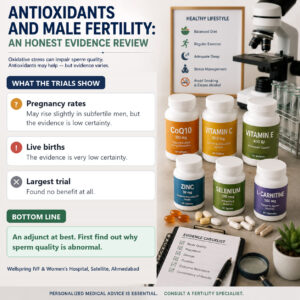
- The Clinical Evidence: In a randomised trial in women under 35 with poor ovarian reserve (Xu et al., 2018; 169 women analysed), pre-treatment with Coenzyme Q10 for 60 days before IVF-ICSI increased the number of eggs retrieved, the fertilisation rate and the number of high-quality embryos. Pregnancy and live birth rates tended to be higher but the difference was not statistically significant. A smaller trial in women aged 35 to 43 (Bentov et al., 2014) was stopped early and found no significant difference.
2. Myo-Inositol in Ovulatory Dysfunction and PCOS
- The Science: In women with PCOD and PCOS, hyperinsulinemia impairs intra-follicular inositol signaling, resulting in elevated oxidative stress and compromised oocyte maturation.
- The Clinical Evidence: As summarised on our page on PCOS treatment in Ahmedabad, supplementing with a 40:1 ratio of myo-inositol to D-chiro-inositol improves insulin sensitivity, restores physiological LH/FSH ratios, and significantly enhances mature metaphase II (MII) oocyte recovery during IVF.
3. Melatonin & Antioxidant Quenching
- The Science: The pre-ovulatory LH surge naturally generates high levels of reactive oxygen species (ROS) in follicular fluid. In pathologic states, excessive ROS damages oocyte cell membranes and induces spindle detachment.
- The Clinical Evidence: Clinical studies by Tamura and colleagues demonstrated that evening melatonin supplementation (3 mg) crosses into follicular fluid, quenching free radicals and reducing intra-follicular lipid peroxidation.
4. Correcting Ovarian Inflammation in Endometriosis
Women with endometriosis frequently exhibit altered follicular fluid containing elevated tumor necrosis factor-alpha (TNF-alpha) and interleukin-6. Minimizing systemic inflammation through antioxidant-rich Mediterranean dietary patterns and tailored medical suppression prior to stimulation protects developing oocyte cohorts from inflammatory degradation.
How Individualized IVF Stimulation and Blastocyst Culture Maximize Oocyte Competence
At Wellspring IVF & Women’s Hospital in Ahmedabad, Dr. Pranay Shah emphasizes that how a cycle is stimulated directly impacts egg quality:
- Avoiding Ovarian “Baking” with Excessive Gonadotropins: In patients with low AMH and diminished ovarian reserve, mega-doses of FSH (>300–450 IU/day) do not recruit extra eggs; they simply subject the few available follicles to excessive chemical stress. Standard stimulation injections are included in every tier of our transparent IVF pricing.
- Tailored Mild and DuoStim Protocols: Our dedicated low AMH IVF protocols utilize physiological stimulation, dual stimulation (DuoStim), and agonist triggers to rescue oocytes at their peak biological competence. Our page on IVF treatment in Ahmedabad explains where these protocols fit in the cycle.
- ISO Class 5 Cleanroom Protection: Once retrieved, oocytes have no protective skin or immune defenses. Senior Embryologist Divyesh Bhalodia handles all gametes inside VOC-filtered, low-oxygen (5% O₂) cleanroom workstations, ensuring temperature, pH, and osmolarity mimic the natural fallopian tube.
Frequently Asked Questions (FAQ)
Can a woman in her late 30s still improve her egg quality?
Yes, but with clear statistical realism. While chromosomal aneuploidy rates remain tied to maternal age, optimizing cytoplasmic health ensures that the euploid eggs she does produce have the mitochondrial energy necessary to fertilize, develop into blastocysts, and implant.
How long does it take to improve egg quality?
Because pre-antral follicles take approximately 85 to 90 days to reach the pre-ovulatory stage, lifestyle, dietary, and supplement modifications should be maintained consistently for at least 3 months prior to an IVF cycle or targeted conception attempt.
Are over-the-counter fertility supplement blends effective?
Most commercial over-the-counter “fertility blends” contain sub-therapeutic dosages of dozens of unverified ingredients. It is far more effective to take targeted, clinically verified single compounds (such as high-grade Ubiquinol CoQ10, Vitamin D3, and Myo-inositol) at therapeutic dosages under the supervision of your fertility specialist.
Scientific Citations & References
- Gougeon, A. (1986). Dynamics of follicular growth in the human: a model from preliminary data. Human Reproduction, 1(2), 81–87.
- Xu, Y., et al. (2018). Pretreatment with coenzyme Q10 improves ovarian response and embryo quality in low-prognosis young women with decreased ovarian reserve: a randomized controlled trial. Reproductive Biology and Endocrinology, 16(1), 29. PubMed
- Bentov, Y., et al. (2014). Coenzyme Q10 supplementation and oocyte aneuploidy in women undergoing IVF-ICSI treatment. Clinical Medicine Insights: Reproductive Health, 8, 31–36. PubMed
- Tamura, H., et al. (2014). Melatonin and female reproduction. Journal of Obstetrics and Gynaecology Research, 40(1), 1–11. PubMed
Where Can You Read More From Official Sources?
Independent guidance on fertility and age. Outcomes vary between patients.