
Published: 29 October 2026
Medically reviewed by Dr. Pranay Shah, MS (ObGy), Director & Chief Fertility Consultant, Wellspring IVF & Women’s Hospital, Ahmedabad
Last medically reviewed: 29 October 2026
When both partners carry beta-thalassaemia trait (also written beta-thalassemia), every pregnancy carries a one in four risk of a child with thalassaemia major. Preimplantation genetic testing for monogenic disorders (PGT-M) allows embryos created through IVF to be tested for the couple’s specific mutations before any pregnancy begins, so that only unaffected embryos are transferred. Section 25(1) of India’s ART (Regulation) Act, 2021 expressly permits embryo testing for known heritable disease, and prohibits it for anything else.
Gujarat has one of the most active haemoglobinopathy screening programmes in India, and one of the highest concentrations of at-risk communities. Many couples in this state discover that both of them are carriers only when a routine antenatal blood test is repeated, or when a first child is diagnosed. By then the reproductive options have narrowed considerably.
This article sets out what carrier status actually means, how it is confirmed, what the full range of options is for a carrier couple, exactly what has to happen before a PGT-M cycle can begin, what Indian law permits and forbids, and — importantly — what PGT-M cannot promise. It is written for couples in Gujarat who are trying to make this decision, and for the family members and referring doctors advising them.
How common is thalassaemia carrier status in Gujarat?
Beta-thalassaemia carrier frequency in India averages 3–4 per cent nationally, according to the Ministry of Health and Family Welfare’s Prevention and Control of Hemoglobinopathies in India guidelines. The same document estimates that India has roughly 42 million carriers of beta-thalassaemia trait and that about 10,000 to 15,000 babies with thalassaemia major are born every year.
The Gujarat picture is more specific, and more surprising, than the national average suggests. The largest published Gujarat screening dataset — an analysis of 317,539 people screened between 2004 and 2008 by Patel and colleagues in the National Journal of Community Medicine — found beta-thalassaemia trait in 1.95 per cent of those screened overall, which is below the national figure. Sickle cell trait, at 6.54 per cent, was more than three times commoner.
The overall average, however, conceals what actually matters clinically. Carrier frequency in Gujarat is highly concentrated by community and by district.
| Group | Beta-thalassaemia trait | Sickle cell trait |
|---|---|---|
| Gujarat overall (317,539 screened, 2004–2008) | 1.95% | 6.54% |
| Non-tribal areas | 2.18% | 1.1% |
| Tribal areas | 1.74% | 11.37% |
| Banaskantha district | 4.45% | 5.12% |
| Bhanusali community | 8.1% | — |
| Bhakta community | 7.93% | — |
| Lohana community | 6.5% | — |
| Rathva community | — | 18.65% |
| Gamit community | — | 17.64% |
| Tadvi community | — | 16.95% |
Two cautions about reading this table. It reports a screening-programme population rather than a random sample of Gujarat, so the figures describe who came forward to be screened. And it is a decade and a half old. Both limitations point the same way: a couple’s own test result matters far more than any community average, and no couple should assume they are low-risk because their community is not on this list.
Gujarat’s own prevention programme gives a sense of the scale of the effort. The Indian Red Cross Society’s Gujarat State Branch reports having screened over 24 lakh students through school and college programmes and approximately 7.87 lakh antenatal women between April 2010 and March 2022, among whom around 40,010 were identified as carriers of a haemoglobinopathy — a little over five in every hundred women tested. The programme reports having prevented more than 560 births of children with thalassaemia major to date.
A more recent national picture comes from a 2025 cross-sectional study in the Indian Journal of Medical Research covering 34,647 pregnant women across 36 districts in five states including Gujarat. Of the 33,270 women who completed screening, 6.8 per cent were carriers — 2.7 per cent beta-thalassaemia, 3.5 per cent sickle cell disease and 0.6 per cent other haemoglobinopathies. Partner testing was completed for 86.4 per cent, identifying 339 at-risk couples. That study calculated that one affected birth was prevented for every 787 families enrolled.
What happens genetically when both partners are carriers?
Beta-thalassaemia is inherited in an autosomal recessive pattern. A carrier — someone with beta-thalassaemia trait — has one altered copy of the beta-globin gene and one normal copy, and is generally healthy, often with a mild anaemia that is easily mistaken for iron deficiency.
Where both partners are carriers, the MoHFW guidelines state the arithmetic plainly: there is “a 25% risk in each pregnancy of giving birth to a child with disease state”, a “25% chance in every pregnancy of having a ‘normal’ child”, and a “50% chance in each pregnancy to give birth to a ‘carrier’ child”.
Three points about this that couples routinely get wrong:
- The risk resets with every pregnancy. Having one unaffected child does not “use up” the risk. Each conception is an independent one-in-four.
- A carrier child is not an affected child. Half the children of a carrier couple will be carriers themselves — healthy, but facing the same decision a generation later.
- It is not sex-linked. Boys and girls are affected equally, and the sex of the embryo or foetus is irrelevant to the risk. This matters legally as well as clinically, and is returned to below.
A child with thalassaemia major typically presents in the first year or two of life with severe anaemia and requires lifelong regular blood transfusions and iron chelation. The only established curative option is haematopoietic stem cell transplantation, which requires a matched donor and is not available to most families.
How do you find out whether you are a carrier?
Carrier detection is inexpensive and widely available, and it is the step that makes everything else possible. The pathway has three stages.
| Stage | Test | What it shows |
|---|---|---|
| 1. Initial screen | Complete blood count with red cell indices; NESTROFT (naked eye single tube red cell osmotic fragility test) in community settings | Reduced MCV and MCH raise suspicion. NESTROFT is reported by MoHFW as having 91–100% sensitivity and 85.47% specificity — a screening test, not a diagnosis |
| 2. Confirmation | High performance liquid chromatography (HPLC) for HbA2 | HbA2 of 4.0–8.0% indicates beta-thalassaemia trait. Values between 3.5% and 3.9% are described as equivocal and need further evaluation |
| 3. Characterisation | DNA analysis to identify the specific mutation in each partner | Screening for the six common Indian beta-thalassaemia mutations detects the defect in 85–90% of families; the remainder need extended testing |
Stage 3 is the one most often skipped, and for a couple considering PGT-M it is not optional. A test that looks for “thalassaemia” in general does not exist at the embryo level. PGT-M is built around the two specific mutations a particular couple carries, and if those mutations have not been identified in an accredited laboratory report, the test cannot be designed.
Iron deficiency anaemia can lower HbA2 and mask a carrier result. Where iron deficiency is present alongside a borderline HbA2, the sensible sequence is to correct the iron deficiency and repeat the test rather than accept a falsely reassuring number.
What are the options if both partners are thalassaemia carriers?
There is no single correct answer here, and the MoHFW guidance is explicit that genetic testing “should always be voluntary, respecting the autonomous decisions of the patients, and should be preceded by proper information in the form of non-directive genetic counseling”. The role of the clinician is to lay out the options accurately, not to steer.
| Option | How it works | Main considerations |
|---|---|---|
| Natural conception with prenatal diagnosis | Conceive naturally; test the foetus by chorionic villus sampling or amniocentesis; decide about the pregnancy based on the result | Lowest cost and no IVF. Requires facing a decision about an established pregnancy, potentially repeatedly, and depends on early booking |
| PGT-M with IVF | Create embryos through IVF, test each for the couple’s mutations, transfer only unaffected embryos | Avoids a decision about an ongoing pregnancy. Requires IVF with all that entails, a preparatory genetic workup, and there may be no unaffected embryo in a given cycle |
| Donor gametes | Use donor oocytes or donor semen from a non-carrier donor through a registered ART bank | Removes the genetic risk from one side. Involves the loss of a genetic link for one partner; governed by the ART Act’s donor framework |
| Adoption | Legal adoption | Listed by MoHFW as a recognised option for at-risk couples |
| Deciding not to have children | — | Also listed by MoHFW as a legitimate choice, and should be presented without pressure |
Two things are worth adding to that table. First, prenatal diagnosis and PGT-M are not competing philosophies; many couples who choose PGT-M are advised to have prenatal confirmation anyway, for reasons explained below. Second, the option a couple can realistically take often depends on when they are asked. A couple counselled before a pregnancy has all five options. A couple counselled at sixteen weeks has effectively one.
How does PGT-M prevent thalassaemia major?
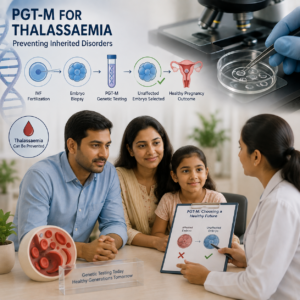
PGT-M prevents thalassaemia major by moving the diagnosis to a point before pregnancy begins. Embryos are created by IVF, allowed to develop to the blastocyst stage, and a small number of cells is biopsied from each. Those cells are tested against a test designed specifically for the mutations carried by that couple, and only embryos shown to be unaffected are considered for transfer.
The result is that a pregnancy, when it starts, has already been shown not to carry thalassaemia major. That is a materially different experience from conceiving and then testing, and for many couples — particularly those who have already been through a prenatal diagnosis — it is the reason they choose this route.
PGT-M is one of two distinct forms of genetic testing of embryos, and the distinction matters. PGT-A screens embryos for the wrong number of chromosomes, which is a random event and not inherited. PGT-M tests for a specific inherited gene change that the couple is known to carry. They answer different questions, and a couple at risk of thalassaemia needs the second one.
What has to happen before a PGT-M cycle can start
PGT-M is not a test that is added to an IVF cycle at the last minute. The preparatory work takes weeks to months and must be complete before stimulation begins. The sequence is as follows.
- Confirm carrier status in both partners by HPLC, and obtain the DNA report identifying each partner’s specific mutation. ESHRE’s good practice recommendations state that “the original molecular genetic reports including the description of identified variants together with the appropriate gene reference sequence are obtained from an accredited laboratory”.
- Genetic counselling. ESHRE recommends that “genetic counselling should be provided by a qualified clinical geneticist or genetic counsellor”, covering inheritance, recurrence risk, the limitations of the test and the possibility of misdiagnosis, before treatment begins.
- Preclinical laboratory workup. The laboratory must “perform a preclinical work-up to assess PGT-M feasibility, identify informative genetic markers, establish parental haplotypes (when possible)”. In practice this often requires DNA samples not only from the couple but from an affected child or other relatives, so that the high-risk and low-risk chromosome versions can be told apart reliably.
- The IVF cycle itself. Ovarian stimulation and egg collection proceed much as in any cycle; couples unfamiliar with the process may find it useful to read how an IVF cycle is planned before starting.
- Blastocyst culture and biopsy. Embryos are grown to the blastocyst stage and a few trophectoderm cells are removed for testing.
- Freeze and wait. Testing takes longer than the embryo can safely remain in culture. As ESHRE notes, trophectoderm biopsy “often leaves insufficient time for fresh embryo transfer”, which “is overcome by cryopreservation and embryo transfer in a deferred cycle”. A PGT-M cycle therefore almost always ends in a frozen embryo transfer in a later month, not a fresh transfer.
- Transfer of an unaffected embryo, followed by the option of confirmatory prenatal testing in the resulting pregnancy.
The single most common reason a PGT-M plan stalls is step 1: the couple knows they are carriers but has no mutation-level report, and the samples needed to build the test are not available. Anyone considering this route should get the DNA characterisation done early, before any cycle is booked.
What does Indian law permit — and prohibit?
Embryo testing in India sits inside a clear statutory framework, and the boundaries are drawn tightly. Three provisions of the Assisted Reproductive Technology (Regulation) Act, 2021 matter most.
Section 25(1) states: “The Pre-implantation Genetic testing shall be used to screen the human embryo for known, pre-existing, heritable or genetic diseases only.”
That single sentence does two jobs. It provides the affirmative legal basis for PGT-M in a thalassaemia carrier couple — a known, pre-existing, heritable disease is exactly what the provision contemplates. And by the word “only” it excludes every other purpose.
Section 26 deals with sex selection, and its terms are absolute. Section 26(1) provides that, subject to the Pre-conception and Pre-natal Diagnostic Techniques (Prohibition of Sex Selection) Act, 1994, “the clinic shall not offer to provide a couple or woman with a child of a pre-determined sex”. Section 26(2) prohibits any act “at any stage, to determine the sex of the child to be born through the process of assisted reproductive technology”. Section 26(3) prohibits any person from providing, prescribing or administering anything “that shall identify the sex of an in-vitro embryo, except to diagnose, prevent or treat a sex-linked disorder or disease”.
The narrow exception in section 26(3) applies only to genuinely sex-linked conditions such as Duchenne muscular dystrophy or haemophilia, where the disorder itself tracks with sex. Beta-thalassaemia is autosomal recessive and affects boys and girls equally, so the exception has no application to it whatsoever. In a thalassaemia PGT-M cycle the sex of an embryo is neither relevant nor reported, and no clinic may agree to disclose it. Advertising sex-selective services carries imprisonment of five to ten years and a fine of ten to twenty-five lakh rupees under section 32.
Section 24(b) limits the number of embryos: “not more than three oocytes or embryos may be placed in the uterus of a woman during the treatment cycle”. In a PGT-M cycle this rarely binds, because the number of unaffected embryos available is usually the limiting factor, and current international guidance favours transferring one embryo at a time in any case.
| Permitted | Prohibited |
|---|---|
| Testing embryos for a known, pre-existing, heritable or genetic disease the couple is documented to carry — section 25(1) | Testing or reporting the sex of an in-vitro embryo, other than to diagnose, prevent or treat a genuinely sex-linked disorder — section 26(3) |
| Transfer of embryos shown to be unaffected | Offering to provide a couple with a child of a predetermined sex — section 26(1) |
| Donation of an affected embryo to an approved research laboratory, with the couple’s approval — section 25(2) | Any testing for non-disease traits |
| Up to three embryos placed in the uterus in a treatment cycle — section 24(b) | Advertising sex-selective services — section 32, with imprisonment and fine |
What PGT-M cannot promise
This is the section a couple should read twice, because it is the part that is most often left out.
There may be no unaffected embryo to transfer. This is the commonest disappointment. In a large multicentre series of 342 couples undergoing PGT-M for thalassaemia published in the Journal of Assisted Reproduction and Genetics in 2024, 51 couples had no transferable embryo at the end of the process. ESHRE’s recommendations require that couples be counselled in advance about “the possibility of having no embryos for transfer if all the embryos are morphologically and/or genetically unsuitable”.
The test is highly accurate but not infallible. The main technical risk is allele drop-out, described by ESHRE as a phenomenon “in which one of two alleles in a heterozygous sample is amplified while the other remains undetected”, and which “may have a severe impact on the reliability of the diagnostic result”. Modern haplotype-based testing is designed specifically to guard against this, and in the 2024 series the haplotype was successfully established in 99.4 per cent of couples.
Confirmatory prenatal testing is still offered. ESHRE’s position is that “it is acceptable to indicate in the report the need for prenatal testing to confirm the result in case of pregnancy”, and an Indian review of PGT-M genetic counselling by Parikh and colleagues places “emphasis on the need of post-conception testing” by chorionic villus sampling or amniocentesis. In the 2024 multicentre series, prenatal confirmation was concordant with the PGT-M result in all 99 pregnancies tested — reassuring, but the confirmation was still done.
PGT-M addresses one condition. A test designed for a couple’s beta-globin mutations says nothing about any other genetic or chromosomal condition, and nothing about the many things that determine whether a pregnancy continues normally.
IVF success still depends on everything else. Age, ovarian reserve, embryo development and endometrial receptivity all apply exactly as they would in any cycle. PGT-M changes which embryos are suitable for transfer; it does not change how likely a transfer is to work.
What if you already have a child with thalassaemia major?
This situation raises an additional question that comes up often in Gujarat, where families frequently learn their carrier status through an affected first child. Haematopoietic stem cell transplantation can cure thalassaemia major, but it needs a matched donor, and a sibling is the most likely source. It is technically possible to combine PGT-M with HLA typing, so that an embryo is selected which is both free of thalassaemia and tissue-matched to the existing child.
Internationally, ESHRE regards HLA-matched embryo selection as acceptable “when all other clinical options have been exhausted” for couples with an affected child who could benefit from stem cell transplantation. It has been done in India: a case reported in the Journal of Human Reproductive Sciences in 2019 described the birth of a 10/10 HLA-matched sibling following PGT-M with HLA matching for a child with beta-thalassaemia major.
The legal position, however, needs care. Section 25(1) authorises preimplantation genetic testing to screen an embryo “for known, pre-existing, heritable or genetic diseases only”, and HLA typing is not a test for disease in the embryo being tested. The Act does not expressly address HLA matching, and section 25(3) leaves the National Board free to set further conditions. Couples in this position should not assume the answer either way: it needs case-specific legal and ethical advice alongside the clinical assessment, and it should be raised at the first consultation rather than mid-cycle.
If you are already pregnant
Carrier couples who discover their status during a pregnancy are not out of options, but the timings are tight and depend on gestation.
| Test | Timing | Notes |
|---|---|---|
| Chorionic villus sampling | 10–12 weeks of gestation | The earliest option, and the reason early booking matters |
| Amniocentesis | After 16 weeks | For patients who present later |
| Fetal blood sampling (cordocentesis) | 18–20 weeks | Mid-trimester option |
Where an affected foetus is diagnosed, the legal framework is the Medical Termination of Pregnancy Act as amended in 2021. Termination is permitted up to twenty weeks on the opinion of one registered medical practitioner, and between twenty and twenty-four weeks for prescribed categories of women on the opinion of two, where there is “a substantial risk that if the child were born, it would suffer from any serious physical or mental abnormality”. Beyond twenty-four weeks, section 3(2B) provides that the gestational limits “shall not apply” where the termination “is necessitated by the diagnosis of any of the substantial foetal abnormalities diagnosed by a Medical Board”.
Whether to act on such a diagnosis is entirely the couple’s decision. In the 2025 Indian Journal of Medical Research series, 65 affected foetuses were identified and 44 families — 68 per cent — chose to end the pregnancy, which means roughly a third did not. Both decisions are made by families every year and neither is the clinician’s to make.
What this means for a family in Gujarat, and when to see a specialist
The practical conclusions are short.
- If either family has a history of thalassaemia, transfusion-dependent anaemia or a known carrier, have an HPLC done — for both partners, not only the woman.
- If you are a carrier, have your partner tested before conceiving rather than at the first antenatal visit.
- If both of you are carriers, have the mutation identified by DNA analysis in an accredited laboratory. This is what makes every subsequent option, including PGT-M, possible.
- Ask for genetic counselling before deciding anything. All five reproductive options are legitimate and the decision is yours.
- If you already have a child with thalassaemia major, raise HLA matching at the first consultation, so the legal and clinical positions can be settled before a cycle is planned.
Referral to a fertility specialist is appropriate as soon as both partners are known to be carriers and a pregnancy is being planned — not after a pregnancy has started, and not after a prenatal diagnosis. The preparatory workup takes time that an ongoing pregnancy does not allow, and a couple who arrives early has the widest set of options. It is equally appropriate where a couple has already been through prenatal diagnosis and does not wish to repeat it, where there is an existing affected child, or where subfertility is present alongside carrier status. Wellspring IVF & Women’s Hospital is an ART-registered clinic in Ahmedabad, Gujarat, led by Dr. Pranay Shah, MS (ObGy).
Frequently asked questions
What are the options if both partners are thalassaemia carriers?
There are five recognised options: natural conception with prenatal diagnosis by CVS or amniocentesis; IVF with PGT-M so that only unaffected embryos are transferred; the use of donor gametes from a non-carrier donor through a registered ART bank; adoption; and choosing not to have children. Indian national guidelines require that these be presented through non-directive counselling, with the decision left to the couple.
Can PGT-M guarantee an unaffected baby?
No. PGT-M substantially reduces the risk by testing embryos before transfer, but no genetic test is infallible, allele drop-out is a recognised technical risk, and confirmatory prenatal testing by CVS or amniocentesis is still offered in the resulting pregnancy. A cycle may also produce no unaffected embryo to transfer.
How common is thalassaemia carrier status in Gujarat?
The largest published Gujarat screening series found beta-thalassaemia trait in 1.95 per cent of 317,539 people screened, below the national average of 3–4 per cent, but with much higher frequencies in specific communities — 8.1 per cent among Bhanusali and 6.5 per cent among Lohana individuals in that dataset — and 4.45 per cent in Banaskantha district. Sickle cell trait is commoner overall in Gujarat, at 6.54 per cent, and reaches 11.37 per cent in tribal areas.
Is PGT-M legal in India?
Yes, for its intended purpose. Section 25(1) of the ART (Regulation) Act, 2021 provides that preimplantation genetic testing “shall be used to screen the human embryo for known, pre-existing, heritable or genetic diseases only”. Testing or disclosing the sex of an embryo is separately prohibited by section 26, except to diagnose, prevent or treat a genuinely sex-linked disorder — which thalassaemia is not.
Do I need to know my exact mutation before PGT-M?
Yes. The test is built around the specific variants each partner carries, and ESHRE requires that the original molecular genetic reports come from an accredited laboratory. Screening for the six common Indian beta-thalassaemia mutations identifies the defect in 85–90 per cent of families; the remainder need extended analysis. Without this step the laboratory cannot design the test.
Will a PGT-M cycle end with a fresh embryo transfer?
Usually not. Testing takes longer than the embryos can remain in culture, so embryos are frozen while the results are awaited and the transfer takes place in a later, prepared cycle.
The takeaway
Thalassaemia major is one of the few serious inherited conditions in India that is almost entirely preventable, and the step that prevents it is a blood test that costs very little. What limits prevention in Gujarat is not technology; it is how late in the process couples are usually tested.
PGT-M is a genuine option for carrier couples, it is expressly lawful for this purpose, and it allows a pregnancy to begin already knowing the embryo is unaffected. It is not a guarantee, it does not always produce a transferable embryo, and it requires preparation that cannot be compressed. Used early and counselled honestly, it gives carrier couples in Gujarat a real choice that their parents’ generation did not have.
Couples who know they are carriers, or who have a family history of thalassaemia and want to be tested before planning a pregnancy, can discuss their situation with a fertility specialist at Wellspring IVF & Women’s Hospital, Ahmedabad. Call or WhatsApp +91 9099946050. OPD hours are Monday to Saturday, 10:00 AM to 4:00 PM.
References
- Ministry of Health & Family Welfare, National Health Mission, Government of India. Prevention and Control of Hemoglobinopathies in India — Thalassemias, Sickle Cell Disease and other Variant Hemoglobins, 2016. https://nhm.gov.in/images/pdf/programmes/RBSK/Resource_Documents/
- Patel AP, Naik MR, Shah NM, Sharma NP, Parmar PH. Prevalence of common hemoglobinopathies in Gujarat: an analysis of a large population screening program. National Journal of Community Medicine, 2012;3(1):112–116. https://njcmindia.com/index.php/file/article/view/1658
- Agarwal RK, Dhanya R, Parmar L, et al. Prenatal hemoglobinopathy screening & prevention in India: a cross-sectional study. Indian Journal of Medical Research, 2025;161(5):441–448. doi:10.25259/IJMR_1003_2024. https://ijmr.org.in/
- Indian Red Cross Society, Gujarat State Branch. Thalassemia & Sickle Cell Control Programme. https://redcrossgujarat.org/thalassemia/
- Government of India. The Assisted Reproductive Technology (Regulation) Act, 2021 (Act No. 42 of 2021), sections 24, 25 and 26. https://www.indiacode.nic.in/bitstream/123456789/17031/1/aA2021-42.pdf
- Government of India. The Medical Termination of Pregnancy (Amendment) Act, 2021 (Act No. 8 of 2021), section 3. https://nhm.hp.gov.in/storage/app/media/uploaded-files/mtp-amendment-act2021.pdf
- Carvalho F, Moutou C, Dimitriadou E, et al.; ESHRE PGT-M Working Group. ESHRE PGT Consortium good practice recommendations for the detection of monogenic disorders. Human Reproduction Open, 2020;2020(3):hoaa018. https://academic.oup.com/hropen/article/2020/3/hoaa018/5848301
- De Rycke M, Goossens V, Kokkali G, et al. ESHRE PGT Consortium good practice recommendations for the organisation of PGT. Human Reproduction Open, 2020;2020(3):hoaa021. https://academic.oup.com/hropen/article/2020/3/hoaa021/5848302
- Ren Z, Huang P, Wang Y, et al. Technically feasible solutions to challenges in preimplantation genetic testing for thalassemia: experiences of multiple centers between 2019 and 2022. Journal of Assisted Reproduction and Genetics, 2024;41(11):3225–3235. https://link.springer.com/article/10.1007/s10815-024-03240-4
- Parikh F, Athalye A, Madon P, et al. Genetic counseling for pre-implantation genetic testing of monogenic disorders (PGT-M). Frontiers in Reproductive Health, 2023;5:1213546. https://www.frontiersin.org/journals/reproductive-health/articles/10.3389/frph.2023.1213546/full
- Banker JM, Arora P, Khajuria R, Banker M. India’s first child using PGT-M, PGT-A and HLA matching for helping a sibling having beta-thalassemia major. Journal of Human Reproductive Sciences, 2019;12(4):341–344. doi:10.4103/jhrs.JHRS_50_19. https://doaj.org/article/87dcbd90ebd84dba8b3778a4f37fc6a3