
Published: Jun 11, 2026 | Medically reviewed by: Dr. Pranay Shah, MS (Obs. & Gyn.), GMC Reg. No. G-18311 — Founder, Director & Chief Fertility Consultant, Wellspring IVF & Women’s Hospital, Ahmedabad | Last medically reviewed: 25 October 2026
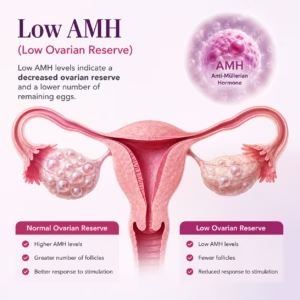
A woman is born with a finite, non-renewable lifetime pool of primordial follicles that naturally depletes over time—meaning true biological ovarian reserve cannot be increased naturally by any food, supplement, or herbal medicine. While Anti-Müllerian Hormone (AMH) blood test numbers may temporarily fluctuate by 10% to 25% due to assay variations, resolving severe Vitamin D deficiency, or discontinuing long-term oral contraceptive pills, these changes reflect altered hormone secretion from existing pre-antral follicles, not the creation of new eggs.
When a woman receives a low Anti-Müllerian Hormone (AMH) test result, the psychological shock is often immediate. Almost every patient instinctively searches online for ways to “boost” or “reverse” her low AMH. Search engines and social media platforms are crowded with commercial blogs claiming that specific ayurvedic herbs, wheatgrass juices, fertility yoga poses, or expensive supplement powders will “raise your AMH from 0.5 to 2.5 ng/mL in 60 days.”
As a practicing reproductive endocrinologist, my responsibility is to tell you the unvarnished scientific truth: no medical treatment, diet, or supplement on earth can create new eggs in your ovaries. Selling false promises of “AMH reversal” wastes the most precious commodity a woman with low reserve has: time.
At Wellspring IVF & Women’s Hospital, our fertility clinic in Ahmedabad, we help women understand the biology behind their numbers without panic. Led by Dr. Pranay Shah, this guide explains what AMH actually measures, why your lab numbers can naturally fluctuate, why a low AMH does not mean you cannot conceive naturally, and how to read your reports with clinical clarity.
Ovarian Biology 101: Where Does AMH Actually Come From?
To understand why AMH cannot be “increased,” we must examine where this hormone originates in the body:
- The Finite Primordial Pool: A female fetus develops roughly 6 to 7 million eggs in the womb. By birth, that number drops to approximately 1 to 2 million, and by puberty, roughly 300,000 to 400,000 primordial follicles remain. These dormant primordial follicles do not secrete AMH.
- The Pre-Antral & Small Antral Secretion Factory: Every month, a cohort of dormant follicles wakes up and enters an initial 90-to-120-day growth phase. The granulosa cells lining these microscopic pre-antral and small antral follicles (measuring 2 to 8 mm) secrete Anti-Müllerian Hormone directly into your bloodstream.
- What AMH Actually Reflects: The concentration of AMH circulating in your blood is simply proportional to the number of small antral follicles currently growing in that 90-day window. It acts as a mirror reflecting the size of your remaining dormant bank. Once a follicle grows larger than 9 to 10 mm under FSH stimulation, its granulosa cells stop producing AMH.
Because the human ovary cannot perform neo-oogenesis (the creation of new germ cells from stem cells under physiological conditions), you cannot add new primordial follicles to your bank.
Real Biological Reserve vs. Lab Value Fluctuations: Why Your Numbers Change
Patients frequently tell us: “Doctor, my AMH was 0.7 ng/mL three months ago, but today another lab reported 1.1 ng/mL! Did my reserve increase?”
While your true biological pool of eggs did not increase, circulating blood AMH levels can fluctuate by 0.2 to 0.5 ng/mL due to four scientifically documented physiological and analytical factors:
Factor Influencing AMH | Biological Mechanism | Impact on AMH Lab Value | Does True Egg Count Change? |
|---|---|---|---|
Severe Vitamin D3 Deficiency | The promoter region of the human AMH gene contains a Vitamin D Response Element (VDRE). Severe Vitamin D deficiency (<10–12 ng/mL) downregulates AMH gene transcription in granulosa cells (PMC7352921). | Correcting severe deficiency with high-dose cholecalciferol can produce an apparent 10% to 20% rise in circulating AMH. | No. Granulosa cells simply secrete more hormone per follicle; no new eggs were created. |
Discontinuing Oral Contraceptive Pills (OCP) | Long-term use of combined oral birth control pills or hormonal IUDs suppresses pituitary LH and FSH, temporarily arresting antral follicular recruitment. | AMH levels tested while on OCPs can be artificially suppressed by 25% to 30%. Testing 2 to 3 months after stopping OCPs reveals your true baseline. | No. The dormant pool was unchanged; follicles simply resumed normal recruitment. |
Laboratory Assay Platform Discrepancies | Different laboratory analyzers use different antibody targets (e.g., Beckman Coulter Access AMH vs. Roche Elecsys automated assay vs. manual ELISA). | The exact same blood sample sent to two different laboratories can report values differing by 0.2 to 0.4 ng/mL due to calibration curves. | No. Purely an analytical instrument difference. |
Active Heavy Tobacco Smoking | Polycyclic aromatic hydrocarbons in tobacco smoke accelerate follicular apoptosis and impair granulosa cell viability. | Active smokers show lower age-matched AMH values, which may stabilize slightly after 3 to 6 months of cessation. | No. Stopping smoking halts accelerated loss, but does not recover lost follicles. |
The Biggest Myth: “Low AMH Means You Cannot Get Pregnant Naturally”
The single most damaging myth in modern fertility care is equating low AMH with absolute infertility. The American Society for Reproductive Medicine (ASRM) Practice Committee Guidance (2020) and a landmark multicenter study published in JAMA (Steiner et al., $n=750$) clearly established:In women attempting natural conception, biomarkers of ovarian reserve (low AMH or high FSH) do NOT predict the probability of getting pregnant in any given month.
Why is this true?
- Natural conception requires only one single, healthy, mature egg to ovulate each month.
- A 29-year-old woman with an AMH of 0.6 ng/mL still ovulates one high-quality, chromosomally competent egg every month, and her chance of natural conception within 6 to 12 months is statistically comparable to a 29-year-old with an AMH of 3.0 ng/mL.
- AMH predicts quantity in an IVF laboratory stimulation (whether you will retrieve 3 eggs or 15 eggs); it does not predict natural ovulatory competence or egg quality.
Age vs. AMH: Understanding the Hierarchy of Ovarian Reserve
When evaluating your chances of a successful pregnancy, female age is exponentially more important than your AMH number. To put this into perspective, explore our clinical guide on what your AMH level means for your age:
- Scenario A: A 29-year-old woman with an AMH of 0.5 ng/mL: She has a low quantity of eggs, but approximately 70% of her remaining eggs are chromosomally normal (euploid). If she undergoes IVF, she may retrieve only 4 eggs, but 2 or 3 of them will develop into robust, euploid Day 5 blastocysts, giving her a high live-birth probability.
- Scenario B: A 42-year-old woman with a “high” AMH of 2.8 ng/mL (due to PCOS): She has abundant egg quantity, but due to age-related meiotic nondisjunction, roughly 80% of her eggs are chromosomally aneuploid. She may retrieve 16 eggs, but only 1 or 2 will be genetically normal.
Never let anyone convince you that an AMH number alone defines your fertility. Age dictates quality; AMH dictates quantity. Age-related chromosome changes cannot be reversed, but you can read what actually helps egg quality.
If You Cannot Increase AMH, What SHOULD You Do?
If you have been diagnosed with low AMH and diminished ovarian reserve, the most productive clinical response is taking proactive, evidence-based action rather than chasing miracle cures:
- Protect Egg Quality During the 90-Day Recruitment Window: While you cannot increase quantity, you can optimize the metabolic health of the eggs currently growing. Supplementing with CoQ10 (Ubiquinol 200–400 mg/day), correcting Vitamin D deficiency, taking active folate, and following an anti-inflammatory Mediterranean dietary framework protects mitochondrial ATP production.
- Audit Uterine and Sperm Factors: Ensure that you are not losing precious time to an undiagnosed male factor or intrauterine cavity polyps. A comprehensive semen analysis and diagnostic hysteroscopy ensure the environment is optimal.
- If Pursuing IVF, Choose a Specialized Low-Reserve Protocol: Do not undergo standard high-dose stimulation protocols that yield poor results. At Wellspring IVF, our individualized IVF protocols for low AMH utilize Dual Stimulation (DuoStim) and embryo banking to maximize your self-egg cumulative success.
Frequently Asked Questions
Can ashwagandha, shatavari, or royal jelly increase my AMH levels?
No. There is no rigorous, placebo-controlled human clinical trial demonstrating that any herbal formulation can generate new oocytes or permanently raise biological AMH. While some herbs have mild adaptogenic or antioxidant properties, they do not alter the fundamental ovarian follicular pool.
How often should I re-test my AMH level?
We advise against testing AMH every few weeks. Because AMH reflects a slow, gradual biological decline over years, testing more frequently than once every 6 to 12 months causes unnecessary anxiety and merely captures routine laboratory assay noise.
Can ovarian PRP (Platelet-Rich Plasma) reverse low AMH?
Autologous intraovarian PRP is an experimental procedure currently under clinical investigation. While preliminary studies suggest it may temporarily improve paracrine signalling in dormant pre-antral follicles in a subset of women, it does not “create” new eggs and should never be marketed as a guaranteed cure for low reserve.
I am 32 with an AMH of 0.8 ng/mL and regular periods. How long should we try naturally before seeking IVF?
If you have been trying for 6 months without success—or if your partner has borderline semen parameters—scheduling a comprehensive fertility assessment is advisable. Low AMH narrows your biological runway; identifying any secondary roadblocks early ensures you do not waste years on unassisted attempts.
Evidence-Based Fertility Guidance in Ahmedabad
Navigating a low AMH diagnosis requires clinical honesty, compassionate guidance, and modern protocol design. To discuss your ovarian reserve reports and personalized family-building options with Dr. Pranay Shah, book a consultation at Wellspring IVF & Women’s Hospital, Ahmedabad.
- Hospital Address: Titanium City Center Mall, 440, 100 Feet Anandnagar Road, near Sachin Tower, Satellite, Ahmedabad, Gujarat 380015 (Registered Level 2 ART Clinic No. GS/AHD/024)
- Appointments & WhatsApp: +91 90999 46050
- OPD Timings: Monday to Saturday, 10:00 AM to 4:00 PM
References
- Practice Committee of the American Society for Reproductive Medicine. Testing and interpreting measures of ovarian reserve: a committee opinion. Fertility and Sterility. 2020;114(6):1151–1157.
- Steiner AZ, Pritchard D, Stanczyk FZ, Kesner JS, Meadows JW, Herring AH, et al. Association Between Biomarkers of Ovarian Reserve and Infertility Among Older Women of Reproductive Age. JAMA. 2017;318(14):1367–1376.
- The Association between Vitamin D and Anti-Müllerian Hormone: A Systematic Review. Nutrients / PMC7352921. 2020;12(6):1567.
- Anti-Müllerian Hormone and Ovarian Reserve: Update on Assessing and Interpreting Serum AMH. Journal of Clinical Endocrinology & Metabolism / PMC7486884. 2020;105(12):dgaa513.
- Iliodromiti S, Kelsey TW, Wu O, Anderson RA, Nelson SM. The predictive accuracy of anti-Müllerian hormone for live birth after assisted conception: a systematic review and meta-analysis of the literature. Human Reproduction Update. 2014;20(4):560–570.
- Pretreatment AMH–AFC stratification of poor-ovarian-response risk in assisted reproductive technology. Frontiers in Endocrinology. 2026;17:1968836.