

Published: 29 September 2026
Medically reviewed by Dr. Pranay Shah, MS (ObGy), Director & Chief Fertility Consultant, Wellspring IVF & Women’s Hospital, Ahmedabad
Last medically reviewed: 29 September 2026
After two or more pregnancy losses, the evaluation supported by current guidelines is short: antiphospholipid antibody testing, thyroid function with TPO antibodies, an assessment of the shape and cavity of the uterus, and — decided case by case — parental karyotyping and genetic analysis of the pregnancy tissue. Most of the large commercial “recurrent miscarriage panels” are not recommended by either ESHRE or ASRM.
If you have had two or three losses, you have almost certainly been offered a long list of tests. Somewhere on that list there is usually an NK cell assay, a thrombophilia panel, an MTHFR genotype, and a set of immune markers with unfamiliar names. The list is expensive, it takes weeks, and it carries an unspoken promise: that somewhere inside it is the answer.
The honest position is narrower and more useful. Two international guideline groups — the European Society of Human Reproduction and Embryology (ESHRE) and the American Society for Reproductive Medicine (ASRM) — have both reviewed this literature systematically, and both arrive at a short recommended evaluation and a long list of tests they specifically advise against. This article sets out both lists, says where the two guidelines genuinely disagree, and explains what to do when every recommended test comes back normal.
It is written for couples who have already had a loss. If you are looking for an explanation of why miscarriage happens at all, the causes and symptoms of miscarriage are covered separately.
How many miscarriages before investigation is recommended?
Two. Both guidelines now use two or more losses as the threshold at which evaluation becomes appropriate, rather than the older three-loss rule. The ESHRE guideline update published in Human Reproduction Open states that a diagnosis of recurrent pregnancy loss “could be considered after the loss of two or more pregnancies”, and specifically recommends screening for antiphospholipid antibodies after two losses. The ASRM 2026 committee opinion defines recurrent pregnancy loss as the spontaneous loss of two or more pregnancies, excluding confirmed molar and ectopic pregnancies.
Two details in the ASRM definition matter in practice. First, a pregnancy confirmed only by a urine or blood hCG test counts — biochemical losses are included. Second, the losses do not have to be consecutive. Couples are frequently told that an early positive test that never became a scan “does not count”. Under the current definition, it does.
Earlier evaluation is reasonable in specific circumstances: a loss in the second trimester, a loss of a pregnancy in which a fetal heartbeat had already been seen, a known chromosomal rearrangement in either partner, or advancing maternal age where waiting for a third loss has a real cost in time.
What tests are actually recommended after recurrent miscarriage?
A structured recurrent miscarriage evaluation is built from a small number of investigations, each of which can change what happens next. The table below gives the recommended core and the strength each guideline assigns to it.
Table 1 — The guideline-recommended evaluation after two or more losses
| Investigation | What it looks for | ESHRE (2022 update) | ASRM (2026) |
| Antiphospholipid antibodies — luyus anticoagulant, anticardiolipin IgG and IgM | Obstetric antiphospholipid syndrome, a treatable clotting disorder | Recommended after two losses (strong). Anti-β2 glycoprotein I may be added | Recommended for those meeting clinical criteria |
| Thyroid function — TSH, with TPO antibodies | Overt or subclinical thyroid dysfunction and thyroid autoimmunity | TSH and TPO antibodies recommended (strong); abnormal TSH followed by T4 | TSH recommended; treat if TSH is above 4 mIU/L. Does not recommend TPO antibody screening |
| Assessment of uterine shape and cavity | Septate uterus, other congenital anomalies, polyps, fibroids distorting the cavity, adhesions | All women should have an assessment of uterine anatomy (strong); transvaginal 3D ultrasound preferred; sonohysterography more accurate than HSG | Cavity evaluation offered to all women — HSG, saline sonogram or hysteroscopy |
| 2D ultrasound for adenomyosis | Adenomyosis as a contributing factor | Could be performed in all women with RPL (conditional; new in the 2022 update) | Not specifically recommended |
| Genetic analysis of the pregnancy tissue | Whether the loss was chromosomally abnormal, and whether an unbalanced rearrangement is present | Not routine, but may be performed for explanatory purposes (conditional); array-CGH is the preferred method (strong) | Array-based analysis of miscarriage tissue recommended as the first step |
| Parental karyotyping | A balanced translocation or inversion in either partner | After individual assessment of risk, for diagnostic or explanatory purposes (conditional) | When an unbalanced translocation is found in the tissue, or when tissue testing is not available |
| HbA1c | Undiagnosed or poorly controlled diabetes | Routine assessment of fasting glucose and insulin is not recommended (strong) | Recommended where risk factors are present |
Antiphospholipid antibodies: the one blood test that most often changes management
Obstetric antiphospholipid syndrome is the single most important treatable cause identified by the recommended panel, which is why it is the one test both guidelines place at two losses rather than three. The distinction that matters clinically is between a positive antibody result and a diagnosis of the syndrome. A single positive titre is not a diagnosis. Confirmation requires a repeat test at an interval, interpreted alongside the clinical history, because transient positivity after infection is common.
This matters because the treatment that follows a genuine diagnosis — low-dose aspirin with heparin — is exactly the treatment that both guidelines advise against giving to women without the syndrome. ESHRE is explicit: heparin or low-dose aspirin are not recommended in unexplained recurrent pregnancy loss because the evidence shows they do not improve live birth rate. A loosely interpreted antibody result is therefore not a harmless piece of information; it is the doorway to months of unnecessary injections.
Thyroid testing: where the two guidelines genuinely disagree
Both guidelines recommend measuring TSH. They part company on thyroid peroxidase (TPO) antibodies. ESHRE recommends TPO antibody testing as part of the core screen; the ASRM 2026 opinion states that it does not recommend screening for thyroid antibodies. Neither position is careless — the disagreement reflects trials of levothyroxine in euthyroid, TPO-antibody-positive women that did not show the benefit that earlier observational data had suggested.
What this means for a patient in India is straightforward: if TPO antibodies are measured and are positive while TSH is normal, that finding on its own is not an indication for levothyroxine. It is a reason for thyroid function to be monitored during pregnancy. Anyone offering thyroid treatment on the strength of an antibody result alone should be asked which guideline they are following.
Assessing the uterus: the technique matters as much as the test
ESHRE makes uterine assessment a strong recommendation for every woman with recurrent loss, and then makes a second, quieter point that is easy to miss: transvaginal 3D ultrasound is the preferred technique because it can reliably distinguish a septate uterus from a bicorporeal uterus. That distinction is the entire clinical question, because one is potentially correctable at hysteroscopy and the other is not. A conventional 2D scan reported as “bicornuate uterus” is not a sufficient basis for surgery.
Sonohysterography — saline infused into the cavity during ultrasound — is more accurate than hysterosalpingography for uterine malformations. If you are being sent for an HSG primarily to look at the cavity rather than the tubes, it is fair to ask why.
Genetic testing: of the pregnancy first, then of the parents
This is the second real divergence between the guidelines, and the more consequential one. ASRM 2026 puts array-based analysis of the miscarriage tissue first in the sequence: establish whether the loss was chromosomally abnormal, and let that result decide whether parental karyotyping is needed at all. ESHRE treats tissue analysis as optional and explanatory, while allowing parental karyotyping after an individual assessment of risk.
In day-to-day Indian practice the ASRM sequence is usually the more efficient one, for a practical reason: parental karyotyping performed first will be normal in the large majority of couples, and a normal result answers nothing, whereas a chromosomally abnormal loss provides an explanation immediately. The constraint is logistical — tissue has to be collected and transported appropriately at the time of the loss, which requires the possibility to have been discussed before it happens.
Where a balanced translocation or inversion is confirmed in one partner, the conversation changes. That is the setting in which genetic testing of embryos for structural rearrangements has a defined role, and it can only be performed within an in vitro fertilisation cycle, since embryos must be created and biopsied in the laboratory. This is a distinct indication from testing embryos for random chromosomal errors, which is discussed further below.
Which recurrent miscarriage tests have no evidence behind them?
This is the half of the subject that commercial panels do not print. Both guidelines list, explicitly, the investigations that should not form part of a routine evaluation. They are grouped below with the claim usually made for each.
Table 2 — Commonly sold tests that current guidelines do not recommend
| Test | What is usually claimed | What the guidelines actually say |
| Hereditary thrombophilia panel — Factor V Leiden, prothrombin gene, protein C and S, antithrombin | “Your blood is too thick and is clotting off the pregnancy” | ESHRE suggests not screening except within research, or in women with additional risk factors (conditional). ASRM: routine testing for thrombophilias is not recommended |
| Natural killer (NK) cell assay — peripheral blood or endometrial | “Your immune system is rejecting the pregnancy” | ESHRE: insufficient evidence to recommend NK cell testing of either peripheral blood or endometrial tissue (strong). ASRM: not recommended |
| Cytokine panels and cytokine polymorphism testing | “An inflammatory profile is preventing implantation” | ESHRE: cytokine testing should not be used in clinical practice; cytokine polymorphisms should not be tested (both strong) |
| HLA typing, anti-HLA antibodies, anti-HY antibodies | “You and your partner are immunologically too similar” | ESHRE: testing anti-HLA antibodies is not recommended (strong); HLA determination is not recommended in clinical practice, with one narrow prognostic exception in Scandinavian women |
| Endometrial receptivity / “window of implantation” testing | “Your transfer is being timed wrongly” | ASRM: not recommended in the evaluation of recurrent pregnancy loss |
| Reproductive microbiome panels, including mycoplasma and ureaplasma screening | “A hidden infection is causing the losses” | ASRM: not recommended |
| Homocysteine and MTHFR genotyping | “A methylation defect needs high-dose supplementation” | ESHRE: routine measurement of homocysteine is not recommended (strong). MTHFR genotyping does not appear in the recommended evaluation of either guideline |
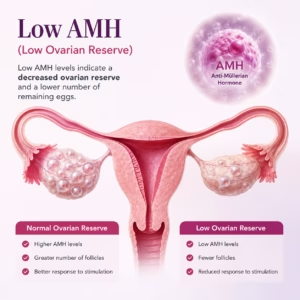
| AMH and other ovarian reserve testing, ordered as part of a miscarriage workup | “Poor reserve is causing poor-quality pregnancies” | ESHRE: ovarian reserve testing is not routinely recommended in women with RPL (strong). ASRM: does not recommend routine ovarian reserve testing |
| Fasting insulin and routine PCOS screening in the absence of clinical features | “Insulin resistance is behind the losses” | ESHRE: assessment of PCOS, fasting insulin and fasting glucose is not recommended (strong) |
| Prolactin, where there are no symptoms | “A hormonal imbalance is the cause” | ESHRE: not recommended in the absence of clinical symptoms (conditional) |
Two of these deserve a note rather than a flat dismissal. Antinuclear antibody (ANA) testing sits in a middle category: ESHRE says it could be considered for explanatory purposes, meaning it may help make sense of a picture without changing treatment. Chronic endometritis is the live question — ASRM 2026 lists endometrial biopsy with CD138 staining among investigations of possible benefit on limited evidence, while ESHRE concluded that further research is needed before screening can be recommended. It is legitimate to discuss; it is not yet a routine test.
It is worth being clear about why the discredited panels persist. They persist because they are profitable, because they are quick to order, and above all because they answer a need that the recommended evaluation often cannot: they produce a finding. A couple who have had three losses and are handed a normal report can feel dismissed. A couple handed an abnormal NK cell result feel they have an explanation and a plan. The second experience is kinder in the moment and worse over a year.
What about the treatments that are sold alongside these tests?
The tests and the treatments travel together, so the evidence on the treatments is part of the same decision. The position of the guidelines is consistent and, in most cases, unusually firm.
Table 3 — Treatments frequently offered for unexplained recurrent loss
| Treatment | Current guideline position |
| Low-dose aspirin and/or heparin in women without antiphospholipid syndrome | ESHRE: not recommended — the evidence shows they do not improve live birth rate (strong). ASRM: empiric aspirin or anticoagulants without a diagnosis of APS are not recommended |
| Lymphocyte immunisation therapy (paternal cell immunisation) | ESHRE: should not be used — no significant effect and the possibility of serious adverse effects (strong) |
| Corticosteroids such as prednisolone | ESHRE: not recommended for unexplained RPL or for RPL with selected immunological markers (strong), because of adverse effects. ASRM: not recommended |
| Intralipid infusions | ESHRE: insufficient evidence to recommend (strong). ASRM: not recommended |
| Granulocyte colony-stimulating factor (G-CSF) | ESHRE: no evidence to recommend it in unexplained RPL (strong) |
| Intravenous immunoglobulin (IVIg) | ESHRE: repeated high doses given very early in pregnancy may improve live birth rate in women with four or more unexplained losses (conditional) — a narrow, late-line exception, not a general treatment. ASRM: not recommended |
| PGT-A (testing embryos for random chromosomal errors) for unexplained recurrent loss | ESHRE: the limited evidence shows no clear benefit (very low quality). ASRM: lists possible benefit only in women over 40 with a previously aneuploid miscarriage |
The PGT-A row is the one most likely to come as a surprise, because the biological argument for it is genuinely persuasive: most early losses are chromosomally abnormal, so selecting a chromosomally normal embryo ought to prevent them. The trial evidence has not borne that reasoning out for couples with unexplained recurrent loss, and both guidelines reflect that. Where a parental structural rearrangement has been confirmed, the situation is different and testing has a defined role. The distinction between those two indications is the whole of the argument, and it is frequently blurred.
Does the male partner need testing?
Yes, but less than is often sold. ESHRE upgraded the assessment of the male partner’s lifestyle to a strong recommendation in the 2022 update, covering paternal age, smoking, alcohol intake, exercise pattern and body weight. This is a clinical history, not a panel, and it is the part most often skipped.
Sperm DNA fragmentation testing moved in the 2022 update from “explanatory only” to something that could be considered for diagnostic purposes (conditional), and ASRM 2026 similarly places it among investigations of possible benefit on limited evidence. That is a reasonable basis for offering the test and discussing the result; it is not a basis for presenting it as a required part of the workup, or for selling a treatment package on the strength of it.
What if every recommended test comes back normal?
This is the most common outcome, and it is not a failure of the evaluation. A substantial proportion of couples with recurrent loss complete the full guideline-based workup without a cause being identified. The term used for this is unexplained recurrent pregnancy loss, and it carries a better prognosis than the phrase suggests: most couples in this group go on to have a live birth without any specific treatment.
A normal set of results is genuinely informative. It rules out the conditions that would have changed management, and it means that no drug, injection or immune therapy is indicated — which, given the list in Table 3, is a form of protection rather than a dead end. What remains useful is supportive early-pregnancy care, correction of any modifiable factor identified in the history, and, for those in whom infertility rather than loss alone is the issue, an assessment of the wider causes of female infertility.
ESHRE also includes a good practice point that preconception counselling may reasonably include prophylactic vitamin D supplementation, while noting that evidence of effectiveness is absent. That is an honest description of a low-risk, low-certainty measure, and it is the right register for this whole subject.
When should you see a fertility specialist?
Evaluation is appropriate after two losses. It should not wait in any of the following situations:
- A loss after 12 weeks, or after a fetal heartbeat had been seen on scan.
- A known balanced translocation, inversion or other chromosomal rearrangement in either partner, or a family history of one.
- A previous pregnancy affected by a chromosomal or structural abnormality.
- A known or suspected uterine anomaly, or a history of uterine surgery, curettage or intrauterine adhesions.
- A personal or family history of thrombosis, autoimmune disease, or a prior pregnancy complicated by severe pre-eclampsia or growth restriction.
- Age above 35, where the time spent waiting for a third loss has an independent cost.
Seek urgent medical attention rather than an outpatient appointment for heavy bleeding, severe or one-sided abdominal pain, fever, or feeling faint — these need assessment on the day, not at the next available clinic.
Frequently asked questions
How many miscarriages before investigation is recommended?
Two. Both ESHRE and the ASRM 2026 committee opinion use two or more losses as the threshold, replacing the older three-loss rule. Losses confirmed only by a positive pregnancy test count, and they do not have to be consecutive. Earlier evaluation is reasonable after a second-trimester loss, where a heartbeat had been seen, or where age makes waiting costly.
Which recurrent miscarriage tests have no evidence?
The main ones are NK cell assays, cytokine panels and cytokine polymorphism testing, HLA and anti-HLA antibody testing, routine hereditary thrombophilia screening, MTHFR genotyping and homocysteine, endometrial receptivity testing, reproductive microbiome panels, and ovarian reserve testing ordered as part of a miscarriage workup. Both guidelines advise against these outside research settings.
Is a positive antiphospholipid antibody result the same as having the syndrome?
No. Transient positivity is common, particularly after infection. A diagnosis of obstetric antiphospholipid syndrome requires a persistently positive result on repeat testing at an interval, interpreted together with the pregnancy history. This distinction matters because aspirin and heparin are indicated for the confirmed syndrome and are specifically not recommended for unexplained loss.
Should the miscarriage tissue be sent for testing?
Where it is practical, yes. ASRM 2026 recommends array-based analysis of miscarriage tissue as the first step, because a chromosomally abnormal result provides an explanation immediately and determines whether parental karyotyping is needed. ESHRE treats it as optional and explanatory. The limiting factor is that collection has to be arranged before the loss occurs.
Will PGT-A stop me miscarrying again?
For unexplained recurrent loss, the evidence does not support that. ESHRE found no clear benefit from preimplantation genetic testing in this group, and ASRM identifies possible benefit only in women over 40 who have had a chromosomally abnormal miscarriage. Where a parental structural rearrangement has been confirmed, embryo testing has a defined and different role.
Do I need to stop trying while the tests are being done?
Usually not. The recommended evaluation can be completed alongside attempts to conceive, and none of the core tests requires you to avoid pregnancy. The exception is where a uterine anomaly has been identified and surgery is planned, or where a specific finding requires treatment to be started and stabilised first. This should be decided individually.
The practical takeaway
A good recurrent miscarriage evaluation is short, sequenced and mostly normal. It looks for antiphospholipid syndrome, thyroid dysfunction, a structural problem in the uterus, and a chromosomal explanation — and then it stops. A long panel is not a thorough panel; it is usually a sign that the tests have been chosen for their availability rather than for what their results would change.
If you have been given a report full of unfamiliar immune markers, the useful question is not “what does this value mean?” but “what would you do differently if this result were normal?” If the answer is nothing, the test should not have been done.
Couples who have had two or more pregnancy losses can discuss a guideline-based evaluation, and what their existing reports actually show, with a fertility specialist at Wellspring IVF & Women’s Hospital, an ART-registered clinic in Ahmedabad led by Dr. Pranay Shah, MS (ObGy). Appointments can be made on +91 9099946050, on WhatsApp at the same number, during OPD hours of Monday to Saturday, 10:00 AM to 4:00 PM.
References
- European Society of Human Reproduction and Embryology. Guideline on the management of recurrent pregnancy loss — update 2022. eu/guidelines-and-legal/guidelines/recurrent-pregnancy-loss
- ESHRE Guideline Group on RPL. ESHRE guideline: recurrent pregnancy loss: an update in 2022. Human Reproduction Open, 2023;2023(1):hoad002. Full text
- Recurrent Pregnancy Loss — Guideline of the European Society of Human Reproduction and Embryology, update 2022 (full version, January 2023). PDF
- Practice Committee of the American Society for Reproductive Medicine. Recurrent pregnancy loss: a committee opinion (2026). org
- Recurrent Pregnancy Loss — patient version of the ESHRE guideline, update 2022. PDF
This article is general medical information and is not a substitute for individual clinical assessment. Test selection and interpretation after pregnancy loss depend on your personal and obstetric history and should be discussed with your treating specialist.