

Published: Jun 11, 2026 | Medically reviewed by: Dr. Pranay Shah, MS (Obs. & Gyn.), GMC Reg. No. G-18311 — Founder, Director & Chief Fertility Consultant, Wellspring IVF & Women’s Hospital, Ahmedabad | Last medically reviewed: 25 October 2026
A miscarriage (spontaneous abortion or early pregnancy loss) is the unintended loss of an intrauterine pregnancy before 20 weeks of gestation, with more than 80% occurring in the first 12 weeks. Approximately 50% to 60% of sporadic first-trimester miscarriages are caused by random embryonic chromosomal abnormalities (aneuploidy) during cell division—not by maternal stress, climbing stairs, or everyday food choices. Over 80% of women who experience a single sporadic miscarriage go on to deliver a healthy full-term baby in their very next pregnancy without requiring invasive fertility treatments. |
Few moments in a couple’s life are as disorienting as seeing a positive pregnancy test—planning due dates, quietly rearranging family routines—and then noticing unexpected bleeding or hearing an ultrasound room fall silent during a seven-week scan. In Indian households, that grief is almost immediately compounded by well-meaning but medically inaccurate speculation: Did you climb too many stairs? Did you travel on a bumpy road? Did you eat something “heat-inducing” like papaya or sesame?
When couples sit across from best fertility doctor in Ahmedabad, Dr. Pranay Shah, after an early pregnancy loss, the very first clinical task is lifting that weight of self-blame. A sporadic first-trimester miscarriage is almost never caused by a woman’s daily physical activity, work schedule, or a meal she ate two days earlier. In the overwhelming majority of cases, nature halts a pregnancy in the first eight to ten weeks because the embryo carried an accidental chromosomal blueprint error from the moment of fertilisation.
At Wellspring IVF & Women’s Hospital in Satellite, Ahmedabad for evidence-based reproductive medicine and high-risk early pregnancy care, we distinguish sharply between a single sporadic first-trimester loss and recurrent pregnancy loss (two or more losses). In selected cases, IVF with genetic testing is discussed after recurrent loss. That distinction governs everything: whether you need medical or surgical management right now, whether micronized progesterone can rescue a current pregnancy with spotting, and whether you actually need an expensive diagnostic workup before trying again.
Why First-Trimester Losses Happen: The 60% Chromosomal Reality vs. Maternal Factors
According to ACOG Practice Bulletin No. 200 on Early Pregnancy Loss and large cytogenetic cohorts (PMC8083898; PMC12694013), roughly 10% to 15% of all clinically recognised pregnancies end in a first-trimester miscarriage. Because maternal age directly influences how cleanly an egg divides its chromosomes during meiosis, the baseline risk shifts predictably with age:
- Ages 20 to 30: ~9% to 17% risk of early pregnancy loss.
- Age 35: ~20% risk.
- Age 40: ~40% risk.
- Age 45: ~75% to 80% risk.
1. Random Embryonic Chromosomal Errors (50% to 60% of All Sporadic Losses)
When a human egg (23 chromosomes) and sperm (23 chromosomes) fuse, the resulting single-cell zygote must duplicate and divide billions of times. If an egg or sperm carries an extra or missing chromosome (meiotic non-disjunction), the embryo forms with trisomy (such as Trisomy 16, 22, 21, or 15—where Trisomy 16 alone accounts for nearly a quarter of all chromosomal miscarriages and is completely incompatible with life), monosomy X (Turner syndrome), or polyploidy (69 chromosomes from double fertilisation).
In these cases, the embryo implants, triggers a positive urine and blood beta-hCG test, and forms a gestational sac—and sometimes even an early flicker of a heartbeat at 6 weeks—before development stops around weeks 6 to 9 because the genetic instructions needed to build fetal organs are missing. Crucially, these de novo errors are random biological accidents; as demonstrated in a 2025 reproductive cohort study (PMC12694013), women whose miscarriage was caused by a random embryonic chromosomal error actually have a higher live birth rate (85.5%) in their subsequent pregnancy than those with chromosomally normal losses, because their uterine environment is healthy.
2. Anatomical & Uterine Cavity Factors
When a genetically normal embryo miscarries—especially late in the first trimester or in the second trimester—structural conditions inside the uterus may be involved. A congenital uterine septum (a fibrous wall dividing the cavity with poor blood supply), submucous uterine fibroids that distort the inner endometrial cavity, large endometrial uterine polyps, or intrauterine scar tissue (Asherman’s syndrome after a prior vigorous D&C) can compromise placental attachment and vascularisation.
3. Endocrine, Metabolic, and Prothrombotic Conditions
Uncontrolled maternal medical conditions can destabilise early placentation:
- Uncontrolled Thyroid Disease & Diabetes: Untreated overt hypothyroidism (or high thyroid peroxidase antibodies with elevated TSH) and poorly controlled periconceptional diabetes (high HbA1c) significantly raise early loss rates.
- Hyperinsulinemia and Ovulatory Dysfunction: Women seeking PCOD and PCOS fertility treatment who have severe insulin resistance or hyperandrogenism can experience impaired endometrial decidualisation if metabolic markers are not optimised before conception.
- Antiphospholipid Syndrome (APS): An acquired autoimmune thrombophilia in which maternal antibodies (lupus anticoagulant, anticardiolipin, and anti-beta-2 glycoprotein I) trigger micro-clots and inflammation in the developing spiral arteries of the placenta (PMC10298962).
4. The Overlooked Paternal Contribution: Sperm DNA Integrity
Historically, miscarriage was viewed strictly through the lens of maternal health. Today, both the ESHRE Recurrent Pregnancy Loss Guideline and ASRM recognise that severe oxidative breaks in paternal DNA—measured via sperm DNA fragmentation testing and treatment—are associated with arrested blastocyst development and first-trimester pregnancy loss, even when a standard semen analysis shows normal sperm count and motility.
Not All Bleeding Means Pregnancy Loss: Differentiating the 5 Clinical Types
Around 20% to 25% of pregnant women experience some vaginal spotting or bleeding during the first 12 weeks, and roughly half of those women continue on to a healthy full-term delivery (PMC7408486). Because symptoms alone cannot distinguish a harmless subchorionic hematoma from an evolving loss, clinicians classify early pregnancy complications into five distinct clinical categories using transvaginal ultrasound and serial beta-hCG tracking:
Clinical Classification | Typical Symptoms (Bleeding & Pain) | Cervical Os Finding on Speculum Exam | Transvaginal Ultrasound & Beta-hCG Picture | Expected Outcome & Evidence-Based Clinical Action |
|---|---|---|---|---|
1. Threatened Miscarriage | Light brown spotting or bright red vaginal bleeding; mild or absent pelvic cramping. | Closed cervical os. | Live intrauterine embryo with visible cardiac activity (or age-appropriate gestational sac), often with a small subchorionic bleed. | 50%–75%+ continue to live birth. Rest, reassurance, and targeted vaginal micronized progesterone (400 mg twice daily until 16 weeks) if the patient has ≥1 prior miscarriage (PRISM Trial, PubMed: 32609084). |
2. Missed (Silent) Miscarriage (Blighted Ovum / Anembryonic or Early Fetal Demise) | Often no bleeding or pain at all; pregnancy symptoms (nausea, breast tenderness) may quietly fade, or brown discharge appears days later. | Closed cervical os. | Either an empty gestational sac >=25 mm with no embryo (blighted ovum) or a crown-rump length (CRL) >=7 mm with no fetal heartbeat on validated scan. | Pregnancy has stopped developing, but the body has not yet recognised the loss. Managed via expectant observation, medical tablets (mifepristone + misoprostol), or gentle suction evacuation. |
3. Inevitable Miscarriage | Heavy bright red vaginal bleeding with clots and rhythmic, intensifying lower abdominal and lower-back uterine contractions. | Open (dilated) cervical os. | Gestational sac detached or migrating into the lower uterine segment / cervical canal. | Pregnancy cannot be saved; clinical priority is pain relief, monitoring blood loss, and ensuring complete tissue passage. |
4. Incomplete Miscarriage | Persistent heavy bleeding and cramping after some pregnancy tissue or clots have already passed. | Open cervical os (sometimes with tissue visible at the os). | Thickened, heterogeneous endometrial echo with retained products of conception (RPOC) inside the cavity. | Medical management with misoprostol or ultrasound-guided gentle suction evacuation to stop haemorrhage and prevent intrauterine infection. |
5. Complete Miscarriage | Bleeding and cramping rapidly subside after passage of the gestational sac. | Closed (closes shortly after passage). | Empty uterine cavity with a thin, clean endometrial stripe (<15 mm) and rapidly falling serum beta-hCG. | No surgical intervention needed; check Rh blood group (give Anti-D immunoglobulin if the mother is Rh-negative) and schedule a follow-up check. |
Urgent Red Flags: When Early Bleeding Could Be an Ectopic Pregnancy
Every woman with a positive pregnancy test who develops bleeding or pain before an ultrasound has confirmed a sac inside the uterus must be evaluated for an ectopic pregnancy (a pregnancy implanted inside the fallopian tube, ovary, or scar). Seek immediate medical assessment if you notice:
- One-sided (unilateral) sharp or stabbing lower pelvic pain, rather than central menstrual-like cramping.
- Prune-juice-coloured (dark brown, watery) vaginal spotting paired with rising but abnormally slow beta-hCG levels (rising less than 50%–66% over 48 hours).
- Shoulder-tip pain when lying flat (caused by blood irritating the diaphragm), dizziness, lightheadedness, or fainting when standing up.
- Fever, chills, or foul-smelling vaginal discharge, which point toward a septic miscarriage requiring urgent intravenous antibiotics.
Does Progesterone Save a Threatened Miscarriage? What the PRISM & PROMISE Trials Show
In India, almost every woman who spots in early pregnancy is prescribed hormone injections or tablets, leaving couples confused about whether progesterone can prevent any miscarriage. Two landmark randomized controlled trials published in the New England Journal of Medicine by Coomarasamy and colleagues—the PROMISE trial (RRM / NEJM 2015) and the PRISM trial of 4,153 women (PubMed: 32609084; PubMed: 32008730)—clarified exactly who benefits:
- Progesterone Cannot Rescue an Chromosomally Abnormal Embryo: In a first pregnancy with early bleeding and no prior losses, vaginal progesterone produced a 74% live birth rate versus 75% with placebo (PubMed: 32609084). If an embryo has Trisomy 16, adding exogenous progesterone cannot rewrite its chromosomes.
- Progesterone Clearly Helps Women With Both Early Bleeding AND a Prior Miscarriage: In the prespecified PRISM subgroup of women who had one or more previous miscarriages AND presented with early pregnancy bleeding, vaginal micronized progesterone (400 mg twice daily from presentation until 16 weeks) significantly increased live birth rates (75% vs. 70% overall, and 72% vs. 57%—an absolute 15% increase—in women with three or more prior losses, PubMed: 32008730). This is now the international clinical standard endorsed by NICE and ESHRE.
Safe Management of a Confirmed Loss: Protecting Your Future Fertility
When a missed or incomplete miscarriage is confirmed on ultrasound (often re-verified by a second observer or repeat scan 7 to 14 days later if measurements are borderline, so a viable late-ovulation pregnancy is never interrupted prematurely), couples have three safe management choices:
- Expectant Management (Natural Passage): Waiting 7 to 14 days for the body to expel the pregnancy naturally. Successful in 70% to 80% of incomplete losses, though less predictable (50%–60%) in missed miscarriages.
- Medical Management (Tablets at Home/Day-Care): Oral mifepristone followed 24 to 48 hours later by vaginal/sublingual misoprostol tablets triggers uterine contractions and completes passage without surgery in 80% to 85% of women (ACOG Practice Bulletin No. 200).
- Gentle Suction Evacuation (MVA / Ultrasound-Guided Suction): Performed under short sedation in 10 minutes. Crucial Fertility Caveat: At Wellspring IVF, we strongly advise against blind, aggressive metal curettage (“sharp D&C”). Using gentle plastic suction cannulae under ultrasound guidance (or targeted hysteroscopic removal when needed) completely avoids scraping the basal layer of the endometrium, preventing intrauterine adhesions (Asherman’s syndrome) and preserving your uterine lining for future conception.
One Sporadic Loss vs. Recurrent Miscarriage: When Should You Get Tested?
A single first-trimester miscarriage is a painful statistical event, not a diagnosis of infertility. After one uncomplicated first-trimester loss, routine expensive thrombophilia panels, karyotyping, and immune tests are not medically indicated.
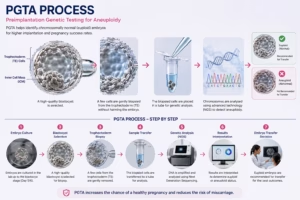
However, if you have experienced two or more pregnancy losses (consecutive or non-consecutive)—or a single loss after a confirmed fetal heartbeat in the late first or second trimester—international guidelines from the ESHRE Recurrent Pregnancy Loss Working Group recommend a structured investigation rather than simply “trying again and hoping for the best.” You can explore our dedicated clinical protocol on recurrent miscarriage causes and treatment in Ahmedabad as well as our companion diagnostic guide on which tests are genuinely recommended for recurrent miscarriage (and which TORCH tests to skip). Where parental balanced chromosomal translocations or repeated aneuploid losses are identified, IVF combined with preimplantation genetic testing (PGT-A or PGT-SR) allows our embryology team to identify a chromosomally balanced embryo before transfer.
Frequently Asked Questions
How soon after a miscarriage can we try to get pregnant again?
Medically, once vaginal bleeding has completely stopped, urine pregnancy tests have returned to negative, and you have completed one normal menstrual period (to allow accurate dating and fresh endometrial regeneration), there is no biological need to wait six months. In fact, large observational studies show that couples who conceive within 3 to 6 months after an uncomplicated sporadic first-trimester miscarriage have equal or slightly higher live birth rates than those who delay trying for over a year—provided both partners feel emotionally ready.
Did stress, crying, working at a desk, or lifting a toddler cause my miscarriage?
No. Everyday emotional stress, working full-time, walking, climbing stairs, sexual intercourse, or lifting normal household weights does not detach an implanted embryo or cause chromosomal trisomies. When the uterus itself cannot support a pregnancy, gestational surrogacy is the legal route in India, and only on medical grounds. The uterus is a muscular organ cushioned deep inside the bony pelvis; when an early pregnancy is chromosomally healthy and properly implanted, ordinary daily movement does not dislodge it.
Should we send the miscarriage tissue for genetic testing (Product of Conception Karyotyping / Microarray)?
In a very first uncomplicated miscarriage, routine genetic testing of tissue is optional. However, if a loss occurs after an IVF cycle, or if it is a second or third miscarriage, sending the pregnancy tissue for Chromosomal Microarray Analysis (CMA) or NGS is invaluable (PMC10380966). Knowing whether the loss was due to a random fetal trisomy (meaning the uterus worked fine) versus a chromosomally normal (euploid) loss immediately tells Dr. Pranay Shah whether to focus treatment on embryo genetics or on the maternal uterine environment.
Why did my pregnancy symptoms continue even after the baby’s heartbeat stopped on scan?
In a missed miscarriage, the placental trophoblast cells often continue secreting modest amounts of beta-hCG and progesterone into the mother’s bloodstream for days or even two weeks after embryonic cardiac activity ceases. Because morning sickness and breast tenderness are driven by placental hormones rather than the embryo itself, you can still feel pregnant even when the gestational sac has stopped growing.
Compassionate Evaluation & Pre-Conception Planning in Ahmedabad
Whether you are currently experiencing early pregnancy spotting and need an urgent viability ultrasound, or want a clear, blame-free medical plan before trying again after one or more losses, you can consult Dr. Pranay Shah at Wellspring IVF & Women’s Hospital, Ahmedabad.
- Hospital Address: Titanium City Center Mall, 440, 100 Feet Anandnagar Road, near Sachin Tower, Satellite, Ahmedabad, Gujarat 380015 (Registered ART Clinic No. GS/AHD/024)
- Appointments & WhatsApp: +91 90999 46050
- OPD Timings: Monday to Saturday, 10:00 AM to 4:00 PM
References
- American College of Obstetricians and Gynecologists (ACOG). ACOG Practice Bulletin No. 200: Early Pregnancy Loss. Obstetrics & Gynecology. 2018;132(5):e197–e207.
- Coomarasamy A, Devall AJ, Cheed V, Harb H, Middleton LJ, Gallos ID, et al. Progesterone to prevent miscarriage in women with early pregnancy bleeding: the PRISM RCT. Health Technology Assessment / N Engl J Med. 2020;24(33):1–70. (PubMed: 32008730 | PMC7408486).
- ESHRE Guideline Group on RPL, Bender Atik R, Christiansen OB, Elson J, Kolte AM, Lewis S, et al. ESHRE guideline: recurrent pregnancy loss: an update in 2022. Human Reproduction Open. 2023;2023(1):hoad002.
- Gu C, Li K, Li R, Li L, Li X, ZhangQA, et al. Chromosomal Aneuploidy Associated With Clinical Characteristics of Pregnancy Loss. Frontiers in Genetics. 2021;12:667697.
- Chromosomal miscarriage and pregnancy outcomes in recurrent pregnancy loss cohorts. Reproduction and Fertility. 2025;6(4):e250052. (PMC12694013 | Bioscientifica).
- Turesheva A, Aimagambetova G, Ukybassova T, Marat A, Kanabekova P, Kaldygulova L, et al. Recurrent Pregnancy Loss Etiology, Risk Factors, Diagnosis, and Management: Fresh Look into a Full Box. Journal of Clinical Medicine. 2023;12(12):4074.