
Ovarian Rejuvenation: How New Treatments May Help Women Conceive
Direct Answer
Ovarian rejuvenation refers to experimental fertility treatments designed to improve ovarian function in women with diminished ovarian reserve, low AMH, poor ovarian response, or age-related fertility decline. The most commonly discussed approach is ovarian Platelet-Rich Plasma (PRP) therapy. While early studies have shown encouraging results in selected patients, ovarian rejuvenation remains investigational, and current scientific evidence is not yet strong enough to consider it a standard fertility treatment. Women considering ovarian rejuvenation should understand both its potential benefits and its limitations.
Key Facts Table
| Topic | Information |
|---|---|
| Treatment | Ovarian Rejuvenation |
| Most Common Method | Ovarian PRP |
| Standard Fertility Treatment? | No |
| Considered Experimental? | Yes |
| Target Patients | Low AMH / Poor Ovarian Reserve |
| Goal | Improve Ovarian Function |
| Scientific Evidence | Emerging |
| Pregnancy Guaranteed? | No |
| IVF Often Still Required | Yes |
| Specialist Evaluation Essential | Yes |
Introduction
One of the most challenging situations in fertility medicine occurs when a woman has:
- Low AMH
- Diminished ovarian reserve
- Poor ovarian response
- Advanced reproductive age
- Repeated IVF failures related to egg quantity
For many years, treatment options were limited.
Recently, however, ovarian rejuvenation has generated considerable interest among fertility specialists and patients.
Women frequently ask:
- Can ovarian rejuvenation increase AMH?
- Can PRP improve fertility?
- Can ovarian rejuvenation reverse menopause?
- Can it help me conceive naturally?
- Does it improve IVF success rates?
These questions are important because ovarian rejuvenation has received substantial media attention, often accompanied by exaggerated claims.
At Wellspring IVF & Women’s Hospital, Ahmedabad, patients are encouraged to understand the current scientific evidence before making decisions regarding emerging fertility treatments.
What Is Ovarian Rejuvenation?
Ovarian rejuvenation refers to a group of experimental procedures designed to improve ovarian activity.
The most commonly discussed technique involves:
Ovarian PRP (Platelet-Rich Plasma)
In this procedure:
- Blood is collected from the patient
- Platelet-rich plasma is prepared
- PRP is injected into the ovaries
Researchers believe that growth factors within PRP may potentially stimulate ovarian tissue activity.
However, the exact biological mechanism remains uncertain.
Why Is Ovarian Rejuvenation Being Studied?
The primary goal is addressing conditions such as:
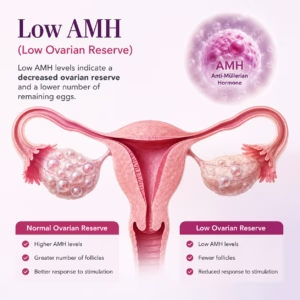
- Diminished ovarian reserve
- Poor ovarian response
- Low AMH
- Age-related fertility decline
Women with these conditions often produce fewer eggs during fertility treatment.
Researchers hope ovarian rejuvenation may:
- Improve ovarian responsiveness
- Increase follicular activity
- Improve IVF outcomes
- Expand fertility options
However, these goals remain under investigation.
Who May Consider Ovarian Rejuvenation?
Potential candidates include:
Women With Low AMH
Women with Low AMH and Ovarian Reserve are among the most common groups exploring ovarian rejuvenation.
Poor Ovarian Responders
Patients producing few eggs during IVF stimulation.
Women With Repeated IVF Failure
Selected women with unsuccessful IVF cycles related to ovarian reserve concerns.
Advanced Reproductive Age
Women experiencing age-related decline in ovarian function.
Fertility Preservation Candidates
Selected women seeking fertility preservation counseling.
Who Is Not an Ideal Candidate?
Ovarian rejuvenation is unlikely to help every patient.
It is generally not recommended as a first-line treatment for:
- Tubal infertility
- Severe male infertility
- Uterine abnormalities
- Implantation failure unrelated to ovarian function
In such situations, alternative fertility strategies may be more appropriate.
How Is Ovarian PRP Performed?
Step 1: Blood Collection
A blood sample is obtained from the patient.
Step 2: PRP Preparation
Special processing concentrates platelets and growth factors.
Step 3: Ovarian Access
Using ultrasound guidance, the ovaries are accessed.
Step 4: PRP Injection
PRP is injected into ovarian tissue.
Step 5: Follow-Up Monitoring
Patients undergo:
- Hormonal assessment
- Ultrasound evaluation
- Fertility treatment planning
How Might Ovarian Rejuvenation Work?
Several theories have been proposed.
Growth Factor Release
Platelets contain biological growth factors that may influence tissue repair.
Improved Ovarian Environment
Researchers suggest PRP may influence local ovarian tissue function.
Follicular Activation
Some investigators propose possible activation of dormant follicles.
Cellular Signaling Effects
Growth factors may alter ovarian microenvironments.
Importantly, many of these mechanisms remain theoretical.
Success Factors Influencing Outcomes
Age
Younger women generally have greater ovarian potential.
Baseline Ovarian Reserve
Patients with residual ovarian function may respond differently.
Underlying Diagnosis
The cause of ovarian dysfunction matters significantly.
IVF Strategy
Many patients still require IVF Treatment after ovarian rejuvenation.
Overall Reproductive Health
Success depends on multiple fertility factors beyond ovarian reserve alone.
Advantages of Ovarian Rejuvenation
Uses Patient’s Own Blood
PRP is autologous, reducing rejection concerns.
Minimally Invasive
The procedure is generally less invasive than major surgery.
Potentially Expands Fertility Options
Selected patients may gain additional treatment opportunities.
Ongoing Research Interest
The field continues to evolve rapidly.
Relationship Between Ovarian Rejuvenation and IVF
Many women considering ovarian rejuvenation are ultimately pursuing IVF.
The hope is that ovarian stimulation may yield:
- More follicles
- More eggs
- Better treatment opportunities
When IVF is performed, advanced technologies such as:
and
may be incorporated into treatment planning.
What Current Research Shows
Research findings remain mixed.
Some small studies have reported:
- Improved AMH levels
- Increased follicle counts
- Improved ovarian response
- Occasional spontaneous pregnancies
However:
- Many studies are small
- Long-term data remain limited
- Large randomized trials are lacking
Therefore, ovarian rejuvenation should currently be viewed as an emerging rather than established fertility treatment.
Risks of Ovarian Rejuvenation
Although ovarian rejuvenation is generally considered minimally invasive, patients should understand that it is still an emerging treatment with limited long-term evidence.
Procedure-Related Discomfort
Some women may experience:
- Mild pelvic pain
- Cramping
- Temporary discomfort
- Spotting
These symptoms are usually short-lived.
Infection
As with any procedure involving ovarian access, a small risk of infection exists.
Bleeding
Minor bleeding can occasionally occur following the procedure.
No Guaranteed Improvement
One of the most important risks is unrealistic expectations.
Some patients may experience:
- No increase in AMH
- No increase in follicle count
- No improvement in IVF outcomes
Financial Cost
Because ovarian rejuvenation remains investigational, the cost may not always be justified by current evidence.
Limitations of Ovarian Rejuvenation
Experimental Status
Ovarian rejuvenation is not currently considered a standard fertility treatment.
Limited Scientific Evidence
Many published studies:
- Include small patient numbers
- Lack long-term follow-up
- Show inconsistent outcomes
Cannot Reverse Aging
No treatment has been proven to reverse ovarian aging completely.
Cannot Create New Eggs
Current evidence does not demonstrate that ovarian rejuvenation creates new eggs.
Not a Replacement for IVF
Many women undergoing ovarian rejuvenation still require:
to achieve pregnancy.
Ovarian Rejuvenation Success Rates
One of the most common patient questions is:
“What is the success rate of ovarian rejuvenation?”
Unfortunately, there is no universally accepted answer.
Published studies report highly variable outcomes.
Some women demonstrate:
- Improved AMH levels
- Increased follicle numbers
- Better ovarian response
Others experience:
- No measurable change
- No improvement in fertility outcomes
Because evidence remains limited, success rates should be interpreted cautiously.
Patients should understand that ovarian rejuvenation is not equivalent to established fertility treatments such as IVF.
How To Improve Fertility Outcomes Alongside Ovarian Rejuvenation
Optimize Overall Health
Focus on:
- Healthy weight
- Balanced nutrition
- Regular exercise
- Adequate sleep
Manage Medical Conditions
Conditions such as:
- Thyroid disorders
- PCOS
- Insulin resistance
should be treated appropriately.
Address Male Fertility Factors
Successful conception depends on both partners.
Consider Advanced Embryo Selection
Selected patients may benefit from:
to improve embryo selection.
Use Advanced IVF Technologies
Modern reproductive medicine offers:
which may improve treatment opportunities.
Clinical Insight From Dr. Pranay Shah
Ovarian rejuvenation is one of the most frequently discussed emerging fertility treatments today.
Patients often arrive with great hope after reading success stories online.
My approach is to provide balanced counseling.
The reality is that ovarian rejuvenation is promising but still investigational.
Some women appear to experience improved ovarian activity after treatment.
Others experience little or no measurable benefit.
At present, I believe ovarian rejuvenation should be viewed as a potential adjunct rather than a replacement for established fertility treatments.
Women with low AMH or diminished ovarian reserve should understand that age, egg quality, and overall reproductive health remain major determinants of fertility outcomes.
The best results occur when emerging therapies are combined with evidence-based fertility care and realistic expectations.
Patients seeking personalized fertility guidance can learn more about Dr. Pranay Shah and fertility services in Ahmedabad.
Common Myths About Ovarian Rejuvenation
Myth 1: Ovarian Rejuvenation Guarantees Pregnancy
Reality:
No fertility treatment can guarantee pregnancy.
Myth 2: PRP Creates New Eggs
Reality:
Current scientific evidence does not prove that PRP creates new eggs.
Myth 3: Ovarian Rejuvenation Reverses Menopause
Reality:
This claim has not been conclusively demonstrated.
Myth 4: IVF Is No Longer Necessary After Ovarian Rejuvenation
Reality:
Many women still require IVF treatment.
Myth 5: Every Low AMH Patient Benefits
Reality:
Responses vary significantly between individuals.
Recent Advances in Ovarian Rejuvenation Research
Researchers continue investigating:
- Ovarian PRP protocols
- Stem cell therapies
- Growth factor treatments
- Ovarian tissue regeneration
- Precision reproductive medicine
Future advances may improve understanding of:
- Ovarian aging
- Follicular activation
- Egg development
- Fertility preservation
However, these approaches remain under active investigation.
Frequently Asked Questions
What is ovarian rejuvenation?
Ovarian rejuvenation refers to experimental treatments intended to improve ovarian function.
What is ovarian PRP?
PRP involves injecting platelet-rich plasma derived from the patient’s own blood into the ovaries.
Can ovarian rejuvenation increase AMH?
Some studies suggest possible improvement in selected patients, but results are inconsistent.
Does ovarian rejuvenation improve fertility?
Potentially in some patients, but evidence remains limited.
Is ovarian rejuvenation approved as standard treatment?
No. It is still considered investigational.
Can ovarian rejuvenation reverse menopause?
Current evidence does not support this claim conclusively.
Does ovarian rejuvenation create new eggs?
There is currently no strong scientific proof that it creates new eggs.
Is ovarian rejuvenation painful?
Most women experience only mild temporary discomfort.
Who may consider ovarian rejuvenation?
Selected women with low ovarian reserve or poor ovarian response may explore this option.
Is ovarian rejuvenation suitable for every infertility patient?
No. Treatment suitability depends on the underlying diagnosis.
Can ovarian rejuvenation replace IVF?
Generally no. Many patients still require IVF.
Can ovarian rejuvenation improve IVF outcomes?
Possibly in selected patients, but evidence remains limited.
Is ovarian rejuvenation safe?
Available data suggest it is generally safe, but long-term evidence remains limited.
What other treatments help low ovarian reserve?
Advanced IVF strategies often remain the most evidence-based approach.
Where can I learn more about fertility treatments?
Visit our Treatment Hub, explore our Fertility Videos, or browse our Blog Centre.
Key Takeaways
- Ovarian rejuvenation is an emerging fertility treatment.
- PRP is the most commonly discussed ovarian rejuvenation technique.
- Current evidence remains limited and evolving.
- Ovarian rejuvenation is not considered standard fertility treatment.
- It cannot guarantee pregnancy.
- It cannot reliably reverse ovarian aging.
- Many women still require IVF after treatment.
- Careful patient selection is essential.
- Realistic expectations are extremely important.
Conclusion
Ovarian rejuvenation represents one of the most intriguing developments in reproductive medicine. Early research suggests that certain women with diminished ovarian reserve or poor ovarian response may experience improvements in ovarian activity after treatments such as ovarian PRP. However, current scientific evidence remains limited, and ovarian rejuvenation should still be considered investigational rather than established therapy.
Women considering ovarian rejuvenation should seek guidance from experienced fertility specialists and carefully evaluate both the potential benefits and limitations. While future research may expand treatment possibilities, evidence-based fertility care remains the foundation of successful reproductive treatment today.
For additional fertility education, explore our Treatment Hub, learn more about IVF Treatment, review Low AMH and Ovarian Reserve, visit our Fertility Videos, and browse our Blog Centre.
About Dr. Pranay Shah
Dr. Pranay Shah is the Director and Chief Fertility Consultant at Wellspring IVF & Women’s Hospital, Ahmedabad. With more than 15 years of experience and over 6000 IVF success stories, he specializes in low AMH management, IVF, fertility preservation, recurrent IVF failure, advanced reproductive technologies, and complex infertility treatment.
Medical Disclaimer
This article is intended for educational and informational purposes only and should not be considered medical advice, diagnosis, or treatment. Ovarian rejuvenation remains an evolving area of reproductive medicine. Please consult a qualified fertility specialist for personalized evaluation and treatment recommendations.