
Published: 19 November 2026
Medically reviewed by Dr. Pranay Shah, MS (ObGy), Director and Chief Fertility Consultant, Wellspring IVF & Women’s Hospital
Last medically reviewed: 19 November 2026
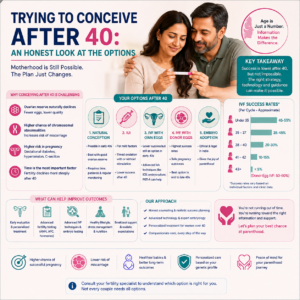
Trying to conceive after 40 changes the problem. The limiting factor is almost always egg quality and rarely the uterus, so the sensible response is to compress the timeline and not to widen the search for a treatable cause. Investigation should begin at once and not after a year of trying, treatment decisions should be made in months and not years, and the conversation about donor eggs should be opened early. It is no answer for everyone, but it stops being an option if it is raised too late.
What This Article Sets Out to Do
Most content written for women trying to conceive after 40 fails in one of two ways. It is relentlessly reassuring and quotes the exceptional case as if it were typical, or it is so bleak that it discourages women who still have a genuine chance. Neither helps someone who has to decide this month.
What follows is a decision framework and makes no promises: what actually changes with age, how quickly to move, what each available option can and cannot do, where the unproven treatments sit, and the obstetric side of the question that fertility content routinely leaves out.
What Actually Changes After 40, and What Does Not
Egg number and egg quality are two separate problems
Ovarian reserve, meaning how many eggs remain, declines steadily and can be measured. Egg quality, meaning the likelihood that an egg will produce a chromosomally normal embryo, declines separately and cannot be measured directly at all. The difference explains a pattern that confuses many patients: a woman of 41 with a reassuring reserve result may still have a low chance per cycle, while a woman of 33 with a poor reserve result may do well.
Reserve testing tells you roughly how many eggs a stimulation cycle is likely to yield and nothing about what those eggs are worth. Age is still the best available proxy for quality, so a treatment plan after 40 is built around age first and reserve second. A separate article covers how to interpret reserve results, including where a low AMH result sits in that picture.
The uterus is usually not the limiting factor
This is the most under-appreciated fact in the whole subject, and it is why donor egg treatment works as well as it does at older ages. Uterine receptivity is preserved far better with age than ovarian function. Fibroids, adenomyosis, polyps or a thin lining can cause problems at any age, and a female fertility evaluation should look for them. Without a specific finding, though, a 42-year-old uterus is generally capable of carrying a pregnancy. The difficulty lies upstream, in the egg.
How Long Should You Try Before Seeking Help?
At 40 and above, not at all, in the sense that the usual waiting period does not apply. NICE guideline NG257, which updates and replaces CG156, recommends at 1.16.8 that specialist referral be offered at presentation when the woman is aged 36 years or over. After 40, waiting a further six or twelve months to “see what happens” spends the one resource that cannot be recovered.
That does not mean treatment must start immediately. It means the assessment should, covering semen analysis, tubal assessment, ovarian reserve, thyroid function and a pelvic ultrasound, so that the next decision is made with information and without it. An assessment completed in three weeks costs only three weeks. A year of unmonitored trying at 41 is materially different from a year at 31.
What the Published Data Show About Age and Treatment Outcome
The UK’s Human Fertilisation and Embryology Authority publishes national registry outcomes for every licensed clinic in the country, which makes it one of the few sources free of selective reporting. In its report Fertility treatment 2024: trends and figures, published in June 2026, the average birth rate per embryo transferred using a patient’s own eggs was 30 per cent across all ages, 38 per cent for patients aged 18 to 34 and 8 per cent for patients aged 43 to 44. The average age of a patient starting IVF was 34.8 years.
Three cautions go with those numbers. They are per embryo transferred and not per cycle started, and after 40 a meaningful share of cycles never reach transfer. They are national averages across all diagnoses, so they describe a population and no individual. And they are UK data. Clinic-specific and India-specific outcomes differ, and Wellspring’s own figures, and how they vary by age and indication, belong in consultation and on the relevant treatment pages and have no place in a general article.
What the registry data establish beyond dispute is the shape of the curve. The decline from the early thirties to the mid-forties is steep and continuous and no protocol reverses it. What treatment can do is make the most of the eggs that remain, within a shorter window.
Miscarriage Risk Rises Before the Chance of Conception Reaches Zero
Conceiving is only the first hurdle, and after 40 it is often not the hardest. The clearest data come from a prospective register-based study of 421,201 pregnancies in Norway, published in The BMJ in 2019, which reported the risk of miscarriage by maternal age across a whole national population.
Maternal age | Proportion of pregnancies ending in miscarriage |
|---|---|
Under 20 | 15.8% |
20 to 24 | 11.5% |
25 to 29 | 9.8% |
30 to 34 | 11.0% |
35 to 39 | 15.0% |
40 to 44 | 24.5% |
45 and over | 53.6% |
Source: Magnus MC et al., The BMJ 2019;364:l869. Risk is lowest at ages 25 to 29, with the absolute minimum at age 27, and rises sharply afterwards.
Read this the right way round. At 40 to 44, roughly three quarters of recognised pregnancies do not end in miscarriage. The risk is far higher than at 30 and is still not the majority outcome. A positive test after 40 therefore calls for earlier reassurance scanning and closer support, and it does not mean the pregnancy is unlikely to continue.
The Options, and What Each One Can and Cannot Do
Option | What it addresses | What it does not do | Where it usually fits after 40 |
|---|---|---|---|
Timed intercourse with monitoring | Timing errors only | Nothing about egg quality or quantity | Reasonable for a short, defined trial at 40 to 41 with a normal assessment; not a plan for 43 |
Ovulation induction with IUI | Ovulatory and mild male-factor problems, sperm placement | Does not select embryos or improve egg quality | Limited value above 40; where used, a small fixed number of cycles with a firm stopping point |
IVF with your own eggs | Maximises the number of eggs obtained per attempt and allows embryo selection | Cannot create eggs that are not there, or make an abnormal egg normal | The main option while own-egg treatment is still reasonable; often planned as more than one cycle |
IVF with genetic testing of embryos | Identifies chromosomally normal embryos among those produced | Does not increase the number of embryos, and cannot help if none reach testing | Discussed case by case; of limited use where very few embryos are expected |
Intraovarian PRP and similar | Proposed to improve response in poor responders | Not established; no reliable benefit for live birth demonstrated | Only within the narrow, consented circumstances set out below |
Donor egg IVF | Replaces the egg-quality problem entirely | Does not change the obstetric risks of pregnancy at an older age; involves a genetic decision the couple must make | The option with the most predictable outcome once own-egg treatment is genuinely exhausted |
Where Ovarian PRP and Other Add-Ons Sit
Women in their forties are the group most heavily marketed to for unproven treatments, for a simple reason: they have the strongest motivation and the least time to evaluate claims. It is worth being precise about the position.
Intraovarian platelet-rich plasma is not an established treatment. Randomised evidence shows no consistent benefit for pregnancy or live birth, and no honest success rate can be quoted for it. There are narrow circumstances in which ovarian rejuvenation may reasonably be discussed: a documented history of poor response, an already optimised stimulation protocol that has not worked, a woman who wants to exhaust autologous options before considering donor eggs, and written acknowledgement that live-birth benefit is unestablished. It should not be offered to a woman who has not yet had an adequate individualised stimulation cycle or who has normal ovarian reserve, or bundled into a package, and it should never be sold with a quoted success rate.
After 40 the deeper risk lies in the delay an intervention can cause and less in the intervention itself. Two years spent working through one unproven option after another cost exactly the years that still held a realistic chance. Any add-on considered at this age should come with a date on which the decision will be reviewed.
When Does Donor Egg IVF Become the Honest Recommendation?
No single age exists at which the answer flips, and any clinic that names one is oversimplifying. The point is reached through a combination of factors: repeated cycles that give very few or no transferable embryos, a reserve result suggesting that further stimulation is unlikely to yield more, and the woman’s own view about how many more attempts she is willing to make.
What can be said clearly is that when autologous options are truly exhausted, donor egg IVF has substantially better and more predictable outcomes, because it removes the variable that age affects most. In India, donor gametes may be obtained only through a registered ART bank. Direct or known donation is not permitted, donors must meet the eligibility criteria in the ART (Regulation) Act, 2021, and the arrangement is altruistic and not commercial.
Two things deserve saying about the emotional side, because they usually go unsaid. The decision is genuinely a loss, and treating it as a purely technical step does patients no favours. And the decision is easier to make well when it is raised early as one of several possible paths, and presented at the end as the only remaining option it is much harder. Raising it early is not pressure to take it.
Pregnancy After 40 Is Also an Obstetric Question
Fertility content tends to stop at the positive pregnancy test. It should not, because the risk profile of the pregnancy is part of an informed decision. It is also one of the few parts of this subject that donor eggs do not change, since obstetric risk follows the age of the woman carrying the pregnancy and not the age of the egg.
A systematic review and meta-analysis of 75 studies covering more than 44 million births, published in PLOS ONE in 2017, found that maternal age of 35 or above was associated with higher odds of stillbirth (odds ratio 1.75, 95% confidence interval 1.62 to 1.89) and of fetal growth restriction (odds ratio 1.23, 95% confidence interval 1.01 to 1.52), together with higher rates of gestational diabetes, pre-eclampsia, placental abruption, preterm birth and low birth weight. Maternal co-morbidities and the use of assisted reproduction did not fully explain the association with stillbirth.
The 2025 ASRM Ethics Committee opinion on assisted reproduction with advancing maternal age is more specific about the upper end. It notes that medical and obstetric complications, particularly hypertensive disorders, gestational diabetes and intrauterine growth restriction, are significantly more common in those carrying a pregnancy above the age of 45, and reports pregnancy-induced hypertension in 16.7 per cent of women aged 45 to 49 against 33.3 per cent of women aged 50 or older. It recommends that women of advanced reproductive age who plan to carry a pregnancy have a comprehensive medical assessment focused on cardiovascular and metabolic fitness, with counselling that, where appropriate, includes a maternal-fetal medicine specialist.
None of this is a reason not to proceed, and large numbers of women have safe pregnancies in their forties. It is a reason for the pre-treatment assessment to cover blood pressure, glycaemic status and cardiovascular risk as well as fertility markers, and for antenatal care to be planned as higher-surveillance from the outset and not adjusted after a complication appears.
A Realistic Decision Sequence
- Complete the assessment now and not after another six months. Both partners, within weeks, and include general health markers as well as fertility tests.
- Set a short, explicit trial period if the assessment is normal and you are 40 or 41. Three to six months of monitored attempts with a fixed review date, and no open-ended plan.
- Move to IVF with a stated number of attempts. Decide in advance how many cycles you will undertake with your own eggs and what result would change the plan. That is far easier before the first cycle than after a disappointing one.
- Review after each cycle against the eggs and embryos obtained and not against how the cycle felt. The number of transferable embryos is the informative signal.
- Have the donor egg conversation early and revisit it, and do not defer it. Whether or not you take that route, knowing what it involves makes every earlier decision clearer.
- Plan the pregnancy as well as the conception. Optimise blood pressure, weight, glycaemic control and thyroid function before treatment and avoid leaving it to pregnancy.
When to See a Fertility Specialist
At 40 or above, a specialist assessment is appropriate at the point you decide you want to conceive, with no defined period of trying first. It becomes urgent if periods have become shorter or irregular, if there is a history of ovarian surgery, chemotherapy or radiotherapy, a family history of early menopause, two or more miscarriages, or a previous low ovarian reserve test. None of these findings means treatment will not work. They mean the assessment should not wait.
Frequently Asked Questions
What are the chances of IVF success after 40?
National registry data give the clearest picture of the trend: the HFEA reported a birth rate of 38 per cent per embryo transferred for patients aged 18 to 34 in 2024, falling to 8 per cent for patients aged 43 to 44, using their own eggs. Individual prognosis varies considerably with ovarian reserve, the number of embryos obtained and the underlying diagnosis, so a figure that means anything for you comes from your own assessment. Wellspring’s outcome data by treatment type are set out on the relevant IVF treatment pages.
Is donor egg IVF the only option after 42?
No. Own-egg IVF is still attempted at 42 and beyond, and some women succeed. What changes is the probability per cycle and the proportion of cycles that produce a transferable embryo, which is why the number of attempts and the stopping point should be agreed in advance. Donor egg treatment is the option with the most predictable outcome, not the only one available.
How does age change the fertility treatment plan?
It changes the pace more than the content. The same investigations are performed and the same treatments are available, but the intervals between steps compress, low-yield options such as prolonged IUI are used more sparingly or skipped, cycles are reviewed against embryo numbers rather than repeated on hope, and the donor egg discussion happens early rather than last. NICE guideline NG257 reflects the same logic in its access criteria, recommending IVF for those who have not yet reached their 42nd birthday, and a single full cycle for a woman aged 40 or 41 who has not previously had IVF.
Can anything improve egg quality at 41?
No treatment has been shown to restore egg quality once it has declined. Supplements, protocols and add-ons are marketed for this purpose, and the evidence does not support the claim. What can be optimised is everything around the egg: the stimulation protocol, the laboratory conditions, thyroid and metabolic status, smoking and alcohol, and the timing of decisions. These are worth doing. They are not the same as reversing age.
Should I freeze eggs at 40?
Egg freezing preserves what exists; it does not recover what has already gone, and its value falls steeply with age. At 40 the yield per cycle is usually low and the number of eggs needed for a reasonable chance is high. It may still be reasonable in specific situations, such as where treatment must be deferred for a medical reason, but it is rarely the right answer to the question “should I buy myself more time?” asked at 40.
Does a low AMH result at 41 mean IVF will not work?
No. Reserve markers predict how many eggs a cycle is likely to yield, not whether those eggs can produce a pregnancy. A low result at 41 argues for moving without delay and for a realistic plan about the number of attempts. It is not, by itself, a reason to be refused treatment.
The Short Version
After 40 the decision that matters most is how quickly to choose a treatment, and which treatment comes second. Assessment should be immediate, low-yield options should be time-limited, each cycle should be judged on the embryos it produced, and the donor egg conversation should be opened early enough to remain a real choice. The pregnancy itself deserves planning as well. The obstetric risks are modest but real, they are largely modifiable in advance, and they follow the age of the woman carrying the pregnancy whoever provided the egg.
Women aged 40 and above who are trying to conceive, or who want an assessment before deciding what to do next, can discuss their individual situation with a fertility specialist at Wellspring IVF & Women’s Hospital, Ahmedabad. Appointments can be arranged on +91 9099946050, Monday to Saturday, 10:00 AM to 4:00 PM.
References
- Human Fertilisation and Embryology Authority. Fertility treatment 2024: trends and figures. Published 16 June 2026. https://www.hfea.gov.uk/about-us/publications/research-and-data/fertility-treatment-2024-trends-and-figures
- Magnus MC, Wilcox AJ, Morken N-H, Weinberg CR, Håberg SE. Role of maternal age and pregnancy history in risk of miscarriage: prospective register based study. The BMJ 2019;364:l869. doi:10.1136/bmj.l869. https://www.bmj.com/content/364/bmj.l869
- Lean SC, Derricott H, Jones RL, Heazell AEP. Advanced maternal age and adverse pregnancy outcomes: a systematic review and meta-analysis. PLOS ONE 2017;12(10):e0186287. doi:10.1371/journal.pone.0186287. https://journals.plos.org/plosone/article?id=10.1371/journal.pone.0186287
- Ethics Committee of the American Society for Reproductive Medicine. Assisted reproduction with advancing paternal and maternal age: an Ethics Committee opinion. Fertility and Sterility 2025;123:999–1005. https://www.asrm.org/practice-guidance/ethics-opinions/assisted-reproduction-with-advancing-paternal-and-maternal-age-an-ethics-committee-opinion-2025/
- National Institute for Health and Care Excellence. Fertility problems: assessment and treatment. NICE guideline NG257, published 31 March 2026 (updates and replaces CG156). https://www.nice.org.uk/guidance/ng257/resources/fertility-problems-assessment-and-treatment-pdf-66144022104517
- Practice Committee of the American Society for Reproductive Medicine and the Genetic Counseling Professional Group. The use of preimplantation genetic testing for aneuploidy: a committee opinion. Fertility and Sterility 2024;122:421–434. https://www.asrm.org/practice-guidance/practice-committee-documents/the-use-of-preimplantation-genetic-testing-for-aneuploidy-a-committee-opinion-2024/
- Government of India. The Assisted Reproductive Technology (Regulation) Act, 2021 (Act No. 42 of 2021). India Code. https://www.indiacode.nic.in/handle/123456789/17031


