
Published: 10 November 2026
Last medically reviewed by Dr. Pranay Shah: 28 November 2026.
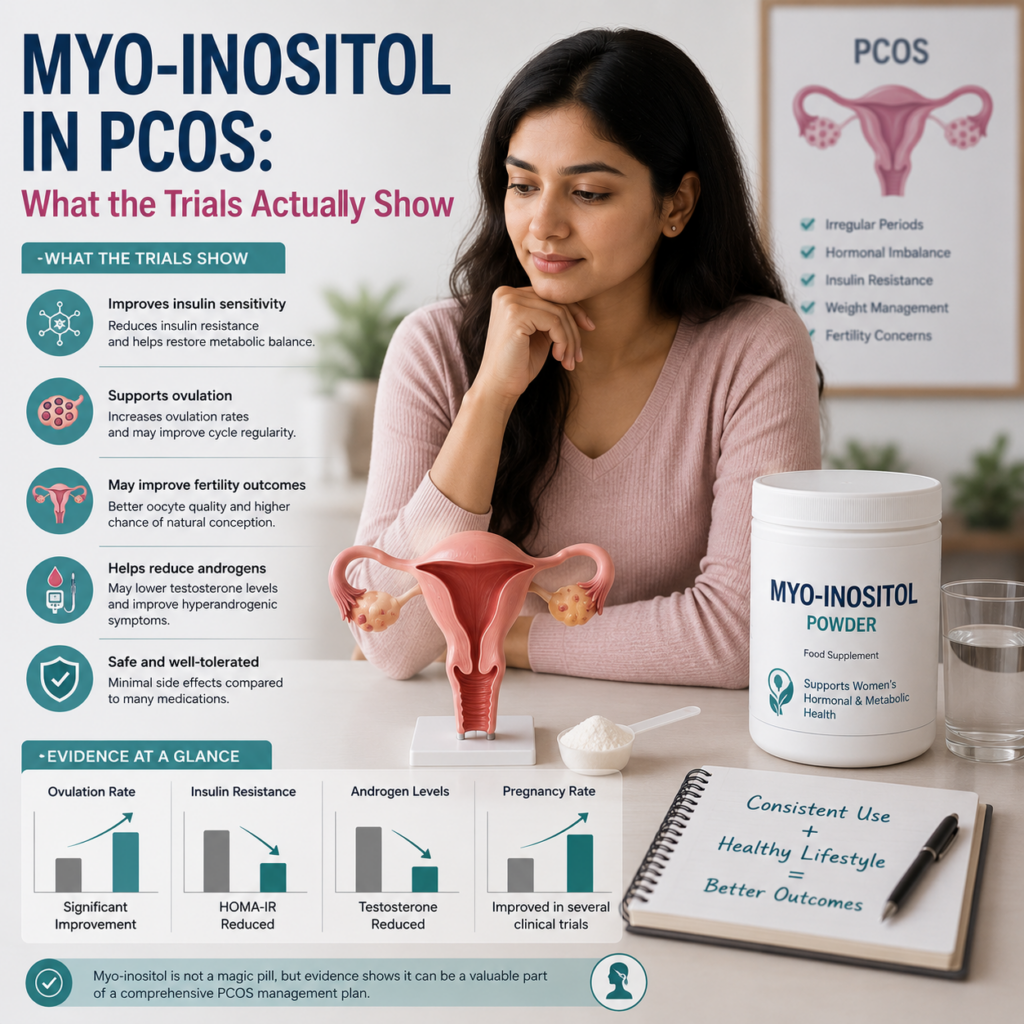
Myo-inositol for PCOS probably improves ovulation and several metabolic markers, but the evidence that it raises pregnancy or live birth rates is low to very low certainty. The 2026 International Evidence-based Guideline concludes that inositol “offers limited clinical benefits” and places metformin ahead of it. Myo-inositol is not an ovulation induction drug, and it does not replace letrozole for a woman who is actively trying to conceive.
Inositol is the most heavily marketed supplement in polycystic ovary syndrome. Indian pharmacies and online shops sell it in dozens of formulations, usually with claims about ovulation, egg quality and “natural” hormone balance. Trial data support some of those claims and do not support several others. This article separates the two, using the systematic reviews and the international guideline and leaving product literature aside, and it states the certainty of the evidence behind each claim and not only its direction.
Why Is PCOS Now Also Called PMOS?
In May 2026 an international consensus process formally renamed the condition. Polycystic ovary syndrome (PCOS) is now polyendocrine metabolic ovarian syndrome (PMOS). The International Evidence-based Guideline was updated in June 2026 to carry the new name, and the American Society for Reproductive Medicine has adopted it in its practice guidance.
The old name described the least important feature. The “cysts” seen on ultrasound are arrested antral follicles and no true cysts. The guideline notes that the original name implied pathological ovarian cysts “which are not a feature of the condition,” and that this contributed to delayed diagnosis and fragmented care. The new name puts the endocrine and metabolic nature of the syndrome where it belongs.
Nothing about your diagnosis or your treatment changes because of the rename. The diagnostic criteria are the same, the management recommendations are the same, and your existing reports remain valid. During the transition the guideline uses the paired form PMOS/PCOS. PCOS is still the term almost every patient and most clinicians in India use, and it is used throughout below.
What Inositol Is, and Why It Was Proposed for PCOS at All
Inositol is a sugar alcohol that the body makes and also takes in from food. It is neither a hormone nor a drug. Its relevance to PCOS comes from its role in the insulin signalling pathway, where inositol-containing molecules act as second messengers that carry the insulin signal from the cell surface to the machinery inside the cell.
Two forms matter clinically:
- Myo-inositol (MI) is the dominant form in the body and the most abundant inositol in ovarian follicular fluid, where it takes part in follicle-stimulating hormone signalling and oocyte development.
- D-chiro-inositol (DCI) is made from myo-inositol by an insulin-dependent enzyme and is involved mainly in insulin-mediated glucose storage.
The hypothesis behind inositol therapy is that insulin resistance, which sits at the centre of PMOS/PCOS in a large share of women, disturbs the balance between these two forms inside the ovary. Correcting the balance, the argument runs, should improve both the metabolic and the ovulatory picture. This is where the widely marketed 40:1 myo-inositol to D-chiro-inositol ratio comes from, since it approximates the ratio reported in the follicular fluid of healthy ovaries.
That is a coherent mechanism. A coherent mechanism is still short of a demonstrated clinical benefit, and the distance between the two is what the rest of this article is about.
Does Myo-Inositol for PCOS Work? Claim Versus Evidence
The table sets each common claim against the best available evidence and the certainty grade assigned to it. Certainty matters more than the size of an effect, because a large effect measured with very low certainty is a hypothesis and no finding.
Claim commonly made | What the evidence actually shows | Certainty of the evidence |
|---|---|---|
“Inositol restores ovulation” | A 2026 umbrella review of 13 meta-analyses found inositol increased the ovulation rate compared with placebo or folic acid (RR 2.75, 95% CI 1.71–4.41). This is the single strongest finding in the inositol literature. | Moderate |
“Inositol lowers testosterone and improves insulin resistance” | The same umbrella review reported reductions in total testosterone (MD −0.91 nmol/L), free testosterone and HOMA-IR (MD −1.14) against placebo or folic acid. | Moderate |
“Inositol helps you get pregnant” | Mixed and inconsistent. The umbrella review found higher pregnancy rates against metformin (RR 1.43, 95% CI 1.14–1.79). The Cochrane review of subfertile women with PCOS found no statistically significant difference in clinical pregnancy (OR 1.27, 95% CI 0.87–1.85; 4 trials, 535 women). | Very low (Cochrane) to moderate (umbrella review, versus metformin only) |
“Inositol increases live birth” | Not established. Cochrane found only 2 trials with 84 women in total reporting live birth (OR 2.42, 95% CI 0.75–7.83), a confidence interval wide enough to include no effect at all. The umbrella review reported RR 2.29 (95% CI 1.07–4.93) but graded it low. | Very low to low |
“Inositol improves egg quality” | There is no adequately powered trial evidence that inositol improves oocyte quality measured by an outcome that matters to a patient. The claim rests on follicular-fluid biochemistry and small studies using laboratory surrogates. | Not established |
“Inositol reduces miscarriage” | Cochrane reported a lower miscarriage rate (OR 0.40, 95% CI 0.19–0.86; 4 trials, 535 women), but rated the evidence very low certainty and the absolute numbers are small. | Very low |
“Inositol works as well as, or better than, metformin” | The 2026 guideline states the opposite: metformin has greater efficacy. The systematic review that informed it found metformin may improve waist-hip ratio and hirsutism more than inositol, with likely no difference for reproductive outcomes. Inositol does cause fewer gastrointestinal side effects. | Low, and pointing towards metformin |
“Inositol can replace fertility treatment” | No. Letrozole is the guideline’s first-line pharmacological infertility therapy in PMOS/PCOS. Inositol is not an ovulation induction agent and has never been trialled as one against letrozole. | Contradicted by guideline |
Why Two Credible Sources Disagree
A careful reader will notice a real conflict. The 2026 umbrella review in Frontiers in Endocrinology concludes that “inositol improves core PCOS manifestations” and calls it “a promising therapy.” The 2026 International Evidence-based Guideline states that “metformin is recommended primarily for metabolic features and has greater efficacy than inositol, which offers limited clinical benefits in PMOS.”
Both statements can be true together, and seeing why is the most useful thing on this page.
- They grade different outcomes. The umbrella review’s moderate-certainty findings concern ovulation, testosterone and HOMA-IR, which are intermediate markers. The guideline judges an intervention mainly on the outcome patients actually came for: a pregnancy that continues to a live birth. For those outcomes the evidence is low or very low certainty in every analysis, the umbrella review’s own included.
- The underlying trials overlap heavily. An umbrella review pools meta-analyses, and those meta-analyses draw on largely the same small set of primary trials. The same handful of studies can therefore seem to be confirmed repeatedly when they have only been counted again.
- The primary trials are small and short. The systematic review that informed the guideline update, published in the Journal of Clinical Endocrinology & Metabolism in 2024, found 30 trials with 2,230 participants in total, fewer than 75 women per trial on average, most followed for three to six months.
- The umbrella review’s own quality audit is sobering. Across all the outcomes it assessed, none of the evidence was high quality. Of it, 18.9% was moderate, 40% low and 41.1% very low.
The JCEM authors state the position plainly: “The evidence supporting the use of inositol in the management of PCOS is limited and inconclusive. Clinicians and their patients should consider the uncertainty of the evidence together with individual values and preferences when engaging in shared decision-making regarding the use of inositol for PCOS.”
The Cochrane review arrives at the same place from another direction: “In light of available evidence of very low quality, we are uncertain whether MI improves live birth rate or clinical pregnancy rate in subfertile women with PCOS.”
What Dose of Inositol Was Used in the PCOS Trials?
Patients ask this often, and the honest answer is that no therapeutic dose has been established, because inositol has never been through the dose-finding programme a prescription drug undergoes.
What can be reported accurately is the range used in the published trials, as recorded in the systematic review that informed the guideline update.
Preparation | Daily dose range used in trials | Typical trial duration |
|---|---|---|
Myo-inositol (MI) alone | 1.2 g to 4 g daily, most commonly 2 g twice daily | 12 to 24 weeks |
D-chiro-inositol (DCI) alone | 600 mg to 1,200 mg daily | 12 to 24 weeks |
MI + DCI combination | Usually a 40:1 ratio | 12 to 24 weeks |
Folic acid (co-administered in most trials) | 200 to 400 micrograms | Throughout |
Two practical cautions follow. Most trials co-administered folic acid, so the comparison arm in several studies was folic acid and no true placebo, which is one reason the results are hard to interpret. And the dose printed on a retail product may bear no relationship to these ranges, since combination products often hold a fraction of the trial dose alongside several other ingredients.
Is Inositol Better Than Metformin?
On the evidence as it stands, no, although the comparison is more nuanced than a single winner.
Consideration | Metformin | Myo-inositol |
|---|---|---|
Regulatory status | Prescription medicine, assessed for efficacy and safety by drug regulators | Nutraceutical or food supplement in most markets, including India; not assessed as a drug for efficacy |
2026 guideline position | Recommended primarily for metabolic features; greater efficacy | “Offers limited clinical benefits” |
Metabolic effect | Established insulin-sensitising effect; decades of clinical use | Moderate-certainty improvement in HOMA-IR and androgens versus placebo |
Hirsutism and waist-hip ratio | May be superior | Less effect reported |
Reproductive outcomes | Likely no meaningful difference between the two | Likely no meaningful difference between the two |
Tolerability | Gastrointestinal side effects common, sometimes dose-limiting | Fewer gastrointestinal adverse events; those reported are typically mild and self-limiting |
Cost over six months | Generally low in India | Varies widely by brand and formulation |
Tolerability is a genuine advantage and not a trivial one. A supplement a woman keeps taking has more real-world effect than a medicine she stops after three weeks because of nausea, and that is a legitimate reason for a clinician and patient to discuss inositol. It gives no ground for calling it a superior therapy.
The Society of Obstetricians and Gynaecologists of Canada position statement of February 2025 lands in the middle. It concludes that “inositol could be considered in those with PCOS; there is limited potential for harm and some demonstrated potential for metabolic and menstrual cycle improvement”, a conditional recommendation on low-certainty evidence, while also stating that the evidence on benefit “was inadequate to make an evidence-based recommendation on efficacy for clinical outcomes.”
Where Does Inositol Fit in a Fertility Plan?
For a woman with PMOS/PCOS who is trying to conceive, the guideline sequence is unambiguous and inositol is not part of it. Letrozole is the first-line pharmacological infertility therapy, with clomiphene alone or combined with metformin, gonadotrophins or ovarian surgery as second-line options.
Structured lifestyle modification remains the foundation at every stage. A stepped approach, with lifestyle first, then insulin sensitisation where indicated, then ovulation induction, then assisted reproduction only when clinically justified, is how PCOS treatment is sequenced at Wellspring IVF & Women’s Hospital.
Inositol can reasonably sit alongside that sequence as an adjunct, especially for a woman who is not yet trying to conceive and whose main concerns are cycle regularity and metabolic markers. It should never delay the sequence. Inositol most often does harm through six or nine months spent on a supplement while ovulation induction is postponed, in a situation where age or ovarian reserve made time the scarcest resource. And when PCOS is not the only factor, the wider causes of female infertility need assessment in parallel and not afterwards.
Where IVF does become the right step, PCOS brings its own protocol considerations, particularly around ovarian hyperstimulation risk, which we cover separately in our guide to PCOS and IVF. If IVF is recommended, our fee page explains what an IVF cycle costs in Ahmedabad and which items are billed separately.
Is Inositol Safe, and What Should You Check on the Label?
Inositol has a good safety record. The most commonly reported adverse effects are mild gastrointestinal symptoms at higher doses, and they are less frequent than with metformin. The trial literature shows no signal of serious harm.
The regulatory point matters more than the safety point. As the SOGC statement puts it, patients should be reminded that inositol “is a natural health product and thus regulated and evaluated differently than prescription drug products.” In India inositol products are sold as nutraceuticals or dietary supplements. They do not have to show efficacy for a medical indication, and one brand’s “PCOS formula” may differ substantially from another’s.
If you are taking or considering inositol, check these things on the actual pack and not in the advertisement.
- Which inositol is in it: myo-inositol, D-chiro-inositol or both. Many products list only “inositol.”
- How many milligrams, per capsule and per recommended daily dose. Compare this with the trial ranges in the table above.
- The MI:DCI ratio, if it is a combination product.
- Whether folic acid is included, and at what dose. This matters if you are trying to conceive and already take a separate preconception folate supplement.
- What else is in the blend. Multi-ingredient “PCOS” products often contain chromium, berberine, vitamin D or herbal ingredients, each with its own evidence base and interaction profile.
- Whether it duplicates something already prescribed to you.
Bring the actual container to your consultation. A photograph of the ingredients panel helps your clinician more than the brand name does.
When to See a Fertility Specialist Rather Than Extend a Supplement Trial
Evaluation is appropriate, in place of a further supplement course, if any of these apply.
- You are under 35 and have been trying to conceive for 12 months without success.
- You are 35 or older and have been trying for 6 months.
- Your cycles stay irregular or absent after three to six months of lifestyle change, with or without inositol.
- You have never had a baseline fertility assessment, and neither has your partner. Male factor is present in a substantial share of couples and treating the woman alone will not detect it.
- You have symptoms that suggest an additional diagnosis, such as significant pelvic pain, unusually heavy bleeding, or a history of pelvic surgery or infection.
- You have had recurrent pregnancy loss.
Sudden severe abdominal pain, heavy vaginal bleeding or fainting needs urgent medical attention and no supplement review.
Frequently Asked Questions
Does myo-inositol help ovulation in PCOS?
Probably yes. This is the strongest finding in the inositol evidence base: the 2026 umbrella review reported a higher ovulation rate against placebo or folic acid (RR 2.75, 95% CI 1.71–4.41) on moderate-certainty evidence. Ovulating more often is a real benefit. It does not automatically translate into a higher live birth rate, and the live-birth evidence remains low to very low certainty.
Is inositol better than metformin for PCOS?
The 2026 International Evidence-based Guideline concludes that metformin has greater efficacy and that inositol offers limited clinical benefits. Inositol is better tolerated, with fewer gastrointestinal adverse events, and reproductive outcomes appear similar between the two. Tolerability is a legitimate reason to prefer it in an individual case; superior efficacy is not currently supportable.
What dose of inositol was used in the PCOS trials?
Myo-inositol was used at 1.2 g to 4 g daily, most commonly 2 g twice daily. D-chiro-inositol was used at 600 mg to 1,200 mg daily. Combination products in trials generally used a 40:1 myo to D-chiro ratio, and most trials co-administered 200 to 400 micrograms of folic acid. Treatment periods were typically 12 to 24 weeks. No formal dose-finding programme has established an optimal dose.
Can inositol improve egg quality?
This is not established. The claim comes from the observation that myo-inositol is abundant in follicular fluid, and from small studies using laboratory surrogate measures. No adequately powered trial has shown that inositol improves an outcome that would demonstrate better egg quality in a way that matters clinically — such as live birth. It is a reasonable hypothesis, not a demonstrated effect.
How long does inositol take to work?
Trials that reported benefit generally ran for 12 to 24 weeks, so a three-month course is a reasonable assessment period. If cycles have not become more regular after three to six months, continuing indefinitely without reassessment is not a good use of time — particularly if you are trying to conceive.
Is inositol safe during pregnancy?
Inositol has not been shown to be harmful, but it has also not been formally evaluated as a pregnancy medicine, and it is regulated as a supplement rather than a drug. Any supplement you are taking should be reviewed with your obstetrician once pregnancy is confirmed, along with the rest of your medication.
Do I still need letrozole if I am taking inositol?
If you are actively trying to conceive and not ovulating reliably, yes — letrozole is the guideline’s first-line ovulation induction therapy, and inositol has never been shown to substitute for it. The two address different questions: inositol targets the underlying metabolic picture, while letrozole induces ovulation in a specific cycle.
The Practical Conclusion
Myo-inositol is a low-risk, generally well-tolerated supplement. It has moderate-certainty evidence for improving ovulation and metabolic markers in PMOS/PCOS and low to very low certainty evidence for the outcomes patients actually want. That is a defensible position for an adjunct. It is no defensible position for a primary fertility treatment, and it does not support most of the claims in the marketing around it.
The decision to take it should be made the way the guideline suggests, through shared decision-making that weighs genuine uncertainty against individual preferences and circumstances. It should never be the reason a fertility evaluation is put off.
If you have PCOS and your cycles remain irregular, or you have been trying to conceive without success, you can discuss your individual situation with a fertility specialist at Wellspring IVF & Women’s Hospital, Ahmedabad. Call +91 9099946050. OPD hours are Monday to Saturday, 10:00 AM to 4:00 PM.
References
- Centre for Research Excellence in Women’s Health in Reproductive Life, Monash University, with ASRM, ESHRE, the Endocrine Society and the European Society of Endocrinology. International Evidence-based Guideline for the Assessment and Management of Polyendocrine Metabolic Ovarian Syndrome, updated June 2026. https://www.monash.edu/__data/assets/pdf_file/0009/4360095/Updated-PMOS-Guideline-12-June26.pdf
- Fitz V, Graca S, Mahalingaiah S, et al. Inositol for Polycystic Ovary Syndrome: A Systematic Review and Meta-analysis to Inform the 2023 Update of the International Evidence-based PCOS Guidelines. Journal of Clinical Endocrinology & Metabolism. 2024;109(6):1630–1655. doi:10.1210/clinem/dgad762. https://academic.oup.com/jcem/article/109/6/1630/7504796 PubMed 38163998
- Showell MG, Mackenzie-Proctor R, Jordan V, Hodgson R, Farquhar C. Inositol for women with a diagnosis of polycystic ovary syndrome and subfertility. Cochrane Database of Systematic Reviews. 20 December 2018;CD012378. https://www.cochrane.org/evidence/CD012378_inositol-women-diagnosis-polycystic-ovary-syndrome-and-subfertility
- Vercoe MA, Rodenburg C, Mackenzie-Proctor R, et al. Inositol for infertile women with polycystic ovary syndrome. Cochrane Database of Systematic Reviews. 18 November 2026;CD012378.pub3 (update of the 2018 review). PubMed 43049177
- Duan M, Yang M, Li C, Wu X, Yin X, Zhu H. Effects of inositol in women with polycystic ovary syndrome: an umbrella review of meta-analyses from randomized controlled trials. Frontiers in Endocrinology. 2026;17:1741509. doi:10.3389/fendo.2026.1741509. https://www.frontiersin.org/journals/endocrinology/articles/10.3389/fendo.2026.1741509/full
- Antaki R, Desrosiers K, Francoeur D, Magee B, Mills K. SOGC Position Statement: Inositol for the Management of Polycystic Ovary Syndrome. Society of Obstetricians and Gynaecologists of Canada, February 2025. SOGC Position Statement: Inositol for the Management of Polycystic Ovary Syndrome (PDF)