

Published: 24 September 2026
Medically reviewed by Dr. Pranay Shah, MS (ObGy), Director & Chief Fertility Consultant, Wellspring IVF & Women’s Hospital, Ahmedabad
Last medically reviewed: 24 September 2026
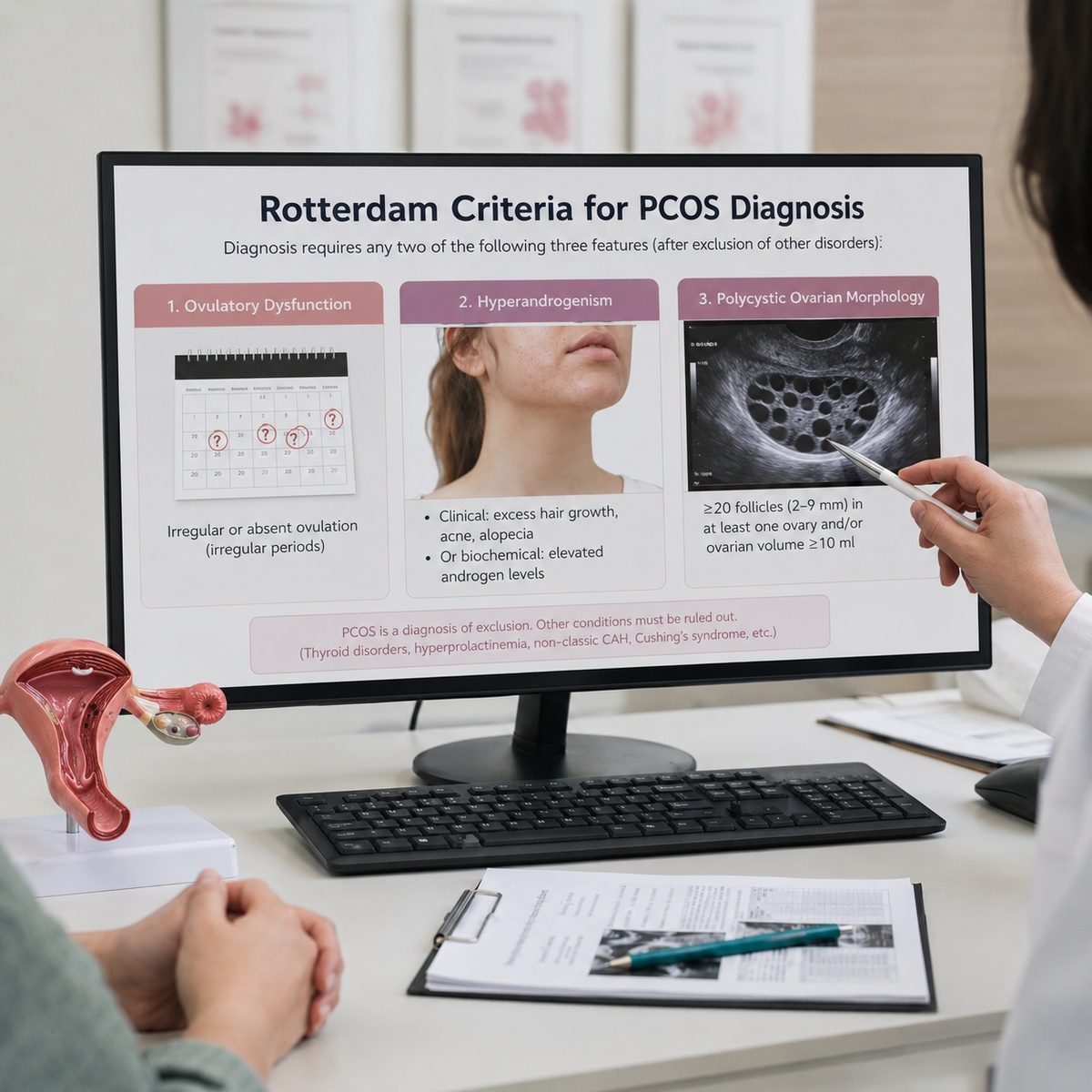
PCOS is diagnosed in adults using the Rotterdam criteria, which require two of three features to be present: irregular or absent ovulation, clinical or biochemical excess of androgens, and polycystic ovarian morphology on ultrasound — or, since the 2023 international guideline, a raised anti-Müllerian hormone (AMH) level in place of the ultrasound. Other conditions that mimic PCOS must be excluded first. Because only two of three are needed, an ultrasound is not always necessary, and a scan alone can never make the diagnosis.
That last point causes more confusion in clinic than any other. A very large number of women arrive with a scan report saying “polycystic ovaries” and assume the question is settled. It is not — in either direction. Some of them do not have PCOS. Others have PCOS with entirely normal-looking ovaries. This article explains what each of the three criteria actually requires, what has changed in the international guideline, and what a complete diagnostic work-up should include.
First, a name change you will start to see: PCOS is now also called PMOS
In May 2026 the international guideline group renamed the condition. Polycystic ovary syndrome (PCOS) is now formally polyendocrine metabolic ovarian syndrome (PMOS), and the International Evidence-based Guideline was updated in June 2026 to reflect this. The guideline describes a managed transition in which both terms are used together as “PMOS/PCOS” for approximately three years, with exclusive use of the new name expected at the next full guideline update. Major professional bodies including the American Society for Reproductive Medicine have adopted the new terminology in their practice guidance.
The reasoning is that the old name emphasised an ovarian imaging finding that is neither necessary for diagnosis nor the central problem, while the condition is in fact an endocrine and metabolic disorder. For patients, nothing about the diagnosis or its management changes. This article uses “PCOS” throughout because that remains the term you will hear in Indian clinics and see on your reports, but you should not be surprised to encounter “PMOS” on newer documents.
What are the Rotterdam criteria?
The Rotterdam criteria are a rule for combining findings, not a single test. In an adult woman, PCOS is diagnosed when any two of the following three are present and other causes have been excluded.
# | Criterion | What it means in practice |
1 | Ovulatory dysfunction | Irregular, infrequent or absent menstrual cycles, judged against the woman’s gynaecological age (years since her first period) |
2 | Hyperandrogenism | Either clinical signs of androgen excess such as hirsutism, or a raised total or calculated free testosterone on a reliable assay |
3 | Polycystic ovarian morphology, or raised AMH | Follicle number per ovary of 20 or more in at least one ovary on ultrasound — or, in adults, an elevated serum AMH used as an alternative to the scan |
Adapted from the 2023 International Evidence-based Guideline, as updated in 2026. Two of three are required in adults.
Two consequences follow immediately. First, if a woman has irregular cycles and demonstrable hyperandrogenism, she already meets the criteria and an ultrasound adds nothing to the diagnosis. Second, polycystic-looking ovaries on their own are one criterion out of three — and polycystic ovarian morphology is common in women who do not have the syndrome at all.
Criterion 1 — what counts as an irregular cycle?
The guideline defines this precisely, and the definition depends on how long ago you started menstruating rather than on your age in years.
Time since first period (gynaecological age) | Cycle pattern considered irregular |
First year after menarche | Irregularity is normal at this stage and is part of the pubertal transition |
More than 1 year and less than 3 years after menarche | Cycles shorter than 21 days or longer than 45 days |
More than 3 years after menarche, up to perimenopause | Cycles shorter than 21 days, longer than 35 days, or fewer than 8 cycles in a year |
More than 1 year after menarche | Any single cycle longer than 90 days |
Source: 2023 International Evidence-based Guideline, recommendation 1.1.1.
This is worth checking against your own record before an appointment, because “irregular” is used very loosely in conversation. A woman with a consistent 33-day cycle does not have ovulatory dysfunction by these criteria, however irregular it feels compared with a friend’s 28-day cycle. Conversely, eight or fewer periods in a year meets the definition even if each one arrives predictably.
Criterion 2 — how is androgen excess established?
Either clinically or biochemically. Both routes are acceptable and only one is needed.
Clinical hyperandrogenism
The guideline states that the presence of hirsutism alone should be considered predictive of biochemical androgen excess, and recommends a modified Ferriman–Gallwey score of 4 to 6 as the threshold for detecting hirsutism. Acne and androgenic hair loss are recognised but are weaker and less specific signs. A structured examination matters here; hirsutism is frequently under-recorded, particularly where cosmetic hair removal is routine, so tell your clinician what you are already doing about it.
Biochemical hyperandrogenism
The guideline recommends assessing total and free testosterone, with free testosterone estimated by the calculated free androgen index. It also makes a point that is often overlooked in practice: laboratories should use validated, highly accurate assays — liquid chromatography–tandem mass spectrometry (LC-MS/MS) — because widely used direct immunoassays for free testosterone are not reliable at the concentrations found in women. If your report gives a directly measured “free testosterone” from an immunoassay, that number deserves caution rather than confidence.
A further practical point: if you are taking or have recently stopped a combined hormonal contraceptive, androgen levels are suppressed and cannot be interpreted. A washout period is usually needed before testing.
Criterion 3 — ultrasound, or AMH
Do you need an ultrasound to diagnose PCOS?
No, not always. If irregular cycles and hyperandrogenism are both present in an adult, the diagnosis is already made and imaging is not required. Where an ultrasound is indicated and acceptable to the woman, the transvaginal approach is the most accurate for assessing ovarian morphology.
The threshold is a follicle number per ovary of 20 or more in at least one ovary. Where image quality or equipment does not allow reliable follicle counting, the guideline permits the alternatives of an ovarian volume of 10 mL or more, or a follicle number per cross-section of 10 or more, in at least one ovary. This is a common source of confusion in India, where older reports were often issued against a threshold of 12 follicles — a scan reported as polycystic under the older count may not meet the current definition.
Can AMH be used to diagnose PCOS?
Serum AMH can now be used to define polycystic ovarian morphology in adults, as an alternative to ultrasound — this was the most significant change introduced by the 2023 guideline. Two limitations are equally important. AMH should not be used as a single test to diagnose PCOS: it substitutes for one of the three criteria, not for the whole rule. And it is not recommended in adolescents.
There is also no single internationally agreed AMH cut-off. Values differ substantially between assay platforms and between reference populations, so a threshold is meaningful only in relation to the assay and population it was derived from. An AMH figure quoted without its assay is not interpretable, and a high AMH in a woman with regular ovulatory cycles and no androgen excess does not amount to PCOS.
What has to be ruled out before PCOS is diagnosed?
PCOS is a diagnosis of exclusion in the sense that several other conditions produce a similar picture and must be considered first. The guideline identifies the following as the conditions to exclude in routine assessment.
Test | Condition it excludes | Why it matters |
Thyroid stimulating hormone (TSH) | Thyroid dysfunction | Thyroid disease commonly disturbs cycles and is treated quite differently |
Prolactin | Hyperprolactinaemia | Raised prolactin suppresses ovulation and may indicate a pituitary cause |
17-hydroxyprogesterone | Non-classic congenital adrenal hyperplasia | Mimics PCOS closely with hyperandrogenism and irregular cycles; genetic counselling implications differ |
Further testing — for example for Cushing’s syndrome or an androgen-secreting tumour — is indicated only where the clinical picture suggests it, such as rapidly progressive virilisation.
Why adolescents are diagnosed differently
In adolescents the Rotterdam rule does not apply in its adult form. Both hyperandrogenism and ovulatory dysfunction are required, and ultrasound and AMH are not recommended for diagnosis within eight years of the first period. There are no definitive criteria for defining polycystic ovarian morphology on ultrasound in adolescents at all.
The reason is that multifollicular ovaries and irregular cycles are both normal features of the years following menarche, so imaging in this group generates false positives rather than clarity. Where a young woman has features suggestive of PCOS but does not meet the full criteria, the guideline places her in an “at increased risk” category with planned reassessment rather than issuing a label that may follow her for life. If your daughter has been given a PCOS diagnosis on the strength of a scan within a few years of her first period, that is a reasonable thing to ask a specialist to revisit.
Why the criteria used changes the answer — the Indian data
How common PCOS is depends heavily on which rule is applied, and this is not a small effect. A systematic review and meta-analysis of Indian studies (Bharali and colleagues, *Cureus*, 2022) pooling 11 studies and 6,555 women aged 10 to 45 found a prevalence of 11.33% using the Rotterdam criteria (95% confidence interval 7.69–15.59), compared with 5.8% using the older NIH criteria and approximately 10% using the AES criteria.
In other words, roughly twice as many Indian women meet the Rotterdam definition as meet the NIH definition. Neither figure is wrong; they answer different questions. The practical implication for a patient is that if you have been told at different times that you do and do not have PCOS, the explanation may simply be that two clinicians applied two different rules — which is a reason to ask which criteria were used, not a reason to assume one of them was careless.
Internationally, the guideline puts prevalence at 10–13% and notes that it is broadly similar across world regions and ethnicities, though it may be higher in South East Asian and Eastern Mediterranean populations, and that the way the condition presents can differ between ethnic groups.
Myths and what the evidence actually shows
Common claim | What the evidence shows |
“My scan shows polycystic ovaries, so I have PCOS.” | Polycystic ovarian morphology is one of three criteria and is common in women without the syndrome. It cannot make the diagnosis on its own. |
“My ovaries look normal, so I cannot have PCOS.” | If irregular cycles and hyperandrogenism are both present, the criteria are met without any imaging finding. |
“A high AMH means PCOS.” | AMH may substitute for the ultrasound criterion in adults, but is explicitly not to be used as a single diagnostic test, and there is no universal cut-off. |
“PCOS means I will need IVF.” | PCOS is a common and generally treatable cause of ovulatory infertility. Most women with PCOS who conceive do so with ovulation induction rather than IVF. |
“PCOS is only a fertility problem.” | It is an endocrine and metabolic condition with long-term implications beyond fertility, which is part of the reasoning behind the 2026 rename. |
“Cysts on the ovary need to be removed.” | The follicles counted in this diagnosis are not cysts in the surgical sense and are not an indication for surgery. |
When should you see a fertility specialist?
A structured assessment is reasonable in any of the following situations, and earlier rather than later if you are trying to conceive:
- Fewer than eight periods a year, or any cycle longer than 90 days, more than a year after your first period.
- Twelve months of unprotected intercourse without conception — or six months if you are 35 or older.
- A PCOS label given on the basis of a scan alone, with no assessment of cycles or androgens.
- Progressive hirsutism, or rapid onset of androgenic features, which needs assessment for other causes.
- A previous diagnosis made in adolescence that has never been reassessed in adulthood.
A first assessment for suspected PCOS should establish all three criteria properly — a structured cycle history, an examination and androgen profile, and imaging or AMH only where it will change the answer — alongside the exclusion tests above. Because PCOS is one of several conditions that present as irregular cycles and difficulty conceiving, it is usually assessed as part of a broader look at the causes of female infertility rather than in isolation.
Once the diagnosis is secure, management is stepped and individualised, and for most women begins well before any consideration of assisted reproduction; our approach to PCOS treatment sets out that sequence. Where IVF does eventually become relevant, PCOS raises specific safety considerations in stimulation that are worth understanding in advance, which we cover separately in our guide to PCOS and fertility before starting IVF.
Frequently asked questions
How is PCOS officially diagnosed?
By the Rotterdam criteria: two of three features — ovulatory dysfunction, hyperandrogenism, and polycystic ovarian morphology on ultrasound or a raised AMH — after excluding thyroid disease, hyperprolactinaemia and non-classic congenital adrenal hyperplasia.
Is a blood test enough to diagnose PCOS?
No. No single blood test diagnoses PCOS. Bloods establish one criterion and exclude other conditions; the cycle history is indispensable.
Can PCOS be diagnosed if my periods are regular?
Yes, if hyperandrogenism and polycystic ovarian morphology or raised AMH are both present. Regular cycles do not exclude the diagnosis, though they generally indicate that ovulation is occurring.
Does the ultrasound have to be transvaginal?
Where a scan is indicated and acceptable to the woman, the transvaginal approach is the most accurate. Where it is not appropriate or not acceptable, ovarian volume of 10 mL or more may be used instead of a follicle count.
My old report says 12 follicles meant polycystic ovaries. Has that changed?
Yes. The current threshold is 20 or more follicles per ovary in at least one ovary, using appropriate imaging. A scan reported as polycystic against an older threshold should be interpreted against the current criteria.
Should I ask for my diagnosis to be reviewed?
It is reasonable to ask which criteria were applied and which conditions were excluded, particularly if the diagnosis was made on imaging alone, made during adolescence, or made while you were taking hormonal contraception.
The key point to take away
PCOS is a pattern, not a picture. It is established by combining a cycle history, an androgen assessment and — only when it will change the answer — an ultrasound or AMH, with a short list of mimicking conditions excluded first. A diagnosis built on any one of those alone is incomplete, and an incomplete diagnosis leads to the wrong treatment plan.
If you have been told you have PCOS and are unsure how the conclusion was reached, or you have irregular cycles and want a proper assessment before trying to conceive, you can discuss your individual situation with a fertility specialist at Wellspring IVF & Women’s Hospital on +91 9099946050, Monday to Saturday, 10:00 AM – 4:00 PM.
References
- Monash University / International PMOS (PCOS) Network. International Evidence-based Guideline for the Assessment and Management of Polyendocrine Metabolic Ovarian Syndrome (formerly PCOS) — guideline hub and 2026 terminology update. monash.edu
- International PMOS (PCOS) Network. Updated guideline document, 12 June 2026. monash.edu
- Teede HJ, Tay CT, Laven J, et al. Recommendations from the 2023 International Evidence-based Guideline for the Assessment and Management of Polycystic Ovary Syndrome. *Human Reproduction* 2023;38(9):1655–1679. academic.oup.com
- Teede HJ, Tay CT, Laven J, et al. Recommendations from the 2023 International Evidence-based Guideline for the Assessment and Management of Polycystic Ovary Syndrome. *Journal of Clinical Endocrinology & Metabolism* 2023;108(10):2447–2469. academic.oup.com
- American Society for Reproductive Medicine. Recommendations from the 2023 International Evidence-based Guideline for the Assessment and Management of Polyendocrine Metabolic Ovarian Syndrome — ASRM practice guidance. asrm.org
- Bharali MD, Rajendran R, Goswami J, Singal K, Rajendran V. Prevalence of Polycystic Ovarian Syndrome in India: A Systematic Review and Meta-Analysis. *Cureus* 2022;14:e32351. doi:10.7759/cureus.32351. pmc.ncbi.nlm.nih.gov