
Published: 4 October 2026
Medically reviewed by Dr. Pranay Shah, MS (ObGy), Director & Chief Fertility Consultant, Wellspring IVF & Women’s Hospital, Ahmedabad
Last medically reviewed: 4 October 2026
Under the Assisted Reproductive Technology (Regulation) Act, 2021, donor gametes in India may be supplied only by an ART bank registered as a separate legal entity. The bank must obtain semen from men aged 21 to 55 and oocytes from women aged 23 to 35, must test every donor for HIV, hepatitis B, hepatitis C and syphilis, and may supply one donor’s gametes to only one commissioning couple. An egg donor must be an ever-married woman with at least one live child of her own aged three or more; she may donate only once in her lifetime, and no more than seven oocytes may be retrieved from her.
Almost everything a patient is told about donor eggs and donor sperm in India arrives second-hand: from a relative, from a forum, or from a clinic’s own summary. Some of it is accurate, some of it is half-remembered, and very little of it comes with a source. This article sets out what the statute and the notified rules actually say, section by section, with the primary documents linked so that you can read them yourself — and it identifies, for each rule, exactly where in the Act or the Rules that rule is written down.
Which law actually governs donor gametes in India?
Two instruments govern donor gametes. The first is the Assisted Reproductive Technology (Regulation) Act, 2021 (Act No. 42 of 2021), which creates the legal framework, defines who may provide and receive services, and sets the criminal penalties. The second is the Assisted Reproductive Technology (Regulation) Rules, 2022, notified by the Ministry of Health & Family Welfare as G.S.R. 419(E) dated 7 June 2022, which prescribe the operational detail the Act leaves to be “prescribed” — registration procedure, staffing, equipment, the donor testing panel and the insurance requirement.
A third element matters practically rather than legally: the National Assisted Reproductive Technology and Surrogacy Registry, established under section 9 of the Act, which publishes the register of every clinic and every bank that holds a valid registration. That register is the only way a patient can independently confirm that the bank behind their donor gametes exists in law.
Instrument | What it does | Where the donor rules sit |
|---|---|---|
ART (Regulation) Act, 2021 (Act 42 of 2021) | Creates the regulatory framework, the National and State Boards, the National Registry and the Appropriate Authorities; sets offences and penalties | Sections 21, 26 to 33 |
ART (Regulation) Rules, 2022 (G.S.R. 419(E), 7 June 2022) | Prescribes registration, staffing, minimum equipment, donor medical examination, insurance and record-keeping | Rules 10, 12, 14 and 15 |
National ART & Surrogacy Registry | Maintains and publishes the register of ART clinics and ART banks, with downloadable registration certificates | Public verification, not a source of obligations |
Table 1. The two instruments that govern donor gametes in India, and where the donor provisions are found in each.
Who can be an egg or sperm donor under Indian law?
Section 27(2) of the Act sets the age criteria directly. A bank may obtain semen from males between twenty-one and fifty-five years of age, both inclusive, and may obtain oocytes from females between twenty-three and thirty-five years of age. These are statutory limits, not clinical preferences — a bank that supplies gametes from a donor outside these ages is acting unlawfully, irrespective of how good the sample looks.
Section 27(1) adds a structural requirement that patients frequently miss: the screening of gamete donors, the collection, screening and storage of semen, and the provision of an oocyte donor may be done only by a bank registered as an independent entity under the Act. An IVF clinic, however well equipped, cannot lawfully perform that function as part of its own registration. Section 21(b) closes the loop from the clinic’s side, requiring that clinics obtain donor gametes from banks, and that those banks have tested the donor for the prescribed diseases.
Criterion | Oocyte (egg) donor | Semen (sperm) donor | Source in the Act or Rules |
|---|---|---|---|
Age | 23 to 35 years | 21 to 55 years, both inclusive | Section 27(2) |
Marital status | Must be an ever-married woman | Not specified | Statement of Objects and Reasons, point 5(e) |
Existing children | Must already have at least one live child of her own, aged at least three years | Not specified | Statement of Objects and Reasons, point 5(e) |
Who may collect and supply | A separately registered ART bank only | A separately registered ART bank only | Section 27(1) |
Mandatory infection screening | HIV-1 and HIV-2, hepatitis B, hepatitis C, syphilis (VDRL) | HIV-1 and HIV-2, hepatitis B, hepatitis C, syphilis (VDRL) | Rules 10 and 14 |
Number of donations permitted | Once in her lifetime | Not specified as a lifetime number in the Act | Section 27(4) |
Limit on gametes retrieved | Not more than seven oocytes | Not specified | Section 27(4) |
Recipients per donor | One commissioning couple only | One commissioning couple only | Section 27(3) |
Parental rights | Relinquished in full | Relinquished in full | Section 31(2) |
Table 2. Donor criteria under the ART (Regulation) Act, 2021 and the ART (Regulation) Rules, 2022, with the provision each one comes from.
Must an egg donor be married and already have a child?
Yes. This is a genuine requirement of Indian law, and it is worth knowing exactly where it is written, because patients are sometimes told it is merely a clinic preference. The Assisted Reproductive Technology (Regulation) Act, 2021 states, at point 5(e) of the Statement of Objects and Reasons printed as part of the Act, that the legislation is “to provide that an oocyte donor shall be an ever married woman having atleast one live child of her own with a minimum age of three years and to donate oocytes only once in her life and not more than seven oocyte shall be retrieved from the oocyte donor”.
That single clause is the source of three separate donor rules, and it is worth seeing how they travel through the statute. Two of the three reappear word for word in the operative text of section 27(4) — the once-in-a-lifetime limit and the seven-oocyte ceiling. The third, the ever-married-with-a-living-child requirement, is the criterion that registered ART banks in India apply when they recruit and screen oocyte donors, and it operates alongside the age limits set out in section 27(2).
For a patient, the practical effect is easy to state. An egg donor in India will be a woman who is or has been married, who already has a child of her own aged at least three years, and who is between twenty-three and thirty-five. She will be donating for the first and only time in her life, and her oocytes will go to your cycle and to no one else’s. If you are offered a donor who does not meet those criteria, that is the point at which to ask for the bank’s registration details and its screening records.
The clinical logic behind the requirement is worth understanding too, because it explains why it exists rather than simply asserting it. A woman who has already carried and delivered a child has demonstrated fertility, which is directly relevant to oocyte quality. She has also completed at least part of her own family, which matters for informed consent: donation is irreversible, and the Act permits it only once. The three-year minimum for the existing child gives space between her own delivery and an ovarian stimulation cycle.
One thing is genuinely not prescribed, and it is worth asking about. Genetic carrier screening — for thalassaemia, for example, which is of particular relevance in Gujarat — is not part of the mandatory testing panel set out in rules 10 and 14, which covers transmissible infection only. Where carrier screening is performed, it is performed because the bank or the clinic has chosen to add it. That is a fair question to put to your clinic before a cycle begins.
What screening is a donor legally required to undergo?
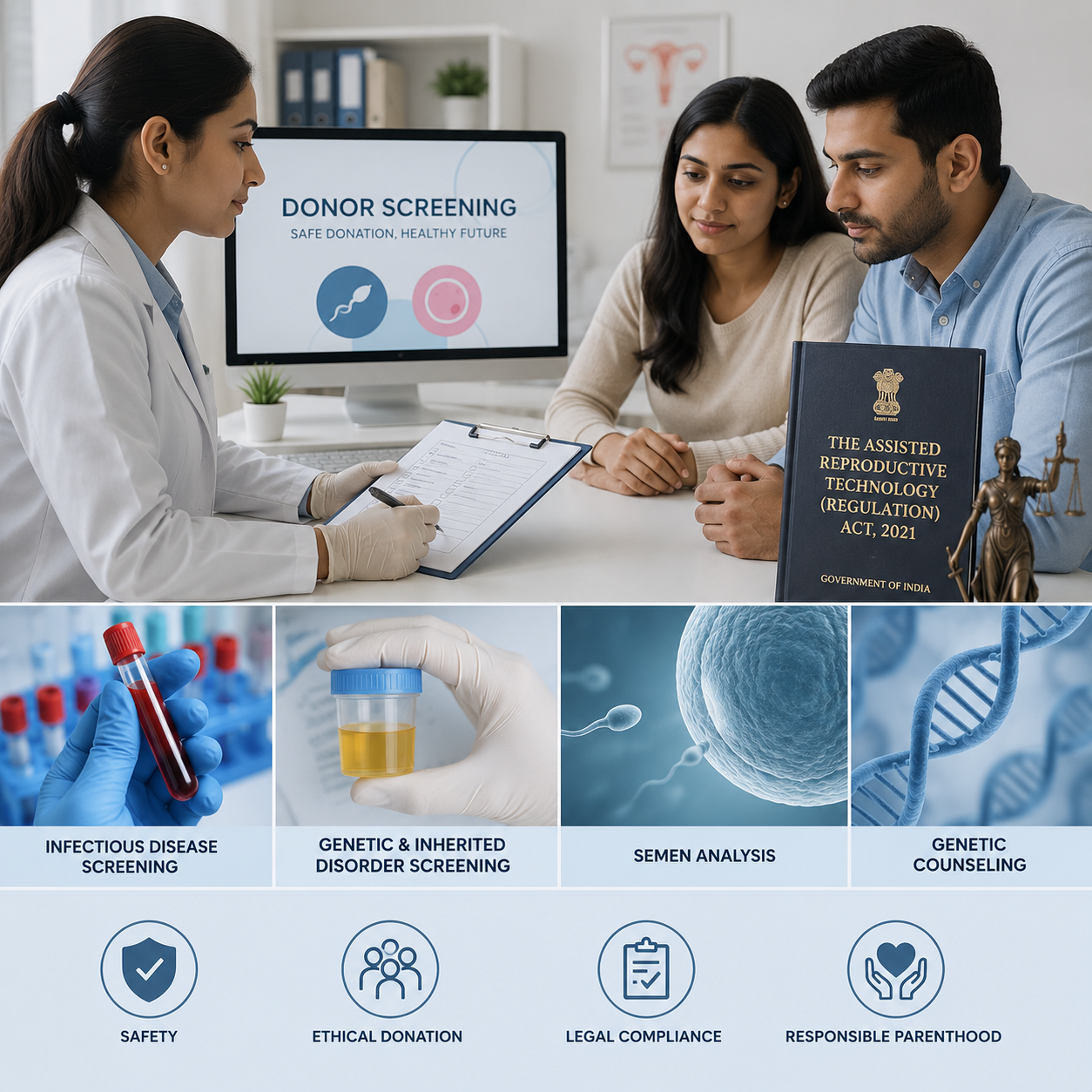
Rule 10 of the ART (Regulation) Rules, 2022 sets out the medical examination of the donor, and rule 14 applies the same requirement to gamete donors examined by ART banks. The donor must be tested for human immunodeficiency virus types 1 and 2, hepatitis B virus, hepatitis C virus, and Treponema pallidum (syphilis) by VDRL. Rule 15 requires the bank to obtain and maintain the prescribed information in respect of each sperm or oocyte donor, and to report to the National Registry the number of donors screened, maintained and supplied to clinics.
Read carefully, this is a minimum floor, not a comprehensive quality standard. The notified panel screens for transmissible infection. It does not, by itself, address karyotype, single-gene carrier status, family history, semen quality thresholds, or ovarian reserve in an egg donor. A responsible bank will go further; the law does not compel it to. If you are considering the donor egg pathway, the useful question is not “is the donor screened?” — the answer will always be yes — but “which tests beyond the statutory four were done, and may I see the panel?”
How many times can a woman donate eggs under Indian law?
Once. Section 27(4) states that an oocyte donor shall donate oocytes only once in her life, and that not more than seven oocytes shall be retrieved from her. Section 27(3) adds that a bank shall not supply the sperm or oocyte of a single donor to more than one commissioning couple. Together these are among the most restrictive donor provisions anywhere in the world.
The consequences run in both directions. For the donor, the rule is protective: repeated ovarian stimulation carries cumulative risk, and a once-in-a-lifetime limit removes the incentive structure that produces repeat donors elsewhere. For the recipient, the arithmetic is unforgiving. Seven oocytes is a modest starting number, and attrition through maturity, fertilisation and blastocyst development means a single donor cycle may not produce surplus embryos. Returning to the same donor for a full genetic sibling is not possible in India, so couples who may want more than one child should raise it at the planning stage.
The one-donor-one-couple rule under section 27(3) also removes an entire category of risk that other jurisdictions manage with family limits and donor-sibling registries: in India, by law, no two families share a donor.
Can a donor be known to the couple in India?
In practice, no. The Act contains no section headed “anonymity”, and it does not expressly prohibit a known or directed donor. The effect nonetheless follows from two provisions read together. Section 21(b) requires that clinics obtain donor gametes from banks. Section 21(e) requires clinics and banks to keep information about the commissioning couple, the woman and the donor confidential, and provides that it shall not be disclosed to anyone except to the database maintained by the National Registry, in a medical emergency at the request of the commissioning couple to whom the information relates, or by an order of a court of competent jurisdiction.
Because the gametes must pass through a registered bank, and because the bank is under a statutory confidentiality duty with only those three exceptions, a registered Indian ART clinic cannot operate the kind of open or identity-release donation programme available in the United Kingdom or parts of Australia. Patients who have read about donor-conceived people accessing identifying information at eighteen should understand that Indian law does not currently provide that route. Whether it should is a live policy debate; it is not the position today.
Who is legally the parent of a child born from donor gametes?
Section 31(1) is unambiguous: a child born through assisted reproductive technology shall be deemed to be a biological child of the commissioning couple, and is entitled to all the rights and privileges available to a natural child, from the commissioning couple. Section 31(2) provides that a donor shall relinquish all parental rights over any child born from his or her gamete.
Section 21(d) places a related duty on the clinic: to make the commissioning couple or woman aware of the rights of a child born through ART. This is a counselling obligation, not a formality, and it is one of the few places where the Act speaks to the interests of the child rather than the adults.
What may not be done with donor gametes
Four prohibitions in the Act govern what happens to gametes and embryos once they exist. They are absolute rather than discretionary, and contravention carries the penalties described below.
Prohibition | What the Act provides | Section |
|---|---|---|
Sale or transfer | The sale, transfer or use of gametes, zygotes and embryos is prohibited, except transfer of a person’s own gametes and embryos for personal use with the permission of the National Board | Section 29 |
Storage beyond ten years | The gamete of a donor or an embryo shall be stored for a period of not more than ten years | Section 28 |
Sex selection | Subject to the PC-PNDT Act, 1994, the clinic shall not offer to provide a couple or woman with a child of a pre-determined sex | Section 26 |
Export for research | The use of any human gametes and embryos, or their transfer to any country outside India for research, is absolutely prohibited | Section 30 |
Table 3. Statutory prohibitions applying to donor gametes and embryos.
Section 29 is the provision that makes the commercial framing of donation unlawful in India. Donation operates on an altruistic basis; the donor is not a vendor and the gametes are not a commodity. Section 22 requires written informed consent from all parties, together with insurance coverage in favour of the oocyte donor for a period of twelve months. Rule 12 of the 2022 Rules requires the intending couple or woman to purchase that cover from an IRDAI-recognised insurer in an amount sufficient to cover all expenses for complications arising from oocyte retrieval, and to swear an affidavit before a Metropolitan Magistrate or Judicial Magistrate of the first class giving the guarantee referred to in section 22(4)(ii). No fixed rupee figure is prescribed — the standard is adequacy, not a stated sum, and any clinic quoting a statutory amount should be asked for its source.
How do you check that the ART bank supplying your donor gametes is registered?
This is the single most useful verification a patient can perform, it takes about ten minutes, and almost nobody does it. The National ART & Surrogacy Registry publishes the register as a searchable public list showing, for each entity, its name, address, State, email, registration number and a downloadable copy of its registration certificate.
- Open the Registry’s public list of registered ART banks. This is the list that matters for donor gametes, because section 27(1) requires the bank to be registered as an independent entity.
- Ask your clinic for the name and registration number of the ART bank that will supply the donor gametes. A clinic acting lawfully will have this and will give it to you.
- Find that bank in the register and confirm that the name, the State and the registration number all match what you were told. A near-match is not a match.
- Download the registration certificate from the register and check the validity dates. Registration is time-limited and must be renewed.
- Separately, confirm your treating clinic on the register of ART clinics. Clinic registration and bank registration are different registrations held by different entities.
- If the bank cannot be found on the register, do not proceed on an assurance. Ask the clinic to identify the registration in writing, and raise the matter with the Appropriate Authority for the State if it cannot.
Wellspring IVF & Women’s Hospital is a registered ART clinic in Ahmedabad, Gujarat — our ART registration is ART Clinic Level 2 Reg. GS/AHD/024, and it appears on the same public register that we are asking you to search. Donor gametes used in an IVF treatment cycle here are obtained from registered ART banks, as section 21(b) requires; the clinic does not itself hold, and under section 27(1) could not hold, the bank function.
Donor gametes in surrogacy follow a different and stricter law
One of the most common misunderstandings in Indian fertility practice is the assumption that the donor rules described above apply equally to surrogacy. They do not. Surrogacy is governed by the Surrogacy (Regulation) Act, 2021, a separate statute with its own eligibility framework, and its position on donor gametes is far more restrictive than the ART Act’s.
Under the Surrogacy Act as originally enacted, both gametes had to come from the intending couple. The Surrogacy (Regulation) Amendment Rules notified on 21 February 2024 (G.S.R. 119(E)) changed that in one narrow respect: where a District Medical Board certifies that a medical condition prevents one of the intending parents from using their own gamete, a single donor gamete may be used, provided the child still has a genetic link to at least one intending parent. Donor eggs and donor sperm together remain impermissible for surrogacy. If you are considering surrogacy under the 2021 Act, that distinction determines eligibility before any clinical question is reached.
What happens if these rules are broken?
The Act does not rely on professional self-regulation. Section 33 provides that contravention of the specified prohibitions is punishable with a fine of not less than five lakh rupees and up to ten lakh rupees for a first contravention. For a subsequent contravention the penalty is imprisonment for a term of not less than three years and up to eight years, together with a fine of not less than ten lakh rupees and up to twenty lakh rupees. Section 32 deals separately with advertising in relation to sex-selective assisted reproductive technology.
For a patient the practical significance is straightforward: a clinic or bank that offers to work outside these provisions — a second donation from the same donor, a donor shared between two couples, an arrangement that bypasses a registered bank — is not offering flexibility. It is offering to commit an offence, with the patient’s treatment as the evidence.
What this means for you as a patient
Donor conception in India is legal, regulated and, done properly, thoroughly documented. The regulation is unusually strict on donor supply and unusually thin on donor quality beyond infection screening. That combination shapes the questions worth asking.
- Which registered ART bank is supplying the gametes, and what is its registration number? You should be able to verify it on the public register yourself.
- What screening was done beyond the statutory four infections? Ask for the panel, not a reassurance — genetic carrier screening is not part of the prescribed minimum.
- Does the donor meet the statutory profile? Ever-married, at least one live child aged three or more, aged 23 to 35, donating for the first and only time.
- How many oocytes are expected, and what is the plan if the cycle yields few embryos? The seven-oocyte ceiling and the once-in-a-lifetime rule mean a repeat cycle with the same donor is not an option.
- Do we want more than one child from this donor? If so, that has to be planned for at the outset, because it cannot be arranged later.
- Has the oocyte donor’s twelve-month insurance been arranged, and by whom? The obligation sits with the intending couple under rule 12.
- Have we had the counselling on the child’s rights that section 21(d) requires? If it has not happened, ask for it.
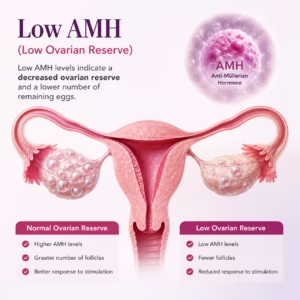
None of this replaces individual medical assessment. Whether donor gametes are the right option at all depends on ovarian reserve, semen parameters, age and previous cycle history — factors that cannot be judged from a legal framework. What the framework does tell you is what a compliant programme must look like, and that is something you can check before you commit.
Frequently asked questions
What are the rules for egg donors in India?
An egg donor must be an ever-married woman with at least one live child of her own aged at least three years, as provided at point 5(e) of the Statement of Objects and Reasons of the ART Act, 2021, and she must be between 23 and 35 years old under section 27(2). She may donate only once in her lifetime and no more than seven oocytes may be retrieved (section 27(4)). Her gametes may go to only one commissioning couple (section 27(3)). She must be screened for HIV-1 and 2, hepatitis B, hepatitis C and syphilis, and the supply must be through a separately registered ART bank.
Can a donor be known to the couple in India?
Not in practice. The Act does not expressly ban a known donor, but section 21(b) requires clinics to obtain donor gametes from a registered bank, and section 21(e) imposes a confidentiality duty on that bank with only three exceptions — the National Registry database, a medical emergency at the couple’s request, and a court order. Identity-release or open donation is therefore not available in India.
How many times can a woman donate eggs under Indian law?
Once. Section 27(4) of the ART (Regulation) Act, 2021 states that an oocyte donor shall donate oocytes only once in her life, and that not more than seven oocytes shall be retrieved from her. This is stricter than most international frameworks, which typically cap the number of families created rather than the number of donations.
Is a sperm donor’s age limited by law?
Yes. Section 27(2) permits an ART bank to obtain semen from males between twenty-one and fifty-five years of age, both inclusive. The same infection-screening requirements apply as for oocyte donors under rules 10 and 14 of the ART (Regulation) Rules, 2022. The Act does not state a lifetime cap on the number of semen donations, but the one-donor-one-couple restriction in section 27(3) applies to sperm as well as to oocytes.
Can donor eggs be stored indefinitely?
No. Section 28 of the Act provides that the gamete of a donor or an embryo shall be stored for a period of not more than ten years. Storage arrangements, and what happens at the end of that period, should be set out in writing before a cycle begins, and are part of the written informed consent that section 22 requires from all parties.
Speaking to a fertility specialist
Deciding whether donor gametes are appropriate is a clinical judgement that depends on your own investigations, not on a legal summary. If you are weighing donor conception, or you have been told something about the donor rules that does not match what you have read here, you can discuss your individual situation with a fertility specialist at Wellspring IVF & Women’s Hospital, Ahmedabad.
Telephone and WhatsApp: +91 9099946050
OPD hours: Monday to Saturday, 10:00 AM to 4:00 PM
References
- Government of India. The Assisted Reproductive Technology (Regulation) Act, 2021 (No. 42 of 2021), including the Statement of Objects and Reasons. India Code, Ministry of Law and Justice.
- Ministry of Health & Family Welfare, Government of India. The Assisted Reproductive Technology (Regulation) Rules, 2022, G.S.R. 419(E), notified 7 June 2022. National ART & Surrogacy Portal.
- Ministry of Health & Family Welfare, Government of India. Rules and notifications under the ART and Surrogacy Acts. National ART & Surrogacy Portal.
- National ART & Surrogacy Registry, Government of India. Public list of registered assisted reproductive technology banks. Accessed 4 September 2026.
- National ART & Surrogacy Registry, Government of India. Public list of registered assisted reproductive technology clinics. Accessed 4 September 2026.
- Ministry of Health & Family Welfare, Government of India. Ministry of Health & Family Welfare. Accessed 4 September 2026.
- Government of India. The Surrogacy (Regulation) Amendment Rules, 2024, G.S.R. 119(E), notified 21 February 2024. Gazette of India.