
Published: 17 November 2026 Medically reviewed by Dr. Pranay Shah, MS (ObGy), Director and Chief Fertility Consultant, Wellspring IVF & Women’s Hospital Last medically reviewed: 17 November 2026
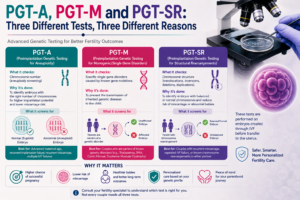
PGT-A, PGT-M and PGT-SR share a name and almost nothing else. PGT-A screens embryos for the wrong number of chromosomes in couples with no known genetic diagnosis. PGT-M tests for one specific inherited single-gene condition that the couple is already known to carry. PGT-SR tests for unbalanced chromosome material in couples where one partner carries a structural rearrangement such as a translocation. PGT-A is a screening test of debated benefit, and the other two are diagnostic tests for a documented, identified risk.
Why the Shared Name Causes So Much Confusion
Preimplantation genetic testing is written as a single family of tests, so patients often arrive at a consultation asking whether they should “have PGT”. That question cannot be answered as asked. The three members of the family are ordered for different reasons, they answer different questions, they need different laboratory preparation and, a point almost always missed, they do not carry the same weight of evidence.
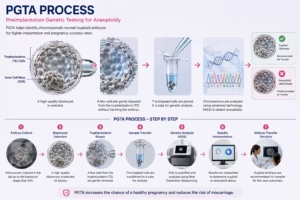
This article sets out what separates them, with particular attention to PGT-SR, the least discussed of the three and the one most often confused with PGT-M. For a detailed account of how PGT-A itself is performed, including the biopsy step, mosaic results and cost, see the preimplantation genetic testing page.
The One Distinction That Matters Most: Screening Versus Diagnosis
PGT-A is a screening test. It is offered to couples who have no known genetic diagnosis, in the hope that identifying embryos with a normal chromosome count will improve the outcome of a transfer. Because it is offered on a hope and no documented abnormality, it has to prove itself in randomised trials, and that is where it has struggled.
PGT-M and PGT-SR are diagnostic tests. They are offered only when a specific, documented genetic abnormality has already been found in one or both partners, either a pathogenic variant in a known gene or a structural chromosome rearrangement visible on a karyotype. The clinical question is then a different one. It no longer asks whether testing might help and asks instead whether this couple’s defined reproductive risk can be reduced before pregnancy and not during it.
That difference explains why the UK’s Human Fertilisation and Embryology Authority lists PGT-A among treatment add-ons and rates it red for improving the chance of a baby in most patients, while PGT-M and PGT-SR are not classified as add-ons at all. They are no optional extras layered onto a cycle. They are the reason the cycle is being done.
What Each Test Actually Looks For
| PGT-A | PGT-M | PGT-SR | |
|---|---|---|---|
| Older name | PGS | PGD | PGD (translocation testing) |
| What it detects | A whole extra or missing chromosome (aneuploidy) | One specific single-gene (monogenic) variant | Unbalanced amounts of chromosome material arising from a structural rearrangement |
| Who it is for | Couples with no known genetic diagnosis | Couples known to carry a monogenic condition | Couples where a partner carries a translocation, inversion, deletion or duplication |
| Prior genetic diagnosis needed | No | Yes, a confirmed molecular report | Yes, a confirmed karyotype or equivalent |
| Laboratory preparation before the cycle | None specific to the couple | Bespoke family and marker workup, often weeks to months | Case-specific design around the breakpoints |
| Test category | Screening | Diagnostic | Diagnostic |
| Evidence status | Contested for live birth; see below | Established for the stated purpose | Established for the stated purpose |
What Is PGT-SR, and When Is It Needed?
PGT-SR is used when one partner carries a structural chromosome rearrangement, most often a balanced translocation. The carrier is usually entirely healthy, because all the chromosome material is present and is merely arranged differently. The difficulty appears at meiosis. When the rearranged chromosomes separate into eggs or sperm, a substantial share of the resulting gametes carry too much or too little of the chromosomes involved. An embryo formed from one of those gametes is chromosomally unbalanced, and most such pregnancies end in miscarriage.
According to the ESHRE PGT Consortium’s good practice recommendations for the detection of structural and numerical chromosomal aberrations, familial reciprocal and Robertsonian translocations are the most common indications for PGT-SR. The recommendations also cover insertional translocations, deletions, duplications and inversions, whether inherited or arising de novo. The stated aim of PGT-SR is to identify chromosomally unbalanced embryos at the earliest possible stage, so that a balanced or normal embryo can be chosen for transfer.
How PGT-SR Is Usually Discovered to Be Necessary
Very few couples know they carry a translocation before they start trying to conceive. It is typically found during the investigation of repeated pregnancy loss, when parental karyotyping is done. The 2026 ASRM Practice Committee opinion on recurrent pregnancy loss takes a targeted position on that testing: screening for parental balanced structural chromosomal rearrangements should be offered when an unbalanced structural rearrangement is detected in miscarriage tissue, or when chromosomal testing of the miscarriage is not available. Couples investigating recurrent pregnancy loss should expect the question of parental karyotype to be addressed explicitly and not left out.
What PGT-SR Can and Cannot Distinguish
Patients are least often told about this technical limit, and it changes what the result means for the next generation. Whether the laboratory can tell a completely normal embryo from one that carries the same balanced rearrangement as its parent depends entirely on the platform used. The ESHRE recommendations state that FISH-based PGT-SR analysis cannot separate embryos with a normal karyotype from those with a balanced one, and that array-CGH shares that limit. SNP-array methods, which use haplotype information, can tell embryos carrying the balanced form of the rearrangement from normal diploid non-carrier embryos.
In practice, on some platforms a “balanced” result means the embryo is either genetically normal or a carrier like its parent, with no way to say which. A carrier child would be healthy but would face the same reproductive difficulty in adulthood. Whether that matters to a particular couple is a question of values and no laboratory can settle it, though they can weigh it only if they are told which platform will be used before the cycle starts.
Does PGT-SR Improve the Outcome for Translocation Carriers?
The honest answer is more layered than the marketing usually allows. The same 2026 ASRM opinion reports that several observational studies of couples with translocations have found live birth rates as high as 70 to 71 per cent without assisted reproduction, with miscarriage rates of 29 to 30 per cent. With PGT-SR, reported outcomes are a live birth rate of 56 per cent per euploid transfer and 38 per cent per started cycle, with a miscarriage rate of 11 per cent per clinical pregnancy.
Read carefully, those figures say something specific. Most translocation carrier couples will eventually have a healthy child without intervention. What PGT-SR appears to change is the number of losses endured along the way and how long the journey takes. For a couple who have already had three or four miscarriages, that is a substantial benefit. For a couple who have just discovered the rearrangement and not yet tried, it is a real decision with two defensible answers, and it should be presented that way.
How PGT-M Differs, and Why the Workup Is Not Interchangeable
PGT-M tests for a single-gene condition. The ESHRE PGT Consortium’s recommendations for the detection of monogenic disorders describe its scope as pathogenic variants transmitted in autosomal dominant, autosomal recessive or X-linked patterns, and mitochondrial DNA variants, and it also covers exclusion testing and HLA typing.
PGT-M differs from PGT-SR operationally in its preparation. It requires the original molecular genetic report describing the identified variant, with the correct gene reference sequence, from an accredited laboratory. DNA is then needed from both prospective parents and usually from close relatives whose disease status is known. For a recessive condition that may mean an affected homozygous individual, a carrier and a non-carrier. A preclinical work-up follows to confirm that the case is feasible, identify informative genetic markers and establish parental haplotypes. ESHRE notes that targeted amplification strategies take time and add a great deal to the turnaround between referral and the clinical cycle.
For a couple planning treatment the point concerns scheduling and has little to do with the science. PGT-M cannot be added to a cycle already under way. It has to be designed first, and the design needs samples from relatives. A couple who begin that conversation only after stimulation has started lose a cycle.
Why PGT-A Sits in a Different Evidence Category
PGT-A is used far more often than the other two combined, and it is the only one of the three whose central claim is disputed. The 2024 ASRM Practice Committee opinion on the use of preimplantation genetic testing for aneuploidy states plainly that the value of PGT-A as a routine screening test for all patients undergoing in vitro fertilisation has not been demonstrated. It says that recent multicentre randomised trials found overall pregnancy outcomes via frozen embryo transfer to be similar with and without PGT-A, and that the value of PGT-A in lowering clinical miscarriage risk is also unclear. It adds that the totality of evidence argues against routine use of PGT-A in donor egg cycles.
None of that makes PGT-A useless. It makes it a test with indications and no default. Our earlier article on what PGT-A is and how it may help IVF outcomes gives a fuller discussion of how it works, what euploid, aneuploid and mosaic results mean, and where it may be worth considering.
Repeated Miscarriage and Repeated Implantation Failure Are Not the Same Question
PGT-A is often proposed for both, and the two situations are routinely blurred. They should be kept apart.
In recurrent pregnancy loss, where most early losses are chromosomally abnormal, the Wellspring clinical position is that PGT-A can reduce further loss, and it is discussed as part of an individualised plan. In recurrent implantation failure the position is different and more restrained: PGT-A can be considered, but the evidence that it improves live birth in that specific setting remains limited. Repeated implantation failure is also defined individually, from the cumulative probability across a patient’s own transfers, and no fixed count of failed cycles defines it.
The reason for the difference is mechanistic. Recurrent loss is dominated by embryo aneuploidy, so a test that identifies aneuploidy addresses the main cause. Implantation failure has a much wider differential, including the endometrium itself, and a test of the embryo cannot resolve a problem that lies elsewhere.
Which Test Answers Which Question
| Your situation | The test that addresses it | What has to happen first |
|---|---|---|
| Both partners carry the same recessive condition, or one carries a dominant condition | PGT-M | Confirmed molecular report; family samples; preclinical workup |
| A karyotype has shown a balanced translocation, inversion, deletion or duplication in either partner | PGT-SR | Confirmed karyotype; case-specific test design; agreement on platform |
| Repeated miscarriage with no rearrangement found and no monogenic diagnosis | PGT-A may be discussed | Complete loss workup, including parental karyotype where indicated |
| Transfers of good-quality embryos have repeatedly failed | PGT-A may be considered, but the endometrium and other factors must be evaluated too | Individualised assessment, not a transfer count |
| A previous pregnancy had a confirmed chromosomal abnormality | PGT-A may be discussed | Documentation of the prior finding |
| No known genetic risk; simply want reassurance | None of the three is indicated on that basis alone | Counselling on what testing can and cannot deliver |
What Indian Law Permits
Genetic testing of embryos in India is not unrestricted, and the limits are statutory and no matter of clinic policy. Under section 25 of the Assisted Reproductive Technology (Regulation) Act, 2021, embryos may be screened only for known, pre-existing, heritable or genetic diseases. Section 26 prohibits offering pre-determined sex selection, prohibits determining the sex of the fetus and separating X-bearing from Y-bearing sperm at any stage, and permits intervention only for diagnosing, preventing or treating sex-linked disorders. It sits alongside the Pre-conception and Pre-natal Diagnostic Techniques Act, 1994.
That last exception is narrow and often misunderstood. When a serious X-linked condition is being tested for, working out which embryos are affected is lawful medicine. Choosing an embryo by sex for any other reason is not lawful, and no registered clinic in India may offer it. Section 24(b) of the same Act also caps the number of embryos placed in the uterus in a treatment cycle at three, which is one reason testing and transfer strategy have to be planned together.
What None of These Tests Can Tell You
- They do not improve an embryo. Testing sorts what already exists. It cannot turn a chromosomally abnormal embryo into a normal one, and it cannot raise the number of embryos available.
- They are no general health screen. PGT-M looks only for the variant it was designed around. PGT-SR looks only at the chromosomes involved in the rearrangement, alongside aneuploidy screening where that is part of the same platform. Neither excludes other genetic conditions.
- They do not guarantee a pregnancy. A transferable embryo still has to implant, and implantation depends on the endometrium, the transfer itself and factors not yet fully understood.
- They cannot test embryos that never form. Testing happens at the blastocyst stage. Couples with few eggs or few embryos may finish a cycle with nothing to test, which is itself a reason to discuss the plan before the cycle and not during it.
When to Ask About Genetic Testing of Embryos
The right moment is before an IVF cycle is scheduled and not after. A confirmed monogenic diagnosis or a known chromosome rearrangement in either partner, a family history of a serious inherited condition, two or more pregnancy losses, or a previous pregnancy with a confirmed chromosomal abnormality are all reasons to raise the question at the first consultation, because PGT-M and PGT-SR both need laboratory preparation that cannot be compressed. Couples planning IVF at Wellspring who fall into any of those groups should say so early, so the work-up and the cycle can be sequenced properly.
Frequently Asked Questions
What is the difference between PGT-A and PGT-M?
PGT-A counts chromosomes in embryos from couples with no known genetic diagnosis. PGT-M looks for one specific single-gene variant that the couple is already known to carry. A fuller side-by-side comparison of the two is set out on our PGT-A and PGT-M treatment page.
When is PGT-SR needed?
PGT-SR is indicated when a karyotype has identified a structural chromosome rearrangement in one partner — most commonly a reciprocal or Robertsonian translocation, and also inversions, deletions, duplications and insertional translocations. It is not indicated on the basis of miscarriage history alone; a rearrangement must first have been demonstrated.
Is PGD the same as PGT-M?
Largely, yes. PGD was the older umbrella term, and most of what was called PGD is now called PGT-M. Confusingly, translocation testing was also historically reported as PGD, and that part is now PGT-SR. If you hold an older report using the term PGD, ask which of the two it actually was.
Can PGT-A, PGT-M and PGT-SR be done in the same cycle?
Combining monogenic or structural testing with aneuploidy screening on the same biopsy is technically possible on modern platforms. It has a practical cost: the 2024 ASRM opinion notes that patients undergoing PGT-M together with PGT-A will ultimately have fewer embryos remaining for transfer after testing, because an embryo must pass both filters.
If I carry a translocation, do I have to do IVF?
No. Observational data reported by ASRM show that a majority of translocation carrier couples achieve a live birth without assisted reproduction, though with a higher miscarriage rate along the way. PGT-SR is best framed as a way of reducing losses and shortening the path, not as the only route to a healthy child.
Does a normal PGT result mean the baby will be healthy?
No. Each test answers only the question it was designed to answer. Routine antenatal screening and, where indicated, prenatal diagnosis remain part of the pregnancy regardless of what embryo testing showed.
The Practical Summary
If a genetic diagnosis has already been made in your family, the relevant test is PGT-M or PGT-SR, the case has to be designed before the cycle, and the evidence supporting it is not in dispute. If no diagnosis has been made and testing is proposed to improve the odds, that is PGT-A, and the decision should rest on your specific indication and should not be a default addition to every cycle. The most useful question at consultation is which of the three is being proposed, and what documented finding it responds to. “Should I have PGT?” is the wrong question.
Couples with a known genetic condition, a chromosome rearrangement, repeated pregnancy loss or a previous chromosomally abnormal pregnancy can discuss which form of testing applies to their situation with a fertility specialist at Wellspring IVF & Women’s Hospital, Ahmedabad. Appointments can be arranged on +91 9099946050, Monday to Saturday, 10:00 AM to 4:00 PM.
References
- ESHRE PGT-SR/PGT-A Working Group; Coonen E, Rubio C, Christopikou D, et al. ESHRE PGT Consortium good practice recommendations for the detection of structural and numerical chromosomal aberrations. Human Reproduction Open 2020;2020(3):hoaa017. doi:10.1093/hropen/hoaa017. https://academic.oup.com/hropen/article/2020/3/hoaa017/5848300
- ESHRE PGT-M Working Group; Carvalho F, Moutou C, Dimitriadou E, et al. ESHRE PGT Consortium good practice recommendations for the detection of monogenic disorders. Human Reproduction Open 2020;2020(3):hoaa018. doi:10.1093/hropen/hoaa018. https://academic.oup.com/hropen/article/2020/3/hoaa018/5848301
- Practice Committee of the American Society for Reproductive Medicine and the Genetic Counseling Professional Group. The use of preimplantation genetic testing for aneuploidy: a committee opinion. Fertility and Sterility 2024;122:421–434. https://www.asrm.org/practice-guidance/practice-committee-documents/the-use-of-preimplantation-genetic-testing-for-aneuploidy-a-committee-opinion-2024/
- Practice Committee of the American Society for Reproductive Medicine. Recurrent pregnancy loss: a committee opinion. Fertility and Sterility 2026;125:1023–1041. https://www.asrm.org/practice-guidance/practice-committee-documents/recurrent-pregnancy-loss-a-committee-opinion-2026/
- Human Fertilisation and Embryology Authority. Pre-implantation genetic testing for aneuploidy (PGT-A) — treatment add-on rating. Published 16 October 2023. https://hfea.gov.uk/treatments/treatment-add-ons/pre-implantation-genetic-testing-for-aneuploidy-pgt-a/
- Government of India. The Assisted Reproductive Technology (Regulation) Act, 2021 (Act No. 42 of 2021), sections 24, 25 and 26. India Code. https://www.indiacode.nic.in/handle/123456789/17031
- Government of India. The Pre-conception and Pre-natal Diagnostic Techniques (Prohibition of Sex Selection) Act, 1994. India Code. https://www.indiacode.nic.in/handle/123456789/1937