
Published: 5 November 2026
Medically reviewed by Dr. Pranay Shah, MS (Obs. & Gyn.), Director & Chief Fertility Consultant, Wellspring IVF & Women’s Hospital, Ahmedabad
Last medically reviewed: 5 November 2026
The short answer
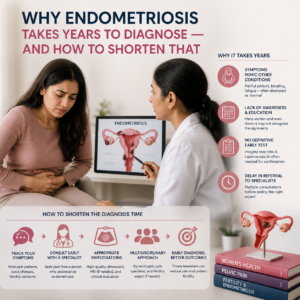
Endometriosis diagnosis delay has three main causes. Period pain is normalised by patients, families and clinicians alike. The condition is routinely mistaken for other pelvic problems. And a normal ultrasound is wrongly read as ruling it out. Indian data put the average gap between symptom onset and diagnosis at 6.3 years. The wait is shortest when the diagnosis is suspected clinically and not held back until surgery.
What this article covers
This article is about the diagnostic gap itself: how long it is, what causes it and what shortens it. It is no guide to treating endometriosis once confirmed, or to conceiving with it, which we answer separately in our article on pregnancy with endometriosis. Wellspring IVF in Ahmedabad offers specialist endometriosis assessment. The delay deserves its own treatment because it is the one part of this disease that can straightforwardly be fixed, and the part that costs women the most.
How long does it actually take to be diagnosed?
Between roughly four and twelve years, depending on the population studied. The World Health Organization’s endometriosis fact sheet, dated 15 October 2025, states that endometriosis “affects an estimated 10% (190 million) of reproductive age women worldwide” and that “currently, the average time to diagnosis is between 4 and 12 years.”
The ESHRE endometriosis guideline (2022) is blunter, describing “a large diagnostic void between the onset of symptoms and a reliable diagnosis averaging between 8-12 years.”
The most relevant figure for Indian patients comes from a qualitative study in the Indian Journal of Medical Research, the journal of the Indian Council of Medical Research. Rajbangshi and colleagues interviewed 21 women with laparoscopically confirmed endometriosis, and 10 male partners, in Assam and Delhi. They found a time lapse between symptoms and diagnosis “ranging from 0 months to 21 yr (average 6.3 yr).”
Source | Reported gap from symptom onset to diagnosis | Population |
|---|---|---|
WHO endometriosis fact sheet, 15 October 2025 | 4 to 12 years | Global average |
ESHRE endometriosis guideline, 2022 | 8 to 12 years | Pooled international studies |
Rajbangshi et al., Indian Journal of Medical Research, 2026 | 0 months to 21 years; average 6.3 years | 21 Indian women with confirmed endometriosis, Assam and Delhi |
Two things follow from that table. The range is enormous, with some women diagnosed within months and others after two decades, which shows the delay is not an unavoidable feature of the disease. And the Indian average sits at the lower end of the international estimates but with a far wider spread, and it comes from women who reached a specialist centre and were diagnosed. Women who never reach one appear in no figure.
Why does the delay happen?
Six mechanisms account for most of it, and they compound. A woman who normalises her pain and is then told that a normal scan means nothing is wrong can lose a decade to two ordinary-looking errors.
1. Severe period pain is treated as normal
This is the largest single cause, and it operates before any clinician is involved. The Indian study found “normalisation of menstrual pain by women, families, and friends” to be a central theme, and every woman reported unfamiliarity with the condition before her diagnosis. Pain that stops a woman working, studying or sleeping is not normal menstruation. The distinction is not subtle, but it is obvious only to someone who has been told it exists.
2. It is mistaken for other pelvic conditions
The same study found misdiagnosis to be near-universal, “often with other conditions like pelvic inflammatory disease, adenomyosis, fibroids and polycystic ovarian syndrome”, the last of which was formally renamed polyendocrine metabolic ovarian syndrome, PMOS, in 2026. Each is a reasonable first thought. Each carries its own treatment, and each treatment buys months before its failure prompts a rethink. Antibiotics for presumed pelvic infection are a particularly costly detour, because temporary improvement is easily read as confirmation.
3. The symptoms are cyclical, so the examination is often normal
A woman seen on day 20 of her cycle may have an entirely unremarkable examination. ESHRE addresses this directly. Clinical examination “should be considered to identify deep nodules or endometriomas in patients with suspected endometriosis, although the diagnostic accuracy is low”, and the guideline recommends explicitly that “in women with suspected endometriosis, further diagnostic steps, including imaging, should be considered even if the clinical examination is normal.”
4. A normal ultrasound is read as a normal pelvis
This is the most consequential technical error in the whole pathway. Ultrasound reliably detects ovarian endometriomas and can detect deep disease in experienced hands. It does not reliably detect superficial peritoneal disease, the commonest form. ESHRE’s recommendation is unambiguous: clinicians should use imaging in the diagnostic work-up “but they need to be aware that a negative finding does not exclude endometriosis, particularly superficial peritoneal disease.”
A scan report reading “normal pelvis” therefore means the scan found nothing, and it does not mean there is nothing. Where that sentence is understood, the pathway moves forward. Where it is not, the woman is reassured and discharged, and returns two years later.
5. Waiting for surgery to give permission
For decades the teaching was that endometriosis is confirmed at laparoscopy and cannot be diagnosed without it. That belief is still widespread among patients and clinicians, and it turns every diagnosis into a decision about an operation, which gets deferred because operations get deferred. The guidance changed in 2022, and a section below covers it, because it is the single most useful thing a patient can know.
6. Access, distance and cost: the Indian layer
The Indian Journal of Medical Research study documents barriers that do not appear in European data: limited specialist availability outside cities, women travelling between 250 and 1,380 kilometres to reach specialist care, and substantial out-of-pocket spending. If you suspect endometriosis, ask a fertility specialist in Ahmedabad for a structured assessment. It also records advice with no clinical basis at all. One participant was told repeatedly “to get married to have children, it would cure my endometriosis.” Pregnancy suppresses symptoms in some women for a time, and it does not cure the disease, and prescribing marriage is no management plan.
Which symptoms should raise suspicion?
The Federation of Obstetric and Gynaecological Societies of India gives a memorable Indian framework in its Key Practice Points on Endometriosis (FOGSI, 2019). Endometriosis should be suspected in women, including those aged 17 or under, with one or more of the “7 D’s”: dysmenorrhoea, dyspareunia, dysuria, dyschezia, dysfunctional uterine bleeding, difficulty in conception, and diffuse abdominal pain.
ESHRE’s first recommendation covers the same ground and adds several presentations that almost nobody connects to the pelvis on first hearing. Clinicians should consider the diagnosis in individuals presenting with “dysmenorrhea, deep dyspareunia, dysuria, dyschezia, painful rectal bleeding or haematuria, shoulder tip pain, catamenial pneumothorax, cyclical cough/haemoptysis/chest pain, cyclical scar swelling and pain, fatigue, and infertility.”
Presentation | What it is commonly attributed to | Why endometriosis belongs on the list |
|---|---|---|
Period pain needing time off work or school | “Normal periods”, low pain threshold | Dysmenorrhoea severe enough to interrupt function is the cardinal symptom, not a variant of normal |
Deep pain during intercourse | Relationship or psychological cause, infection | Deep dyspareunia is one of the FOGSI 7 D’s and suggests deep or posterior compartment disease |
Pain on passing stool, cyclical bowel change | Irritable bowel syndrome | Dyschezia that tracks the menstrual cycle points to bowel-related deposits |
Cyclical urinary pain or blood in urine | Recurrent urinary infection | Cyclical dysuria or haematuria with negative cultures is a recognised presentation |
Shoulder-tip pain or cyclical cough with periods | Musculoskeletal or respiratory cause | Both are listed by ESHRE; thoracic endometriosis is rare but real and is missed for years |
Difficulty conceiving with no other cause found | “Unexplained” infertility | Infertility is itself a listed presenting feature and may be the first one noticed |
One qualifier matters clinically. A woman may have extensive disease with modest symptoms, or severe symptoms with limited disease. Symptom severity does not grade the disease. It only tells you to look.
Can endometriosis be diagnosed without surgery?
Yes, and this is the change that does most to shorten the delay. The ESHRE 2022 guideline moved laparoscopy out of its place as the diagnostic gold standard. Its recommendation now reads that “in patients with negative imaging results or where empirical treatment was unsuccessful or inappropriate”, clinicians should consider offering laparoscopy for the diagnosis and treatment of suspected endometriosis. Laparoscopy is now the step you take when the non-surgical route has not settled the question, and it is no longer the gate you must pass to be believed.
The guideline group treats the alternatives as genuinely equivalent: “Both diagnostic laparoscopy and imaging combined with empirical treatment (hormonal contraceptives or progestogens) can be considered in women suspected of endometriosis. There is no evidence of superiority of either approach and pros and cons should be discussed with the patient.” FOGSI’s Indian practice points reach a compatible conclusion, accepting that empirical analgesic and hormonal treatment without a prior definitive laparoscopic diagnosis can be considered where clinical suspicion is high.
Test | What it can establish | What it cannot establish |
|---|---|---|
History using the 7 D’s / ESHRE symptom list | A clinical suspicion strong enough to act on | Extent, stage or location of disease |
Clinical examination | Deep nodules, a fixed or tender pelvis, an adnexal mass | Anything reliable when normal, ESHRE grades its accuracy as low |
Transvaginal ultrasound | Ovarian endometriomas; deep disease in experienced hands; supportive soft markers such as fixed or “kissing” ovaries | Superficial peritoneal disease. A negative scan does not exclude endometriosis |
MRI | Mapping of deep infiltrating disease before extensive surgery, and clarification where ultrasound is inconclusive | A first-line role: FOGSI states pelvic MRI “should not be considered as the primary investigation” |
Blood biomarkers, including CA-125 | Nothing diagnostic. ESHRE recommends against using biomarkers in blood, endometrial tissue, menstrual or uterine fluid to diagnose endometriosis | Presence or absence of disease; CA-125 rises in many other conditions |
Laparoscopy with histology | Direct visualisation, tissue confirmation, and treatment in the same procedure | Absolute exclusion: ESHRE notes negative histology “does not entirely rule out the disease” |
Where laparoscopy still earns its place
Taking laparoscopy out of the diagnostic gateway is not the same as taking it out of practice, and the difference matters for women who are also trying to conceive. Where imaging is negative and empirical treatment has failed or is inappropriate, ESHRE explicitly supports it. Where a woman presents with infertility and not pain, laparoscopy is diagnostic and therapeutic at once, and early-stage peritoneal disease that no scan will show is a recognised finding in women previously labelled unexplained. The judgement depends on which question is being asked. Pain-led presentations rarely need surgery to reach a working diagnosis, while an infertility work-up may.
What the delay costs
Pain accounts for most of the harm and is rarely quantified. WHO describes severe pain, heavy bleeding, fatigue, depression, anxiety, infertility, poor sexual health and social isolation as outcomes that “can dramatically reduce quality of life.”
The fertility cost is more specific. Endometriosis is disproportionately common in women who cannot conceive. WHO states that “amongst women with infertility, as many as 25-50% have endometriosis”, and ESHRE’s prevalence estimate runs from 2 to 10 per cent of the general female population “but up to 50% in infertile women.” FOGSI notes Indian laparoscopic series reporting the condition in 34 to 48 per cent of women investigated, and estimates around 26 million affected women in India.
A diagnosis at 32 in place of 24 removes eight years from the interval in which ovarian reserve is highest and treatment options are widest. NICE guideline NG257, Fertility problems: assessment and treatment, published 31 March 2026 and updating and replacing CG156, sets out the pathway that then follows. For women with endometriosis it offers expectant management for up to two years, including time already spent trying, or surgical treatment. If conception has not occurred after that, it offers up to four cycles of intrauterine insemination with ovarian stimulation before IVF treatment. The guideline directs that the discussion take into account “the length of time they have been trying to conceive”, the symptoms and severity, age, ovarian reserve, and any male factor. Delay worsens every one of those inputs, and the two-year expectant window is far easier to spend at 27 than at 35.
How to shorten the delay: what a patient can do
- Keep a two-cycle symptom diary before the appointment. Record pain scores by cycle day, days of activity lost, bleeding, bowel and bladder symptoms, and pain with intercourse. Cyclicity is the diagnostic signal, and a single ten-minute consultation cannot show it.
- Describe function as well as pain. “I miss two days of work every month and painkillers do not touch it” moves a consultation along in a way that “my periods are painful” does not.
- Name the symptoms you have been discounting. Pain on passing stool, cyclical urinary symptoms, shoulder-tip pain and pain during intercourse are often left out because they seem unrelated. They are on the diagnostic list.
- Ask one specific question of a normal scan. “Does this rule out endometriosis?” The correct answer is no, and that question alone prevents a common wrong turn.
- Ask whether a trial of treatment is reasonable now. Where suspicion is high, ESHRE and FOGSI both accept empirical hormonal treatment without waiting for surgical confirmation.
- Set a review point. Agree in advance what happens if the trial does not work, typically a reassessment at three to six months with imaging by a clinician experienced in endometriosis and a discussion about laparoscopy.
- Escalate early if you are also trying to conceive. The two clocks run together, and the fertility clock does not pause while a diagnosis is pending.
Endometriosis in adolescents
The biggest available cut in diagnostic delay lies in adolescence, because that is where the clock usually starts. FOGSI’s practice points explicitly include girls aged 17 and under among those in whom endometriosis should be suspected. ESHRE’s 2022 revision added a chapter on adolescence, recommending a careful history to identify risk factors including family history and early menarche, and transvaginal ultrasound in adolescents in whom it is appropriate, with transabdominal or transrectal approaches where it is not.
The practical message for parents is narrow and important. Period pain that keeps a teenager out of school every month, or that does not respond to simple painkillers, warrants assessment and reassurance alone will not do. Treating it as something she will grow out of is how a 6.3-year average is produced.
When specialist assessment is appropriate
Referral to a specialist with an interest in endometriosis is reasonable when severe dysmenorrhoea persists despite simple painkillers or hormonal treatment, when symptoms recur cyclically in the bowel, bladder or chest, when an ovarian endometrioma has been seen on a scan, when pain comes with difficulty conceiving, or when a woman has been investigated repeatedly for suspected infection or bowel disorder without her cyclical pattern being addressed. If conception has not occurred after twelve months, or six months when the woman is over 35, assessment for female infertility should run alongside the endometriosis work-up and should not wait for it to finish.
Frequently asked questions
Why does endometriosis take so long to diagnose?
Because severe period pain is widely normalised, because the condition is commonly mistaken for pelvic infection, fibroids, adenomyosis or PMOS, and because a normal ultrasound is often wrongly taken to exclude it. A further factor is the outdated belief that only laparoscopy can confirm the diagnosis, which turns every assessment into a decision about surgery.
Can endometriosis be diagnosed without a laparoscopy?
Yes. Since its 2022 guideline, ESHRE no longer treats laparoscopy as the diagnostic gold standard. A working diagnosis can be reached from the symptom pattern and imaging, and empirical hormonal treatment may be started on that basis. Laparoscopy is considered where imaging is negative and empirical treatment has failed or is unsuitable.
Does a normal ultrasound mean I do not have endometriosis?
No. Ultrasound detects ovarian endometriomas well and deep disease in experienced hands, but it does not reliably show superficial peritoneal disease, which is the commonest form. ESHRE states that a negative imaging finding does not exclude endometriosis. A normal scan should not end the assessment where symptoms are typical.
Can a blood test diagnose endometriosis?
Not at present. ESHRE recommends against using biomarkers in blood, endometrial tissue, menstrual or uterine fluid to diagnose endometriosis. CA-125 is raised in many other conditions and a normal value does not exclude disease, so it cannot be used to rule the diagnosis in or out.
How long does diagnosis take in India specifically?
The available Indian evidence, from a qualitative study of women with confirmed endometriosis published in the Indian Journal of Medical Research, reports an average of 6.3 years from symptom onset to diagnosis, with a range from under a year to 21 years. Contributing factors documented included limited specialist access outside cities, long travel distances and out-of-pocket cost.
Should a teenager with severe period pain be investigated?
If the pain interrupts school or daily activity, or does not respond to simple analgesia, it should be assessed rather than accepted. FOGSI includes girls aged 17 and under among those in whom endometriosis should be suspected, and ESHRE’s 2022 guideline added specific recommendations for adolescents, including appropriate ultrasound assessment.
The point of all this
Nothing in the delay is inevitable. The disease is common, the symptom pattern is recognisable, the guidance no longer requires surgery to reach a working diagnosis, and treatments that relieve symptoms can start on clinical suspicion. What sustains a gap of six to twelve years is a sequence of individually reasonable decisions: that the pain is normal, that the scan settles it, that surgery can wait. Interrupting any one of them shortens the wait.
Women with persistent cyclical pelvic pain, or with pain accompanied by difficulty conceiving, can discuss their symptoms with a fertility specialist at Wellspring IVF & Women’s Hospital, an ART-registered IVF and women’s health facility in Ahmedabad, Gujarat (ART Reg. GS/AHD/024) led by Dr. Pranay Shah, MS (Obs. & Gyn.).
Telephone and WhatsApp: +91 9099946050
OPD hours: Monday to Saturday, 10:00 AM to 4:00 PM
References
- World Health Organization. Endometriosis — fact sheet. Geneva: WHO, 15 October 2025.
- ESHRE Endometriosis Guideline Development Group. ESHRE guideline: endometriosis. European Society of Human Reproduction and Embryology, 2 February 2022.
- Federation of Obstetric and Gynaecological Societies of India. Key Practice Points on Endometriosis. FOGSI, 2019.
- Rajbangshi PR, Desai S, Gajbhiye RK, Zondervan KT, Jain V, Norton R. Experiences of women with endometriosis & their partners in India: findings from a qualitative study. Indian Journal of Medical Research 2026;162(5):622–630. doi:10.25259/IJMR_1338_2025
- National Institute for Health and Care Excellence. Fertility problems: assessment and treatment. NICE guideline NG257, published 31 March 2026.