

Published: 22 October 2026
Medically reviewed by Dr. Pranay Shah, MS (ObGy), Director & Chief Fertility Consultant, Wellspring IVF & Women’s Hospital, Ahmedabad
Last medically reviewed: 22 October 2026
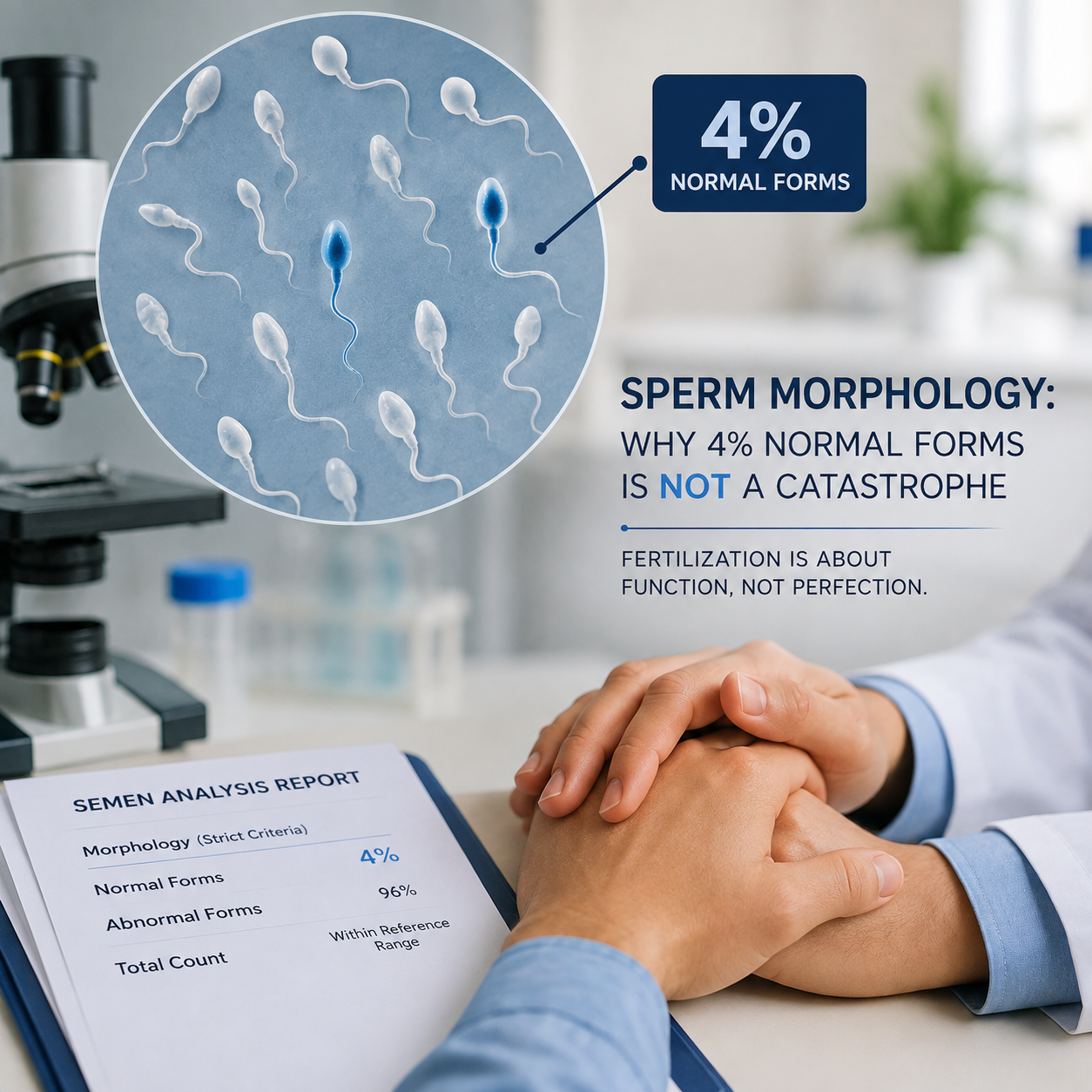
A morphology result of 4% is the lower reference limit, not a pass mark, and it is low for a reason: even men who conceive naturally produce a large majority of imperfectly shaped sperm. Morphology assessed by strict criteria is one of the least reliable and least predictive numbers on a semen report, and on its own it rarely changes what treatment is appropriate.
Very few figures on a fertility report cause as much unnecessary alarm as this one. A man reads “normal forms: 3%” and concludes that 97% of his sperm are defective and that he is almost certainly infertile. Neither inference is correct. This article explains sperm morphology normal range where the 4% figure came from, what the evidence actually shows about morphology and pregnancy, and what a low result should — and should not — change.
What does “4% normal forms” actually mean?
Morphology is the proportion of sperm in a sample whose head, midpiece and tail all fall within a narrowly defined ideal shape. The measurement is made on a stained slide by an embryologist or andrologist who classifies a set number of sperm — usually 200 — one at a time.
The critical point is what counts as “normal”. The classification is deliberately unforgiving: a sperm with a very slightly tapered head, a marginally thickened midpiece or a minor tail irregularity is scored as abnormal even though it may be perfectly capable of fertilising an egg. The number therefore describes how many sperm are close to a textbook ideal, not how many are functional. A result of 4% does not mean 96% of sperm are damaged or incapable.
Morphology is one of nine or more parameters on a standard report, and it is the parameter most often over-interpreted in isolation. Our guide to reading a semen analysis report sets out how the other parameters fit together.
Where the 4% figure came from
The lower reference limits used by laboratories worldwide come from the WHO Laboratory Manual for the Examination and Processing of Human Semen, 6th edition, published in July 2021. These limits are not thresholds distinguishing fertile men from infertile men. They are the 5th centile of a reference population of men whose partners conceived within twelve months — that is, the value below which only the lowest-scoring 5% of recently fertile men fell.
In the critical review of the 6th edition published in Life, Boitrelle and colleagues note that the reference data combine 3,589 fertile men whose partners achieved pregnancy within twelve months, drawing on both the 5th edition cohort and new data collected between 2010 and 2020. Their central caution is worth quoting: “the reference thresholds alone are meaningless and that multiple criteria must be applied to establish a diagnosis of male infertility.” The 6th edition itself moves towards the language of “decision limits” rather than fixed thresholds, and does not specify one for morphology.
So the honest reading of “4%” is this: it is a statistical description of a fertile population, not a biological cut-off at which fertility stops. A man at 3% sits inside the range occupied by some men who conceived naturally within a year.
What are Kruger strict criteria?
Strict criteria — often called Kruger or Tygerberg criteria after the group that developed them — are the standard method for scoring morphology, and they are what the WHO manual specifies. Under strict criteria, any sperm that is not clearly normal in every respect is classified as abnormal; borderline forms are counted against the sample, not in its favour.
This is the reason the normal range looks so alarming. The method was designed to be a sensitive laboratory measure, not a patient-facing score. Applying an intentionally severe classification and then presenting the result as a percentage invites exactly the misreading that this article exists to correct.
It also has a practical consequence: because the judgement is visual and category-based, it is difficult to standardise. The 2024 narrative review of isolated teratozoospermia in Translational Andrology and Urology states that “assessment of sperm morphology continues to be one of the most challenging assessments due to its very subjective nature,” causing “difficulties in standardization.” The same review records that the 4% cut-off “was criticized as being too low, resulting in poor prediction of ART outcomes.”
Claim versus evidence
| What patients are commonly told | What the evidence shows |
|---|---|
| “Only 4% of your sperm are normal, so 96% are defective.” | Strict criteria classify any sperm that is not near-perfect as abnormal. Most men who conceive naturally score in single digits. The percentage describes conformity to an ideal shape, not damage. |
| “Low morphology means you cannot conceive naturally.” | The 2024 Translational Andrology and Urology review reports that “up to 30% of couples with men with absolute teratozoospermia (0% normal forms) could still conceive spontaneously.” |
| “Abnormal morphology is rare and indicates a serious problem.” | The same review found isolated teratozoospermia in 35.9% of 103 fertile control men, against 11.9% of infertile men — it was more common in the fertile group. |
| “Low morphology means you need ICSI.” | The review’s conclusion is direct: “in men with isolated teratozoospermia IVF is sufficient and there is no need for ICSI just because of isolated teratozoospermia.” |
| “Morphology reliably predicts whether IVF will work.” | A meta-analysis summarised in that review “found no significant decrease in the likelihood of pregnancy” with isolated teratozoospermia during IVF. |
| “A supplement or a diet will raise the percentage and fix the problem.” | Where a specific reversible factor exists — heat exposure, smoking, an untreated varicocele, a genital infection — addressing it is reasonable. No supplement has been shown to convert a morphology result into a live birth, and morphology alone is rarely the barrier. |
| “The number is precise, so a fall from 4% to 2% is meaningful deterioration.” | Morphology scoring is subjective and varies between observers and laboratories. Small differences between reports, particularly from different laboratories, should not be treated as clinical change. |
Does low morphology mean IVF or ICSI is needed?
Not by itself, and this is where the evidence has moved furthest from common practice.
For IUI, the older evidence found a signal. The structured literature review by Van Waart and colleagues in Human Reproduction Update (2001) reported a “significant improvement in pregnancy rate above 4% threshold for strict criteria,” with a risk difference of −0.07 (95% CI −0.11 to −0.03; P < 0.001) between men below and above that threshold. That is a real but modest effect, and more recent work has been inconsistent — the 2024 review notes that while one study found significantly different IUI outcomes between men below 4% and above 9% normal forms, others found “no statistically significant difference” in IUI pregnancy rates regardless of morphology severity.
For IVF and ICSI, the recent evidence is clearer and largely reassuring. A 2025 secondary analysis of a multi-centre randomised controlled trial published in Human Reproduction examined 1,064 couples with normal sperm count and motility, randomised to intracytoplasmic sperm injection or conventional IVF. Median normal morphology was 3% in both groups. Live birth rates after the first embryo transfer were 34.6% with ICSI and 31.2% with conventional IVF (relative risk 1.11, 95% CI 0.90–1.37), and there was no significant interaction between morphology and treatment effect (P = 0.181). The authors concluded that sperm morphology “has limited value as a biomarker to identify” couples who benefit more from ICSI than from conventional IVF.
A large retrospective series presented at ESHRE in 2024 and published as a conference abstract in Human Reproduction pointed the same way: across 5,254 completed cycles, cumulative live birth rates with isolated teratozoospermia versus normal morphology were 35.8% against 37.8% in IVF and 38.1% against 33.2% in ICSI, neither difference reaching statistical significance.
The practical implication is that an isolated low morphology result is not, on its own, a reason to escalate from IVF to ICSI. Where ICSI is genuinely indicated, that indication almost always comes from something else on the report or in the history.
How much can you trust a single morphology result?
Less than most other numbers on the report. Three factors matter.
It is a subjective visual assessment. Two competent technicians scoring the same slide can reach different percentages, and two laboratories using different staining and classification practice can differ further. This is the reason the 2024 review describes standardisation as an unresolved problem.
It varies between samples from the same man. Semen parameters fluctuate with illness, fever, abstinence interval and collection technique. A single result is a snapshot.
It is being compared against a limit derived from a specific reference population. Boitrelle and colleagues go as far as to suggest laboratories should consider developing individualised reference values accounting for population differences rather than relying on a single universal cut-off.
For all three reasons, the AUA/ASRM guideline’s general position on semen testing applies with particular force here: “at least two SAs, ideally obtained at least one month apart, are important to obtain” before an abnormal result is acted upon.
When does abnormal morphology genuinely matter?
Morphology is not meaningless. It matters in three specific situations.
When it is part of a pattern rather than an isolated finding. Low morphology alongside low count and reduced sperm motility — the combined picture often abbreviated as OAT — describes a testis under strain and warrants a full evaluation. The morphology figure in that setting is a marker of a wider problem, not the problem itself.
When morphology is at or close to zero. Absolute teratozoospermia is uncommon and deserves specific attention, particularly to exclude defined structural syndromes.
When there is a recognised structural defect affecting all sperm. Globozoospermia — round-headed sperm lacking the acrosome — is the clearest example. This is a distinct entity rather than a low score on a spectrum, and it has its own management considerations.
| Morphology result | How it is best read | What it usually changes |
|---|---|---|
| At or above 4% normal forms | Within the reference range derived from recently fertile men | Nothing. Attention belongs on the other parameters and on the female evaluation. |
| 1–3%, all other parameters normal | Isolated teratozoospermia — common, and found in a substantial proportion of fertile men | Repeat the analysis after at least a month. Rarely changes treatment on its own. |
| Low morphology with low count and/or low motility | A combined abnormality, not a morphology problem | Full male evaluation directed at the underlying cause. |
| 0% normal forms, or a described structural defect such as globozoospermia | A defined entity requiring specific assessment | Specialist andrology review and individualised planning. |
What to actually do with a 3% result
The reasonable sequence is short.
- Read the whole report, not one line. Volume, concentration, total motile count, vitality and leukocytes together carry far more information than morphology alone.
- Repeat the analysis after at least a month, ideally at the same laboratory so that the two results are comparable.
- Address anything genuinely reversible that is identified on history or examination — smoking, significant heat exposure, an untreated infection, a clinically significant varicocele, anabolic steroid use.
- Have the female partner evaluated in parallel. Treatment decisions are made on the couple’s combined picture and on the female partner’s age, not on a single male parameter.
- Do not accept an escalation of treatment justified by morphology alone. If ICSI is being recommended, ask what the indication is besides the morphology percentage.
When specialist evaluation is appropriate
A morphology result below the reference limit does not itself require urgent action. What warrants review is the clinical situation around it: twelve months of unprotected intercourse without conception, or six months where the female partner is over 35; an abnormal result across more than one parameter; a history of undescended testes, testicular surgery, torsion, mumps orchitis, chemotherapy or anabolic steroid use; or a persistently abnormal repeat sample. Structured assessment is described on our page covering male fertility evaluation.
Frequently asked questions
Why is only 4% normal sperm morphology considered normal?
Because 4% is the 5th centile of a reference population of men whose partners conceived within twelve months, not a biological threshold. Strict criteria classify any sperm that is not near-perfect as abnormal, so even fertile men score in single digits. The figure describes conformity to an ideal shape, not the proportion of sperm that work.
Does poor morphology mean IVF is needed?
Usually not on its own. A 2025 secondary analysis of a randomised trial in Human Reproduction found that morphology had limited value in identifying which couples benefit from ICSI over conventional IVF, and a 2024 narrative review concluded that isolated teratozoospermia is not by itself an indication for ICSI. Treatment decisions rest on the full picture, including the female partner’s evaluation.
What is Kruger strict criteria?
Kruger, or Tygerberg, strict criteria are the standard method for scoring sperm morphology, adopted by the WHO manual. Sperm are classified individually and any that is not clearly normal in head, midpiece and tail is counted as abnormal. The method is deliberately severe, which is why normal reference values appear so low.
Can sperm morphology be improved?
Where a specific reversible factor is identified — smoking, significant heat exposure, an untreated genital infection, a clinically significant varicocele, anabolic steroid use — addressing it may improve semen parameters generally. No supplement has been shown to convert a morphology percentage into a live birth, and claims that a product will do so should be treated with scepticism.
My morphology was 2% at one laboratory and 5% at another. Which is right?
Both may be technically correct. Morphology scoring is a subjective visual assessment and varies between observers and laboratories, which is why the 2024 review describes standardisation as an ongoing problem. Comparing results from a single laboratory over time is more informative than comparing across laboratories.
The takeaway
Four per cent is a statistic drawn from fertile men, interpreted through a deliberately strict classification, measured by a method that is difficult to standardise. It deserves to be read alongside the rest of the report rather than as a verdict. Isolated low morphology is common in men who conceive naturally, does not reliably predict IVF outcome, and is not by itself a reason to move to ICSI. What deserves attention is the pattern across all parameters, the history behind it, and the couple’s situation as a whole.
Couples who have received a semen analysis showing low morphology and want it interpreted in context can discuss their report with a fertility specialist at Wellspring IVF & Women’s Hospital, an ART-registered IVF clinic in Ahmedabad, Gujarat, on +91 9099946050. OPD hours are Monday to Saturday, 10:00 AM to 4:00 PM.
References
- World Health Organization. WHO Laboratory Manual for the Examination and Processing of Human Semen, 6th edition. Geneva: World Health Organization; 27 July 2021. ISBN 978-92-4-003078-7. https://www.who.int/publications/i/item/9789240030787
- Boitrelle F, Shah R, Saleh R, Henkel R, Kandil H, Chung E, Vogiatzi P, Zini A, Arafa M, Agarwal A. The Sixth Edition of the WHO Manual for Human Semen Analysis: A Critical Review and SWOT Analysis. Life 2021;11(12):1368. doi:10.3390/life11121368. https://www.mdpi.com/2075-1729/11/12/1368
- Atmoko W, Savira M, Shah R, Chung E, Agarwal A. Isolated teratozoospermia: revisiting its relevance in male infertility: a narrative review. Translational Andrology and Urology 2024;13(2):260–273. doi:10.21037/tau-23-397. https://tau.amegroups.org/article/view/121952/html
- Pham TD, Dang VQ, Ho VNA, Tran CT, Nguyen DTP, Vuong LN, Ho TM, Mol BW, Wang R. Intracytoplasmic sperm injection versus conventional in vitro fertilization in infertile couples with normal total sperm count and motility: does sperm morphology matter? Human Reproduction 2025;40(1):23–29. doi:10.1093/humrep/deae252. https://academic.oup.com/humrep/article/40/1/23/7901372
- Van Waart J, Kruger TF, Lombard CJ, Ombelet W. Predictive value of normal sperm morphology in intrauterine insemination (IUI): a structured literature review. Human Reproduction Update 2001;7(5):495–500. doi:10.1093/humupd/7.5.495. https://academic.oup.com/humupd/article-abstract/7/5/495/651196
- Zhang X, McAuliffe D, Ugne G, et al. P-062 The impact of isolated teratozoospermia on cumulative live birth rates in IVF and ICSI treatment: a retrospective analysis of 5254 completed cycles. Human Reproduction 2024;39(Supplement_1):deae108.438 (conference abstract). doi:10.1093/humrep/deae108.438. https://academic.oup.com/humrep/article/39/Supplement_1/deae108.438/7703652
- Schlegel PN, Sigman M, Collura B, et al. Diagnosis and treatment of infertility in men: AUA/ASRM guideline part I. Fertility and Sterility 2021;115:54–61. American Society for Reproductive Medicine. https://www.asrm.org/practice-guidance/practice-committee-documents/diagnosis-and-treatment-of-infertility-in-men-auaasrm-guideline-part-i-2020/