
Published: 3 November 2026
Medically reviewed by Dr. Pranay Shah, MS (ObGy), Director & Chief Fertility Consultant, Wellspring IVF & Women’s Hospital, Ahmedabad
Last medically reviewed: 3 November 2026
The short answer
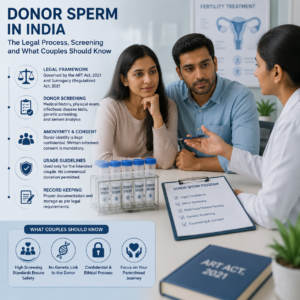
In India, donor sperm may be supplied only by an ART bank registered under the Assisted Reproductive Technology (Regulation) Act, 2021. Donors must be men aged 21 to 55 and must be screened for HIV 1 and 2, hepatitis B, hepatitis C and syphilis. A single donor’s sperm may be supplied to only one commissioning couple. The donor relinquishes all parental rights, and the child is deemed the biological child of the couple.
Why this article exists
Couples advised that donor sperm is the realistic route to a pregnancy usually carry two separate anxieties, rarely addressed together. One is emotional. The other is legal: who is this person, what was checked, who else will use the same sample, and what claim could anyone make on our child later? Those questions now have statutory answers. This article sets out what the law requires, what it leaves to clinical judgement, and what to ask before a cycle begins. It is a legal and process explainer, not a treatment recommendation.
What law governs the use of donor sperm in India?
Two instruments govern it. The primary statute is the Assisted Reproductive Technology (Regulation) Act, 2021 (Act No. 42 of 2021). The operative detail sits in the ART (Regulation) Rules, 2022, notified as G.S.R. 419(E) on 7 June 2022.
The structural point to understand first is that the Act deliberately separates two functions. A clinic treats you. A bank sources, screens and stores gametes. Section 27(1) is explicit that the screening of gamete donors and the collection, screening and storage of semen “shall be done only by a bank registered as an independent entity under the provisions of this Act.” That is not a formality: your treating clinic may not recruit or hold its own donors, and an independently registered entity with its own registration number stands behind every sample. A couple is entitled to know which bank supplied theirs.
Who can legally use donor sperm in India?
The Act provides its services to two categories of person. Section 2(1) defines a commissioning couple as “an infertile married couple who approach an assisted reproductive technology clinic or assisted reproductive technology bank for obtaining the services authorised of the said clinic or bank.” It separately defines a woman, for the purposes of the Act, as “any woman above the age of twenty-one years who approaches an assisted reproductive technology clinic or assisted reproductive technology bank for obtaining the authorised services of the clinic or bank.”
Section 21(g) sets the age band within which a registered clinic may apply ART services: to a woman above 21 and below 50 years, and to a man above 21 and below 55 years.
The clinical indication is a separate question from the legal one. Donor sperm is generally discussed where no sperm can be retrieved, where a serious heritable condition would be transmitted, or where repeated cycles using the partner’s sperm have failed. Men with a nil sperm count are the largest single group, and for many of them donor sperm is not the first option but the fallback if surgical sperm retrieval does not find usable sperm. That sequence matters: a couple should have had the retrieval conversation before the donor conversation.
Who can be a sperm donor in India?
Section 27(2) requires a bank to obtain semen from males “between twenty-one years of age and fifty-five years of age, both inclusive”, and to examine donors for such diseases as may be prescribed.
A point of frequent confusion is worth settling here. India’s criteria for oocyte donors are far more restrictive than its criteria for semen donors, and the two must not be conflated. The oocyte criteria — an ever-married woman with at least one live child of her own aged three or more, aged 23 to 35, donating once in her life — come from point 5(e) of the Statement of Objects and Reasons of the Act and from section 27(2) and 27(4). None of those additional criteria applies to a semen donor. A sperm donor is not required by the Act to be married, and is not required to have a child.
Statutory criterion | Semen donor | Oocyte donor |
|---|---|---|
Age | 21 to 55 years, both inclusive [s.27(2)] | 23 to 35 years [s.27(2)] |
Marital status | Not among the criteria the Act sets for semen donors | Ever-married woman [Statement of Objects and Reasons, point 5(e)] |
Must already have a child | Not among the criteria the Act sets for semen donors | At least one live child of her own, minimum three years of age [point 5(e)] |
How many times may the person donate | Not among the criteria the Act sets for semen donors | Once in her life; not more than seven oocytes retrieved [s.27(4)] |
Recipients per donor | One commissioning couple only [s.27(3)] | One commissioning couple only [s.27(3)] |
Who may screen and supply | A registered ART bank only [s.27(1)] | A registered ART bank only [s.27(1)] |
Where the Act is silent, the bank’s own standard operating procedure and the treating clinician’s judgement govern. Silence in a statute is not permission to be careless, and a well-run bank applies criteria considerably tighter than the statutory floor.
How are sperm donors screened?
Rule 10 of the ART Rules, 2022 prescribes the mandatory testing. The sperm or oocyte donor shall be tested for human immunodeficiency virus (HIV) types 1 and 2, hepatitis B virus, hepatitis C virus, and Treponema pallidum (syphilis) through VDRL. Rule 3(2) makes the bank responsible for screening, collection and registration of the semen donor and for cryopreservation of sperm; rule 13(2) requires the bank to maintain a record of the use of donor gametes and a consent form for the sperm donor, and rule 15 requires the number of donors screened, maintained and supplied to clinics to be reported to the National Registry.
That is the Indian statutory minimum. International practice is broader, and the comparison is the single most useful thing a couple can take into a consultation, because it tells you what to ask.
Screening element | Indian ART Rules, 2022 — testing prescribed by rule 10 | ASRM gamete and embryo donation guidance, 2024 (United States practice) |
|---|---|---|
Infection testing | HIV 1 and 2, hepatitis B, hepatitis C, syphilis (VDRL) — rule 10 | Wider panel including HIV, hepatitis B and C, syphilis, chlamydia, gonorrhoea, CMV and HTLV-I and -II, tested within seven days of semen production |
Quarantine of frozen samples | Not among the matters rule 10 prescribes | Six-month quarantine with repeat infectious-disease testing before release, for non-directed donors |
Genetic screening | Not among the matters rule 10 prescribes | “The donor should undergo appropriate genetic evaluation”, including cystic fibrosis, spinal muscular atrophy and haemoglobinopathy screening |
Psychological evaluation | Not among the matters rule 10 prescribes | “Strongly recommended for all sperm donors” |
Limit on use of one donor | One commissioning couple — section 27(3) of the Act | No more than 25 births per donor is suggested to limit consanguinity risk |
Rule 10 states what must be tested. It does not present itself as a complete laboratory protocol, and a bank or clinic may apply standards beyond it — many do. The practical instruction for a couple is therefore not to assume either way, but to ask the clinic in writing which screening, quarantine and genetic standards its bank actually applies.
One row above deserves separate treatment, because it is the most consequential difference in the table.
Why can one donor’s sperm be used for only one couple in India?
Section 27(3) of the Act states that “A bank shall not supply the sperm or oocyte of a single donor to more than one commissioning couple.” This is a one-donor, one-couple rule, and it is the strictest such provision among the major jurisdictions that regulate gamete donation. The ASRM gamete and embryo donation guidance (2024) regards a limit of 25 births per donor as sufficient to keep the risk of inadvertent consanguineous conception low; India’s limit is, in effect, one family.
The consequence is worth stating plainly. It removes almost entirely the concern — real in several other countries — that dozens of half-siblings may be living unknowingly in the same city. It also means donor availability in India is structurally tighter, because a bank cannot lawfully solve a shortage by reusing a popular donor.
What “altruistic” means in this context
Gamete donation in India operates on an altruistic, non-commercial framework through registered ART banks. Sperm is not a purchase and a donor is not a vendor. Any arrangement presented to a couple as buying a sample, or as paying a donor for gametes, is outside the framework the Act creates and should be refused.
Can couples choose donor characteristics in India?
Partly, and the boundary is sharp. A registered ART bank will ordinarily match a donor on general phenotypic characteristics — height, build, complexion, blood group, eye colour — so that the child does not look conspicuously unrelated to the family. What it will not provide is identifying information: no name, photograph, address or contact details, and no meeting. Section 21(e) places clinics and banks under a duty to keep information about the commissioning couple, the woman and the donor confidential.
What is absolutely prohibited is selection of the child’s sex. Section 26 of the Act bars a clinic from offering to provide a child of a pre-determined sex and from determining the sex of a foetus except to diagnose a sex-linked disorder or disease. Section 32(2) makes contravention punishable with imprisonment of not less than five years, extending to ten, or a fine of not less than ten lakh rupees extending to twenty-five lakh rupees, or both. The Pre-Conception and Pre-Natal Diagnostic Techniques Act applies independently. No registered clinic in India will discuss sex selection, and a facility that does is committing an offence.
Nor can a couple commission particular traits. There is no lawful route in India to selecting a donor for intelligence, academic record, athletic ability or any similar characteristic marketed elsewhere as “donor profiling”. Phenotypic matching exists to protect the family’s privacy, not to design a child.
The legal process, step by step
A donor-sperm cycle in a compliant Indian clinic runs in a fixed order. Steps that look administrative are the steps that make the treatment lawful.
- Diagnosis and confirmation of indication. A repeat semen analysis, and where relevant hormonal, genetic and ultrasound assessment, establishes that the male factor is what it appears to be. Interpretation follows the WHO laboratory manual for the examination and processing of human semen, sixth edition (2021). A single abnormal report is not a diagnosis.
- Consideration of alternatives. Where sperm may be retrievable surgically, that route is discussed and, if appropriate, attempted first. Donor sperm should follow a decision, not substitute for one.
- Counselling. Section 21 requires the clinic to provide counselling about the implications, chances of success and side effects of the procedure, and to make the couple aware of the rights of a child born through ART.
- Written informed consent. Section 22 requires written informed consent from all parties to the procedure, in the prescribed form and language they understand. The donor’s own consent is recorded separately by the bank, in Form 15.
- Sourcing from a registered bank. The clinic obtains the sample from an ART bank registered under the Act, which has screened the donor under rule 10 and registered him.
- Treatment. The sample is used in the planned procedure — most commonly intrauterine insemination or IVF with ICSI, depending on the female partner’s assessment.
- Records and reporting. The clinic and bank maintain records and report to the National Registry. Under section 23, records are maintained for at least ten years, after which they transfer to the National Registry’s central database.
Is donor sperm used with IUI or with IVF?
Either, and the choice is determined by the female partner’s assessment rather than by the fact that the sperm is donated. Where the tubes are patent, ovulation is predictable and there is no significant female factor, donor sperm is generally used with IUI. Where there is tubal disease, advanced age, low ovarian reserve or repeated IUI failure, IVF is the appropriate route. Where the female partner also requires donated oocytes, the pathway becomes donor egg treatment alongside donor sperm, which is legally permitted but requires both gametes to be sourced through registered banks and both sets of consents to be recorded.
What does the law say about the child?
This is the question couples most often ask last and worry about most. Section 31 of the Act provides that a child born through assisted reproductive technology shall be deemed to be a biological child of the commissioning couple, and section 31(2) provides that “A donor shall relinquish all parental rights over the child or children which may be born from his or her gamete.”
In practical terms: the donor has no claim on your child, and your child has no legal claim on the donor. The child born of the cycle is your child in law from birth, with the same status as a child conceived without assistance. The obligation the Act places on the clinic is to make the couple aware of the rights of the child born through ART before the procedure — which is why the counselling step is not optional paperwork.
What couples should verify before a cycle begins
Six checks, in order of importance:
- Is the bank registered? The National ART and Surrogacy Registry publishes public lists of registered ART clinics and ART banks, and separate lists of rejected applications. Ask for the bank’s name and registration number and check it.
- Is your clinic registered? The same registry lists ART clinics. Wellspring IVF & Women’s Hospital holds ART clinic registration GS/AHD/024.
- What was the donor tested for, and when? Rule 10 is the floor. Ask whether the bank screens beyond it — genetic carrier screening, a wider infection panel, and whether frozen samples are quarantined and the donor retested before release.
- Is the sourcing altruistic and through the bank? Any payment framed as buying gametes is outside the framework.
- Have both partners signed the prescribed consents? Consent under section 22 is written, informed and in a language you understand. Read it rather than signing it.
- Has the counselling actually happened? Including the discussion about whether, when and how you will tell the child — a conversation easier to have before a pregnancy than after one.
When to see a fertility specialist
Specialist assessment is appropriate where a semen analysis has shown no sperm or a severely reduced count on more than one occasion; where a couple has not conceived after a year of unprotected intercourse, or after six months if the female partner is over 35; where there is a known heritable condition in the male line; or where donor sperm has been recommended and the couple wants the indication independently reviewed. A second opinion before a donor cycle is reasonable, and no reputable clinic will object to one.
Frequently asked questions
Is donor sperm legal in India?
Yes. Donor sperm is lawful when supplied by an ART bank registered under the ART (Regulation) Act, 2021, used by a registered ART clinic, with written informed consent under section 22 and within the age limits in section 21(g). What is unlawful is sourcing gametes outside a registered bank, commercial dealing in gametes, and any element of sex selection.
Can I know who the sperm donor is?
No. Donor identity is confidential. Section 21(e) places clinics and banks under a duty to keep information about the commissioning couple, the woman and the donor confidential. A registered bank supplies a general phenotypic profile — characteristics such as height, complexion and blood group — but no identifying information, and no contact is arranged.
How many couples can use the same sperm donor in India?
One. Section 27(3) provides that a bank shall not supply the sperm or oocyte of a single donor to more than one commissioning couple. This is stricter than international practice; ASRM guidance in the United States treats a limit of 25 births per donor as acceptable.
Does the sperm donor have any rights over the child?
No. Under section 31 the child is deemed to be the biological child of the commissioning couple, and section 31(2) requires the donor to relinquish all parental rights over any child born from his gamete.
What tests must a sperm donor undergo in India?
Rule 10 of the ART Rules, 2022 requires testing for HIV types 1 and 2, hepatitis B, hepatitis C and syphilis by VDRL. That is the prescribed minimum. Banks and clinics may apply wider screening, and couples should ask specifically what additional infection, genetic and quarantine protocols their bank uses.
Can we choose the donor’s height, complexion or blood group?
General phenotypic matching is normal practice: the bank selects a donor broadly consistent with the recipient couple’s physical characteristics. Identity is never disclosed, trait selection beyond phenotypic matching is not offered, and selection of the child’s sex is a criminal offence under section 26 read with section 32(2) of the Act.
The practical conclusion
Donor sperm in India sits inside a tighter legal frame than most couples expect, and the tightness works in their favour: an independently registered bank, a prescribed screening standard, one family per donor, and a child who is yours in law from birth. What the Act leaves to judgement — how far beyond the testing minimum a bank goes, and whether the clinical indication is sound — is where a couple’s questions should be directed.
Couples who have been advised that donor sperm may be the appropriate route, or who want the indication reviewed before proceeding, can discuss their situation with a fertility specialist at Wellspring IVF & Women’s Hospital, an ART-registered IVF clinic in Ahmedabad, Gujarat (ART Reg. GS/AHD/024) led by Dr. Pranay Shah, MS (ObGy).
Telephone and WhatsApp: +91 9099946050
OPD hours: Monday to Saturday, 10:00 AM to 4:00 PM
References
- Government of India. The Assisted Reproductive Technology (Regulation) Act, 2021 (Act No. 42 of 2021). India Code, Ministry of Law and Justice.
- Ministry of Health and Family Welfare, Government of India. The Assisted Reproductive Technology (Regulation) Rules, 2022, G.S.R. 419(E), 7 June 2022. National ART and Surrogacy Portal.
- National ART and Surrogacy Registry, Government of India. Public registry of ART clinics, ART banks and surrogacy clinics.
- Ethics Committee and Practice Committee of the American Society for Reproductive Medicine. Gamete and embryo donation guidance. Fertility and Sterility 2024;122:799–813.
- World Health Organization. WHO laboratory manual for the examination and processing of human semen, sixth edition. Geneva: WHO, 2021.