

Published: 17 September 2026
Medically reviewed by Dr. Pranay Shah, MS (ObGy), Director & Chief Fertility Consultant, Wellspring IVF & Women’s Hospital, Ahmedabad
Last medically reviewed: 17 September 2026
In short: Before paying for any IVF package in India, establish four things in writing — that the clinic holds a current registration under the Assisted Reproductive Technology (Regulation) Act, 2021 and at what level; exactly which procedures, drugs and laboratory steps the quoted amount includes and excludes; who will personally perform your egg retrieval and embryo transfer; and what happens to your money and your embryos if the cycle is cancelled. The Act obliges the clinic to inform you of the advantages, disadvantages and cost of the procedure before you consent.
Most couples starting IVF in India compare clinics on two numbers: a headline price and a headline success rate. Both are the least informative figures available, because neither is defined until you ask what sits inside it. A package that looks cheaper often excludes the stimulation drugs, the largest single variable in a cycle. A success rate that looks higher is often calculated per embryo transfer in a young donor-egg population.
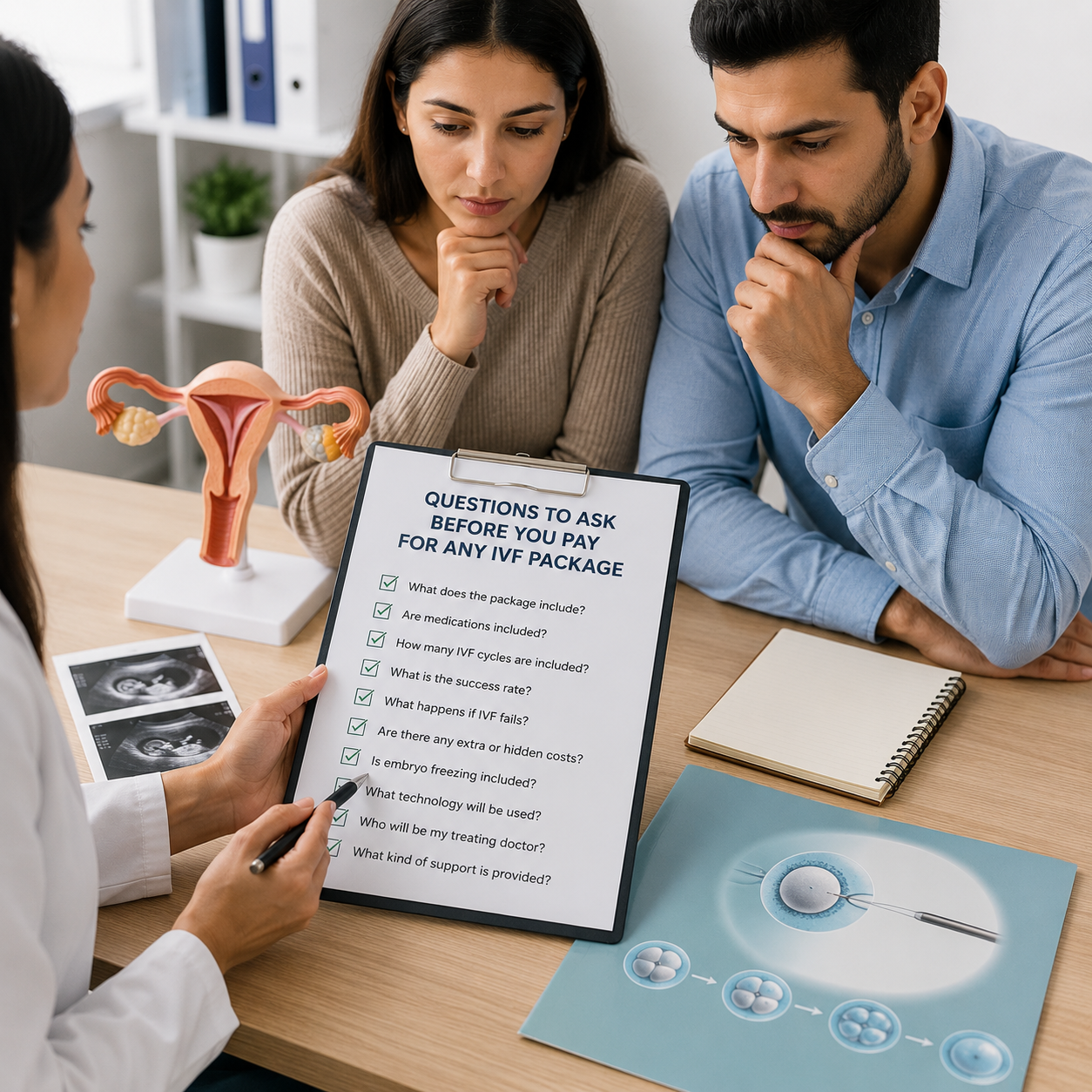
The questions below are the ones that change the answer. Some are rights the ART Act gives you; others are reasonable requests a well-run clinic will meet without hesitation. Where a question is backed by law, this article says so, because that distinction is worth knowing before you walk into a consultation.
1. Is This Clinic Registered Under the ART Act, 2021 — and at What Level?
This is the only question on the list that is not negotiable. Section 15 of the Assisted Reproductive Technology (Regulation) Act, 2021 provides that no person shall establish a clinic or bank for undertaking assisted reproductive technology unless it is duly registered. Operating without registration is an offence; section 33 provides for a fine of ₹5–10 lakh for a first contravention, rising to imprisonment of three to eight years with a fine of ₹10–20 lakh for a subsequent one.
Registration is granted at one of two levels, and the distinction is practical rather than administrative:
| Registration level | What the clinic is registered to do |
| Level 1 | Preliminary investigations, with intrauterine insemination (IUI) as the only treatment carried out |
| Level 2 | All advanced investigations and the full range of diagnostic and therapeutic ART procedures, including IVF and ICSI |
Source: Assisted Reproductive Technology (Regulation) Rules, 2022.
A clinic registered at Level 1 is not registered to perform IVF. Under the 2022 Rules the registration certificate must be displayed at a conspicuous place in the clinic, and a certificate is granted for five years and is non-transferable. Ask to see it, and read the expiry date rather than the issue date.
How to Verify an IVF Clinic Is ART-Registered in India
You do not have to take the clinic’s word for it. The National ART & Surrogacy Portal, run by the Department of Health Research under the Ministry of Health & Family Welfare, publishes the National ART & Surrogacy Registry, which lists registered facilities publicly. Two lists matter to an IVF patient:
- Open the Registry’s list of registered ART clinics and search the page for the clinic’s name and state. Each entry shows the facility name, address, state, email and registration number, with a downloadable registration certificate.
- If donor gametes may be involved in your treatment, separately check the list of registered ART banks, because a clinic and a gamete bank are registered as distinct entities.
- Match the registration number on the Registry entry against the certificate displayed in the clinic. They should be identical.
Wellspring IVF & Women’s Hospital holds ART registration GS/AHD/024 as an ART Clinic Level 2, valid from 27 July 2023 to 26 July 2028; the registration numbers and the clinical team behind them are set out on the page describing our ART registration.
2. What Exactly Does the Quoted Package Include — and What Is Billed Separately?
Ask for the quotation as an itemised list rather than a single figure. The reason is not suspicion; it is that IVF is not one procedure but a sequence, and clinics draw the boundary of a “package” in different places. An IVF cycle in Ahmedabad typically falls within a range of ₹99,999 to ₹2,50,000, and what moves a couple from one end of that range to the other is usually medication dose and laboratory add-ons rather than the base procedure — the components are broken down in detail on our page on IVF cost.
Take this checklist to the counselling session and ask, line by line, whether each item is inside the quoted amount or billed separately:
| Line item | What to establish |
| Pre-cycle investigations | Hormonal profile, semen analysis, infectious disease screening, ultrasound — included or separate? |
| Ovarian stimulation drugs | Included at a fixed dose, capped, or billed at actual usage? This is the single largest variable in most cycles. |
| Monitoring scans and blood tests | How many are assumed in the quote, and what happens if more are needed? |
| Egg retrieval and anaesthesia | Anaesthetist’s fee and day-care charges included? |
| ICSI, if required | Quoted separately, and decided when? |
| Embryo culture to blastocyst | Included, or an upgrade from a day-3 transfer? |
| Embryo transfer | Fresh transfer only, or does the quote cover a subsequent frozen transfer? |
| Vitrification and first year of storage | Included? What is the annual renewal charge thereafter? |
| Add-on laboratory procedures | Assisted hatching, endometrial receptivity testing, genetic testing of embryos — each priced separately? |
| Complication management | Is treatment for ovarian hyperstimulation syndrome or a retrieval complication inside the package? |
| Consumables, records and reports | Any administrative charges levied at the end of the cycle? |
Section 21 of the ART Act places a duty on the clinic to inform the commissioning couple of the advantages, disadvantages and cost of the procedures, together with their medical side effects and risks including multiple pregnancy. An itemised quotation is the ordinary way that duty is discharged. A clinic that will not itemise is not meeting it.
3. Who Will Actually Perform My Egg Retrieval and Embryo Transfer?
Ask for the name, and ask whether that clinician will be the one you see at each monitoring visit. In larger units, the consultant who conducts the first consultation is not always the one who performs the retrieval or the transfer, and embryo transfer in particular is a technique-sensitive step where operator consistency matters.
Ask who supervises the embryology laboratory and with what qualification, what happens if your treating clinician is unavailable on the day the cycle is ready, and how many cycles the unit performs in a year. At Wellspring, treatment is planned and performed under Dr. Shah, who has more than fifteen years of practice in reproductive medicine and over 6,000 successful IVF outcomes.
4. What Success Rate Are You Quoting Me, and How Is It Calculated?
A percentage without a denominator and an age band is not information. Establish four things about any figure you are quoted.
| Question | Why it changes the number |
| Per what? | Per cycle started, per egg retrieval, or per embryo transfer. Per-transfer figures exclude every cycle that was cancelled or produced no transferable embryo, and are therefore the highest. |
| Which outcome? | A positive pregnancy test, a clinical pregnancy on scan, or a live birth. Live birth is the only one that answers the question a couple is actually asking. |
| Which patients? | Own eggs or donor eggs, and which age band. Donor-egg outcomes reflect the donor’s age, not the recipient’s. |
| Over what period? | A single cycle, or cumulative across the transfers from one retrieval. |
Section 21 of the ART Act also requires the clinic to provide professional counselling about all the implications and the chances of success of the proposed procedure. Wellspring reports outcomes above 70% across its IVF programme; like every clinic figure, that varies materially with age, ovarian reserve, indication, sperm parameters and embryo quality, and the number that matters to you is the one for your age band and your indication. Ask for it specifically, and treat any clinic unwilling to disaggregate as having answered the question.
Note also what a success rate cannot do. NICE guideline NG257 on fertility problems, published in March 2026 and replacing CG156, frames treatment decisions around individualised assessment rather than clinic-level averages. An average describes a population; it is not a prediction about you.
5. What Does the Consent Form Say — and May I Read It Before the Day of the Procedure?
Section 22 of the ART Act prohibits a clinic from performing treatment without the written informed consent of all the parties seeking assisted reproductive technology, and separately prohibits cryopreservation of embryos or gametes without specific written consent covering what is to happen in the event of death or incapacity. The 2022 Rules prescribe the consent forms themselves — including forms for the couple, for IUI with a husband’s or a donor’s semen, for embryo freezing, for gamete freezing and for donors.
The practical request is simple: ask for the consent forms in advance, not on the morning of the retrieval. Consent signed under time pressure in a pre-operative room is consent in form only. Read in particular what the cryopreservation consent says about storage duration, renewal, and the disposition of stored embryos on separation, incapacity or death — the clauses couples most often discover too late.
6. Are Donor Gametes Involved, and Where Do They Come From?
If donor eggs or donor sperm are part of the plan, the Act sets the framework. Section 21 requires the clinic to obtain donor gametes only from a registered ART bank, with the screening the law prescribes; section 22 requires insurance coverage in favour of the oocyte donor for twelve months. India operates a regulated, altruistic framework through registered banks — gametes are not a commercial purchase, and a clinic presenting them as one is describing something the law does not permit. Ask which registered ART bank the clinic works with and verify it separately on the Registry. Ask about eligibility too: section 21 restricts ART to women aged 21 to 50 and men aged 21 to 55.
7. What Happens to My Embryos — Storage, Duration, Consent and Renewal?
Surplus embryos are common, and their handling is governed by both consent and record-keeping law. Section 23 of the Act requires clinics and banks to maintain detailed records of all donor oocytes, sperm and embryos used or unused, to submit information to the National Registry, and to retain records for at least ten years, after which they are transferred to a central database.
Ask how long storage is included for, what the annual renewal charge is, what notice you will receive before storage lapses, and what happens to the embryos if renewal is not paid. Keep the answers in your own file at home, not only in the clinic’s.
8. What Is the Cancellation Policy if the Cycle Is Stopped Before Retrieval or Transfer?
A meaningful proportion of cycles do not proceed as planned — because of poor ovarian response, a risk of ovarian hyperstimulation syndrome, no eggs retrieved, failed fertilisation, or a freeze-all decision that defers the transfer. Each of those sits at a different point in the billing sequence, so ask in writing for the refund or credit position at four milestones: after stimulation has started but before retrieval; after retrieval but before fertilisation is known; after fertilisation but with no transferable embryo; and after a freeze-all decision.
9. Which Add-Ons Are You Recommending, and What Problem Do They Solve in My Case?
Laboratory and clinical add-ons — assisted hatching, endometrial receptivity testing, preimplantation genetic testing, immunological treatments, adjuvant medications — vary widely in the strength of evidence behind them, and for several the evidence remains limited or mixed. That does not make them useless; some have clear indications in defined groups. It makes the indication the question. For each add-on offered, ask what specific problem in your history it addresses, what the evidence shows for a patient in your situation, whether current guidelines recommend it for that indication, and what it costs. An add-on justified by a named clinical reason is a clinical decision; an add-on offered to every patient as an upgrade is a pricing tier.
10. How Will Complications and Grievances Be Handled?
Section 21 requires clinics to inform patients of medical side effects and risks including multiple pregnancy, to maintain a grievance cell, to issue a discharge certificate, and to provide periodic outcome data to the National Registry. Ask how each works in practice.
Specifically: who do you call at 11 p.m. if you develop abdominal distension, breathlessness or severe pain after retrieval; whether admission for ovarian hyperstimulation syndrome is managed in-house or referred; whether that admission is charged separately; and how a complaint is escalated if you are not satisfied.
Red Flags: When Not to Pay
Some answers should end the conversation rather than start a negotiation.
| What you are told | Why it is a problem |
| “Guaranteed pregnancy” or “assured baby” schemes | No clinic can guarantee a pregnancy. A guarantee framed as a clinical promise misrepresents the treatment. |
| Any offer relating to the sex of the child | Section 26 of the ART Act prohibits offering a child of a pre-determined sex and prohibits any act to determine or select sex; section 32 provides imprisonment of five to ten years for advertising sex-selective ART. This is criminal conduct, not a service. |
| An offer to arrange a surrogate | Surrogacy in India is altruistic and separately regulated. A clinic offering to find a surrogate is describing an arrangement the law does not permit. |
| Donor gametes described as a purchase | Donation operates through registered ART banks within an altruistic framework. |
| No registration certificate displayed, or a number that does not appear on the Registry | Section 15 requires registration; the certificate must be displayed under the 2022 Rules. |
| Refusal to itemise the quotation | Section 21 obliges the clinic to inform you of the cost of the procedures. |
| Pressure to pay in full on the day of the first consultation | A cycle is planned around your investigations, not around a payment deadline. |
What You Should Have in Writing Before You Pay
- The clinic’s ART registration number and level, matched against the National Registry entry
- An itemised quotation showing inclusions and exclusions, with the basis on which drugs are charged
- The name of the clinician who will perform the retrieval and transfer
- The success figure for your age band and indication, with its denominator and outcome measure stated
- The consent forms, provided in advance of the procedure date
- The cryopreservation and storage terms, including renewal charges and lapse policy
- The cancellation and refund position at each stage of the cycle
- A written list of any add-ons recommended, each with its clinical indication
- The contact route for out-of-hours complications and the grievance escalation path
Frequently Asked Questions
How do I check whether an IVF clinic in India is registered?
Open the National ART & Surrogacy Registry’s public list of registered ART clinics, find the facility by name and state, and read the registration number and downloadable certificate. Then match that number against the certificate displayed in the clinic. If donor gametes are involved, check the registered ART banks list separately.
What should an IVF cost estimate contain?
At minimum: pre-cycle investigations, stimulation drugs and the basis on which they are charged, monitoring, retrieval and anaesthesia, ICSI if applicable, embryo culture, transfer, vitrification and storage, any add-ons, and the position on complication management. No law prescribes the format, but section 21 requires the clinic to inform you of the cost of the procedures.
Discuss Your Treatment Plan
If you are comparing quotations, or want a second opinion on a plan you have already been given, the questions above make a reasonable agenda for a consultation. A fertility specialist at Wellspring IVF & Women’s Hospital, an ART-registered Level 2 clinic in Satellite, Ahmedabad, can review your investigations and set out what your own cycle would involve.
Call or WhatsApp: +91 9099946050
OPD hours: Monday to Saturday, 10:00 AM to 4:00 PM
References
- Government of India. The Assisted Reproductive Technology (Regulation) Act, 2021 (No. 42 of 2021). Ministry of Law and Justice; 2021.
- Ministry of Health & Family Welfare, Department of Health Research. National ART & Surrogacy Portal. Government of India.
- National ART & Surrogacy Registry. List of registered ART clinics and list of registered ART banks. Department of Health Research, Government of India.
- Government of India. The Assisted Reproductive Technology (Regulation) Rules, 2022. Ministry of Health & Family Welfare; 2022.
- National Institute for Health and Care Excellence. Fertility problems: assessment and treatment. NICE guideline NG257. March 2026 (updates and replaces CG156).