
Published: 15 September 2026
Medically reviewed by Dr. Pranay Shah, MS (ObGy), Director & Chief Fertility Consultant, Wellspring IVF & Women’s Hospital, Ahmedabad
Last medically reviewed: 15 September 2026
In short: The World Health Organization’s 2021 (sixth edition) lower reference limits for a basic semen examination are a semen volume of 1.4 mL, a sperm concentration of 16 million per mL, a total sperm number of 39 million per ejaculate, 42% total motility, 30% progressive motility, 54% vitality and 4% normal forms. These are fifth-percentile values drawn from men whose partners conceived naturally within twelve months. They mark the lower edge of a fertile population — they are not a boundary separating fertile men from infertile men.
Almost every semen analysis report printed in India places the patient’s result beside a column headed “normal values” or “reference range”. That layout invites one conclusion: above the line is fine, below the line is a problem. It is the single most common misreading in male fertility, and it causes real harm — unnecessary alarm in men who will conceive without help, and false reassurance in men who will not.
This article explains where the WHO 2021 numbers come from, what statisticians mean by a “fifth-percentile reference limit”, what a value below the limit does and does not tell you, what changed from the 2010 edition, and when a result should prompt a fertility consultation rather than a repeat test. Wellspring IVF & Women’s Hospital is an ART-registered IVF clinic in Ahmedabad, Gujarat, led by Dr. Pranay Shah, MS (ObGy).
What Are the WHO 2021 Semen Analysis Reference Values?
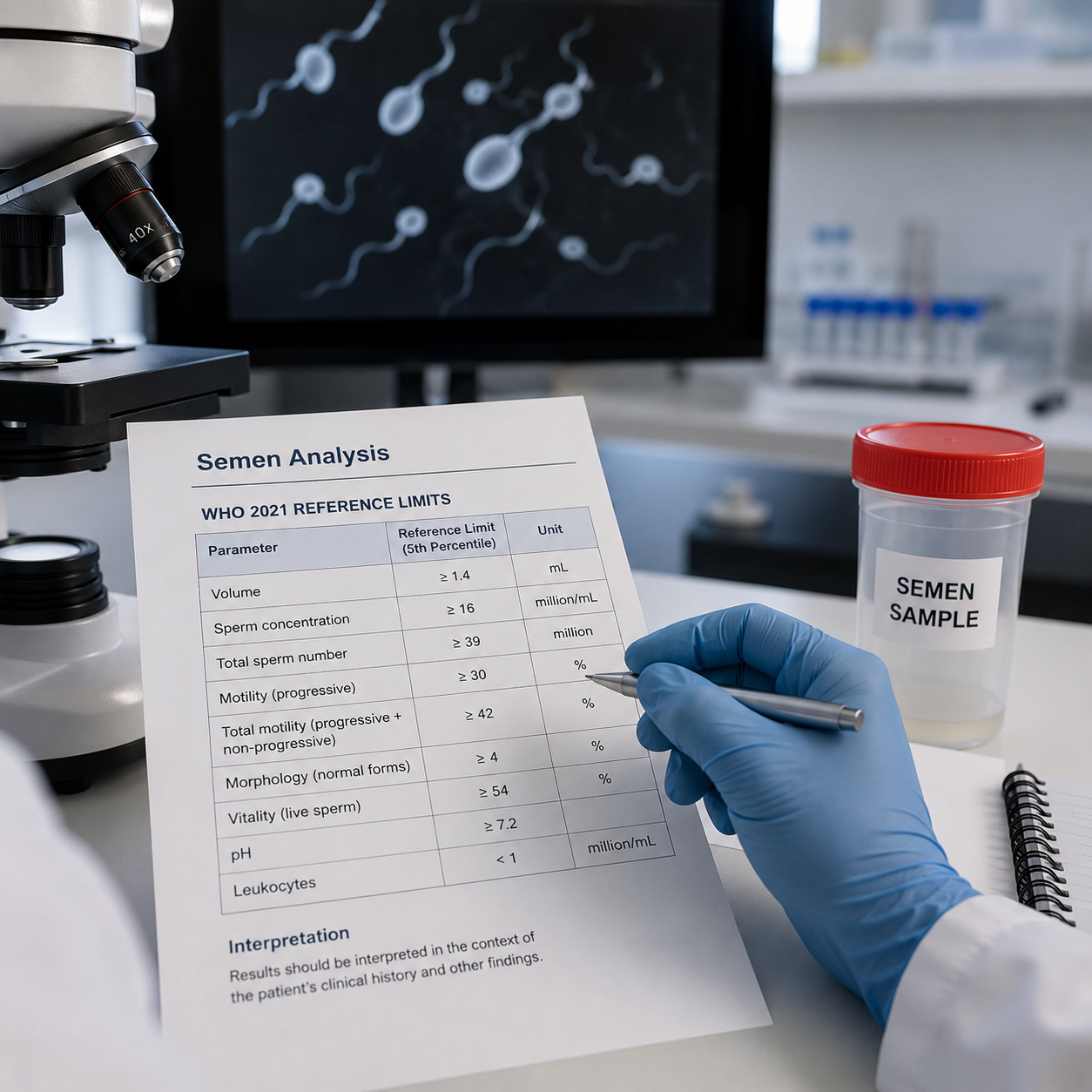
The sixth edition of the WHO laboratory manual for the examination and processing of human semen, published on 27 July 2021, sets out the following lower reference limits for a basic semen examination. Each figure is the fifth percentile of a reference population of men of known fertility, reported with a 95% confidence interval.
| Semen parameter | Lower reference limit (5th percentile) | 95% confidence interval |
| Semen volume | 1.4 mL | 1.3–1.5 |
| Sperm concentration | 16 million per mL | 15–18 |
| Total sperm number | 39 million per ejaculate | 35–40 |
| Total motility (progressive + non-progressive) | 42% | 40–43 |
| Progressive motility | 30% | 29–31 |
| Vitality (live spermatozoa) | 54% | 50–56 |
| Normal forms (morphology) | 4% | 3.9–4.0 |
Source: WHO laboratory manual, 6th edition (2021), as tabulated by Chung et al., Arab Journal of Urology, 2023.
The confidence interval matters more than it looks. A 95% confidence interval of 15–18 million per mL around a concentration limit of 16 million means the true population value is estimated to lie somewhere in that band. A laboratory result of 15.6 million per mL is not meaningfully different from the limit itself — it sits inside the uncertainty of the limit.
Which Edition Is Your Laboratory Reporting Against?
Check the reference column on your own report before you interpret anything. If it lists progressive motility as 32% and vitality as 58%, that column is built on the 2010 fifth edition, not the current one. Both figures were revised downward in 2021 — progressive motility from 32% to 30% and vitality from 58% to 54% — so a report benchmarked against the older column can label a normal 31% progressive motility as abnormal.
What Does a “Fifth-Percentile Reference Limit” Actually Mean?
It means this: take a large group of men who are known to be fertile, rank them from lowest to highest on a given parameter, and draw a line under the bottom 5%. That line is the reference limit. By construction, one man in twenty who has already fathered a pregnancy falls below it.
For the sixth edition, the reference population was assembled from 3,589 men whose partners conceived naturally within twelve months of trying — 1,800 men carried forward from the 2010 dataset plus 1,789 newly contributed subjects, with added representation from Southern Europe, Asia and Africa. The 2010 edition drew on 1,959 men from eight countries. Boitrelle and colleagues, reviewing the new manual in Life in 2021, note that despite the larger dataset, South America and sub-Saharan Africa remain under-represented.
The clinically important consequence: a man below a WHO reference limit is not outside the fertile range. He is in the lowest part of it. The reference population is made up entirely of men who conceived.
Are the WHO Values a Cut-Off Between Fertile and Infertile?
No. The manual itself is explicit that the fifth-centile values are not sufficient to diagnose male infertility and that further clinical and laboratory evaluation is required. The reference limits describe a distribution; they do not classify an individual.
The clearest demonstration of why remains the multicentre study by Guzick and colleagues, published in the New England Journal of Medicine in 2001, which compared semen samples from 765 infertile couples with 696 fertile couples. Using classification-and-regression-tree analysis, the authors identified three zones rather than two.
| Parameter | Subfertile range | Indeterminate range | Fertile range |
| Sperm concentration | Below 13.5 million/mL | Between the two | Above 48.0 million/mL |
| Motility | Below 32% motile | Between the two | Above 63% motile |
| Normal morphology | Below 9% normal forms | Between the two | Above 12% normal forms |
Source: Guzick et al., N Engl J Med 2001;345:1388–1393. The morphology percentages reflect the strict-criteria method used in that study and are not interchangeable with current WHO morphology reporting. The value of the table is the structure it reveals, not the individual numbers.
Two findings from that work have never been overturned. First, there is a wide indeterminate zone in which a semen analysis simply does not tell you which group a man belongs to. Second, and more important, the authors found extensive overlap between fertile and infertile men within both threshold ranges, and concluded that none of the individual measures functions as a diagnostic test on its own.
There is also a live methodological debate about the 2021 limits themselves. Paffoni and colleagues, reappraising the statistical foundation of the reference population in Human Reproduction in 2022, reported that the fifth percentile for sperm concentration ranged from 11 to 36 million per mL across the individual contributing studies, against the pooled figure of 16 million. They argued that clinicians should abandon the notion of the fifth percentile as a diagnostic cut-off altogether. That is a criticism of how the limits are used, not of the manual’s laboratory methods — but it is a reason to treat a single number with humility.
How Reliable Is a Single Semen Analysis?
Less reliable than most patients assume. Sperm production is a continuous process with a spermatogenic cycle of roughly 74 days, and output varies from sample to sample in the same man for reasons that have nothing to do with underlying fertility. This is why the AUA/ASRM male infertility guideline recommends that an abnormal initial result be repeated — conventionally with a second analysis about a month later — before any conclusion is drawn.
Several controllable factors shift the result:
- Abstinence period. The WHO manual specifies 2–7 days of ejaculatory abstinence. A much shorter or much longer interval changes volume and concentration and makes comparison with a previous report meaningless.
- Completeness of collection. The manual requires the laboratory to record whether any part of the sample was lost during collection, because an incomplete sample can materially lower the measured volume and count.
- Recent febrile illness. Because a full spermatogenic cycle takes about 74 days, a high fever, significant illness or surgery in the preceding two to three months can depress a result that would otherwise be normal.
- Laboratory method. Björndahl and Kirkman-Brown, writing in Fertility and Sterility in 2022, emphasise that the sixth edition’s central purpose is standardisation — including replicate assessment of concentration and motility within the laboratory. Results from a laboratory not following the manual are not comparable to the reference limits at all.
If you are trying to compare two reports, confirm that both used the same abstinence interval, the same edition of the manual and, ideally, the same laboratory. A guide to the individual sections of the report — appearance, liquefaction, pH, agglutination and round cells — is available in our companion article on how to read a semen analysis report.
What Does a Result Below the Reference Limit Actually Mean?
It shifts a probability. A result below a reference limit is associated with a lower chance of conception per cycle and, at the more severe end, with a longer time to pregnancy — but it does not establish that conception will not occur, and it does not identify a cause. Cause is established by history, examination, and where indicated hormonal, genetic and imaging assessment, which is why a semen analysis is one input into a structured male infertility evaluation rather than the evaluation itself.
The descriptive terms that appear on Indian reports are simply labels for which parameter fell below the limit:
| Term on the report | What it describes |
| Oligozoospermia | Sperm concentration or total sperm number below the reference limit |
| Asthenozoospermia | Motility below the reference limit |
| Teratozoospermia | Proportion of normal forms below the reference limit |
| Oligoasthenoteratozoospermia (OAT) | All three parameters below the reference limit |
| Cryptozoospermia | No spermatozoa seen on routine examination, but sperm found after centrifugation of the sample |
| Azoospermia | No spermatozoa in the ejaculate, confirmed on examination of the centrifuged pellet |
These are descriptions, not diagnoses. A man with mild oligozoospermia and a partner with normal ovarian reserve and patent tubes has a materially different outlook from a man with the same count whose partner is 39 with diminished reserve. Management follows the couple, not the number. Where the count is very low, or where several parameters are affected together, treatment planning commonly involves ICSI because fertilisation is achieved by injecting a single selected spermatozoon rather than relying on sperm number in the dish.
Two of the most common single-parameter findings have their own clinical pathways: a persistently reduced low sperm count is investigated differently from isolated reduced sperm motility, which raises questions about accessory gland function, infection, varicocele and sample handling.
Can a Normal Semen Analysis Still Miss a Male Factor?
Yes. A basic semen examination measures how many sperm there are, how they move, whether they are alive and what they look like. It does not measure whether the DNA those sperm carry is intact. The sixth edition describes extended and advanced tests — including sperm DNA fragmentation and oxidative stress assays — and Boitrelle and colleagues identify their improved description as a genuine strength of the new manual.
The same reviewers also identify the limitation: sperm DNA fragmentation testing still lacks a standardised methodology and agreed reference ranges, and the manual does not propose clinical decision limits for basic, extended or advanced parameters. The AUA/ASRM guidance makes the complementary point that results from one testing modality should not be extrapolated to another. In practice this means a normal basic report does not exclude a male contribution, and an abnormal DNA fragmentation index does not on its own dictate treatment. Both belong in a clinical assessment, not on a checklist.
When Should a Man See a Fertility Specialist?
Evaluation of the male partner should run in parallel with the female partner from the start of an infertility assessment — the AUA/ASRM guideline is explicit that assessment should be concurrent rather than sequential. In practical terms, that means a couple who have not conceived after twelve months of regular unprotected intercourse (or six months where the female partner is over 35) should have a semen analysis at the same visit as the female evaluation, not months later.
Certain findings warrant specialist assessment without waiting for a repeat test:
- Azoospermia or cryptozoospermia on any report
- Severely reduced counts or motility confirmed on a second sample
- A history of undescended testis, testicular surgery, torsion or trauma
- Previous chemotherapy, radiotherapy or pelvic surgery
- Mumps orchitis after puberty
- A clinically apparent varicocele, testicular asymmetry or a scrotal mass
- Erectile or ejaculatory difficulty, including retrograde ejaculation
- Symptoms suggesting hypogonadism, or use of anabolic steroids or testosterone preparations
A borderline result in a man with no risk factors is generally a reason to repeat the test after correcting abstinence and collection technique — not a reason to begin supplements, hormonal treatment or an unindicated procedure. Where a second result confirms the finding, the next step is a clinical consultation, not a third test.
Frequently Asked Questions
What is a normal sperm count according to WHO 2021?
The 2021 lower reference limit is 16 million spermatozoa per mL, or 39 million in the whole ejaculate. “Normal” is the wrong word for it: the figure is the fifth percentile of men whose partners conceived within a year, so 5% of proven-fertile men fall below it. A count above 16 million is common among fertile men; a count below it is not a diagnosis.
Is a sperm concentration of 10 million per mL bad?
It is below the 2021 reference limit and warrants a repeat test and a clinical assessment, but it is not a statement that natural conception is impossible. Concentration is one of several parameters, and outcome depends on total motile count, morphology, the female partner’s age and ovarian reserve, and tubal status. Interpret it with a specialist rather than in isolation.
Does 4% normal morphology mean 96% of my sperm are abnormal?
It means 96% differ from a very narrow definition of an ideal form. Strict morphological criteria were designed to be demanding, which is why the reference limit sits at 4% rather than at a figure most people would intuitively call normal. Morphology below 4% is associated with reduced fertilisation rates in some settings, but on its own it neither confirms infertility nor determines treatment.
How many semen analyses do I need?
One is enough if it is clearly normal and the clinical picture is otherwise reassuring. If the first result is abnormal, the AUA/ASRM guideline supports repeating it, conventionally about a month later, because sample-to-sample variability in the same man is substantial. Two concordant abnormal results carry far more weight than one.
Do the WHO 2021 values apply to Indian men?
They are the values Indian laboratories should be reporting against, and the sixth edition’s reference population is geographically broader than the 2010 edition’s. However, the newly added cohorts reported for the sixth edition were from China, Egypt, Iran, Italy and Greece, and no India-specific reference population underpins the limits. That is one more reason to read them as a guide rather than a verdict.
Can supplements raise my sperm count above the reference limit?
Evidence on antioxidant and micronutrient supplementation in male subfertility remains mixed, and no supplement has been shown to reliably move an individual man across a reference limit or to guarantee a pregnancy. Correctable factors — smoking, heat exposure, anabolic steroid use, uncontrolled systemic illness, obesity — have clearer biological plausibility and should be addressed first, alongside a proper clinical assessment.
Key Points
- The WHO 2021 lower reference limits are 1.4 mL, 16 million/mL, 39 million total, 42% total motility, 30% progressive motility, 54% vitality and 4% normal forms.
- They are fifth-percentile values from fertile men, so one fertile man in twenty falls below each limit.
- The WHO manual states that the fifth-centile values alone are not sufficient to diagnose male infertility.
- Fertile and infertile populations overlap extensively across all three classical parameters.
- An abnormal result should be repeated with a controlled 2–7 day abstinence interval before conclusions are drawn.
- A normal basic semen analysis does not exclude a male factor, and DNA fragmentation testing has no agreed reference range.
- Interpretation belongs with a clinician who has the couple’s full picture, not with the reference column on the report.
Speak to a Fertility Specialist
A semen analysis is most useful when it is interpreted alongside your partner’s assessment and your own clinical history. If a report has come back below the reference limits, or if you have been trying to conceive for twelve months or more, the result can be reviewed with a fertility specialist at Wellspring IVF & Women’s Hospital, an ART-registered clinic in Satellite, Ahmedabad.
Call or WhatsApp: +91 9099946050
OPD hours: Monday to Saturday, 10:00 AM to 4:00 PM
References
- World Health Organization. WHO laboratory manual for the examination and processing of human semen, sixth edition. Geneva: World Health Organization; 27 July 2021.
- Chung E, Atmoko W, Saleh R, Shah R, Agarwal A. Sixth edition of the World Health Organization laboratory manual of semen analysis: updates and essential take away for busy clinicians. Arab Journal of Urology. 2023;22(2):71–74.
- Boitrelle F, Shah R, Saleh R, et al. The sixth edition of the WHO manual for human semen analysis: a critical review and SWOT analysis. Life (Basel). 2021;11(12):1368.
- Paffoni A, Somigliana E, Boeri L, Viganò P. The statistical foundation of the reference population for semen analysis included in the sixth edition of the WHO manual: a critical reappraisal of the evidence. Human Reproduction. 2022;37(10):2237–2245.
- Guzick DS, Overstreet JW, Factor-Litvak P, et al. Sperm morphology, motility, and concentration in fertile and infertile men. New England Journal of Medicine. 2001;345(19):1388–1393.
- Björndahl L, Kirkman-Brown J, on behalf of the WHO Editorial Board. The sixth edition of the WHO laboratory manual for the examination and processing of human semen: ensuring quality and standardization in basic examination of human ejaculates. Fertility and Sterility. 2022;117(2):246–251.
- American Urological Association / American Society for Reproductive Medicine. Diagnosis and treatment of infertility in men: AUA/ASRM guideline part I. 2020 (amended 2024).