

How to Verify That a Surrogacy Clinic Is Actually Registered in India
September 22, 2026
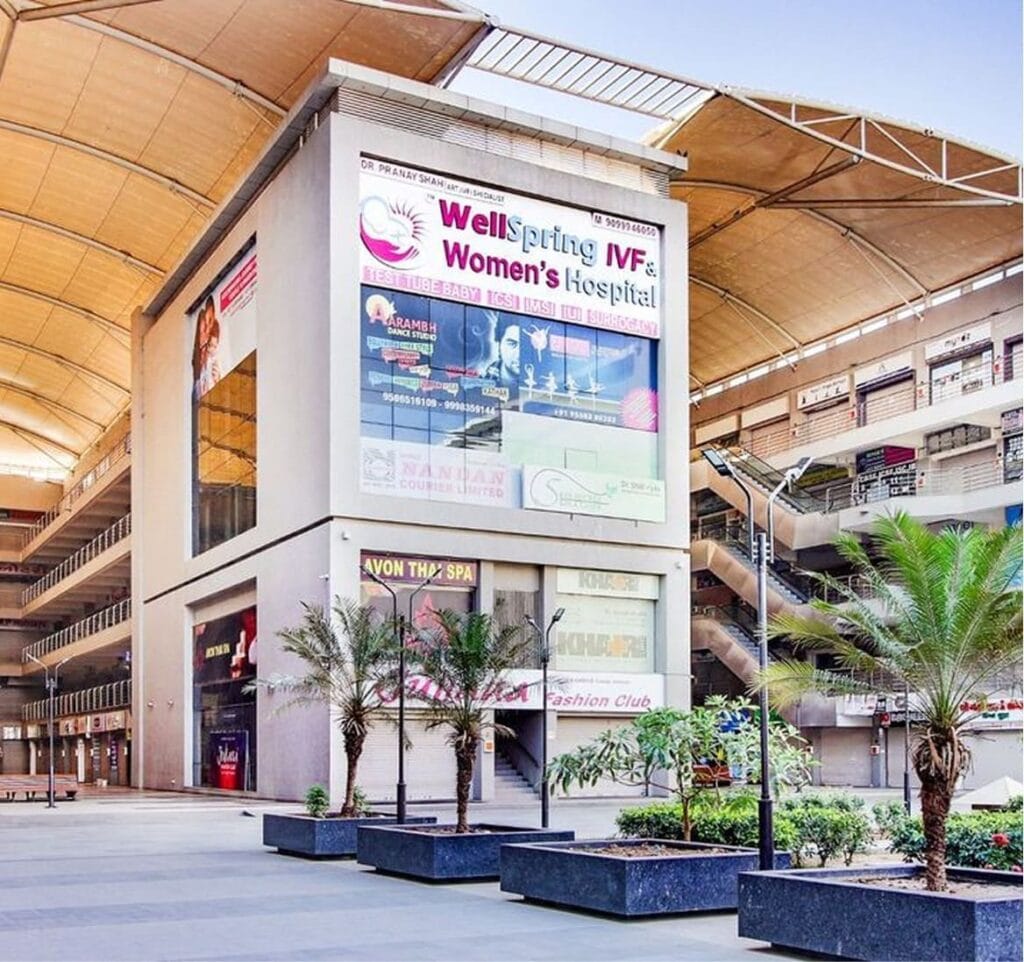
Vastrapur’s position in western Ahmedabad makes it exceptionally well-connected to the Satellite corridor. Whether you drive via the 132 Feet Ring Road or the Drive-in Road, you are on a clear, well-maintained route with no complex navigation required.
From Vastrapur (near the lake or IIM Gate area), take the road heading towards 132 Feet Ring Road (officially Sardar Patel Ring Road at this segment). At the Iscon Crossroads junction, turn towards 100 Feet Road (Anand Nagar Road) heading south-west into Satellite. Drive approximately 400–500 metres — Titanium City Center Mall will be clearly visible on your left, identified by the Sachin Tower landmark. Suite 440 is on the 4th floor.
🟢 Route 1 Summary: Vastrapur → 132 Feet Ring Road → Iscon Crossroads → 100 Feet Road → Titanium City Center
Total distance: ~2.5 km | Typical travel time: 6–8 minutes | Best time: Any — Iscon Crossroads runs smoothly most of the day outside peak rush
From Bodakdev or the Drive-in Road area (near Rajpath Club or Iscon Temple), take Drive-in Road heading towards Satellite Road junction. At the junction, connect to 100 Feet Road via Shyamal Cross Roads or the internal lane linking Drive-in to 100 Feet Road. Titanium City Center is approximately 3 km from the Drive-in Road starting point.
🟡 Route 2 Summary: Drive-in Road / Bodakdev → Satellite Road junction → 100 Feet Road → Titanium City Center
Total distance: ~3–3.5 km | Typical travel time: 8–11 minutes | Traffic note: Drive-in Road can slow near Rajpath Club during evening peak (5–7 PM)
The Vastrapur Lake area is within 2.5 km of the clinic. From the lake road or the IIM Ahmedabad gate, take the connecting lane towards 132 Feet Ring Road and then the Iscon Crossroads route above. This is the shortest Vastrapur-to-clinic route available — under 6–7 minutes at non-peak times.
Ahmedabad One Mall on 132 Feet Ring Road sits approximately 3.5 km from Titanium City Center. From the mall, take 132 Feet Ring Road towards Iscon Crossroads, then turn onto 100 Feet Road. This is an identical route to Route 1, just with a slightly longer starting point. Total travel time: 8–12 minutes.
Vastrapur Landmark Quick-Reference
Live Google Directions: Open in Google Maps →







Vastrapur patients bring their research to the consultation. They arrive having read about blastocyst vs cleavage-stage transfers, having asked questions on fertility forums, having compared laboratory accreditation standards. This is not a problem. It is, frankly, the right way to approach a decision this consequential.
Dr. Pranay Shah welcomes evidence-literate patients because his clinical practice is built on exactly the same foundation: protocol decisions backed by peer-reviewed evidence, technology choices validated by outcome data, and a willingness to say ‘the evidence for that in your specific case does not support it’ rather than offering unnecessary procedures.
The following sections explain the two technologies most frequently researched by Vastrapur patients — Day 5 Blastocyst Culture and PGT-A Genetic Testing — at the clinical depth you came here to find.
Blastocyst culture allows embryos to be cultured to Day 5 or 6 in selected cases. Whether extended embryo culture is appropriate depends on factors such as embryo development, the number of embryos available and the overall treatment plan.
Read the complete Blastocyst Culture Guide
PGT-A (Preimplantation Genetic Testing for Aneuploidy) is a laboratory test that evaluates embryos for chromosome-number abnormalities before transfer. It may be considered in selected clinical situations after discussion of factors such as age, reproductive history, embryo availability and the reason for genetic testing. It is not necessary for every IVF cycle.
Read the complete PGT-A / PGS / PGD guide
An Important Clarification on PGT-A
PGT-A screens for chromosomal abnormalities — it does not test for all genetic disorders, single-gene conditions, or sex-linked diseases. For couples where a specific genetic condition runs in the family (e.g., cystic fibrosis, spinal muscular atrophy, haemophilia), PGT-M (Preimplantation Genetic Testing for Monogenic Disorders) is the appropriate test. Dr. Shah will advise on the correct genetic testing strategy for your specific situation at your consultation. The information on this page applies specifically to PGT-A (aneuploidy screening).
Our fertility specialists are committed to providing personalized, compassionate care with
the latest reproductive medicine techniques.



The Vastrapur patient’s research typically extends beyond blastocyst culture and PGT-A. Here is a concise reference to the other advanced laboratory technologies available at our Satellite clinic:
Technology | What It Does | Who Benefits |
|---|---|---|
IMSI (Intracytoplasmic Morphologically Selected Sperm Injection) | Sperm selection at 6,600–8,000× magnification (vs standard ICSI at 400×) to identify and exclude sperm with nuclear vacuoles or structural defects invisible at lower magnification | Recurrent IVF failure, high sperm DNA fragmentation, previous poor fertilisation or embryo quality despite normal semen analysis |
A precise infrared laser creates a small opening in the zona pellucida (outer shell) of an embryo to facilitate hatching and implantation | Thickened zona pellucida, frozen-thawed embryos, recurrent implantation failure, advanced maternal age | |
A single sperm is directly injected into the cytoplasm of a mature egg using micromanipulation equipment | All male factor infertility, low sperm count / motility / morphology, surgical sperm retrieval (TESE/PESA) | |
Vitrified (flash-frozen) embryos from a prior IVF cycle are thawed and transferred in a prepared endometrial cycle | Freeze-all strategy, PGT-A cycles (mandatory), OHSS prevention, segmented IVF protocol, embryo banking for low AMH patients | |
Extended embryo culture to blastocyst stage (100–200 cells) enabling natural embryo selection before transfer | All patients with 3+ fertilised embryos — standard of care at Wellspring IVF for eligible cycles |
For a research-driven Vastrapur patient, knowing which technologies a clinic offers is only half the question. The more important question is whether the laboratory environment is capable of reliably delivering those technologies at the quality standard that published outcomes data assumes.
Wellspring IVF Embryology Lab — Technical Specifications
“
I genuinely enjoy consultations with well-informed patients. When someone arrives having read about blastocyst grading, or having downloaded a published paper on PGT-A success rates, it tells me they take this seriously — and it means we can have a real scientific conversation about what the evidence says for their specific case, not a generic overview.
My commitment to every Vastrapur patient is this: I will tell you exactly what the current evidence supports for your situation. If blastocyst culture and PGT-A are indicated for you, I will explain precisely why. If they are not indicated, I will explain why — and I will not recommend them simply because they are available or because you expect them. The protocol that gives you the best chance of a healthy pregnancy is not always the most technologically complex one.
Your research has brought you to the right clinic. Now let us use that research together.
— Dr. Pranay Shah, Director & Chief Fertility Consultant, Wellspring IVF & Women’s Hospital
Vastrapur patients choose Wellspring IVF for the quality of clinical technology — not because it is the closest option. That same principle guides patients from every part of Ahmedabad who prioritise care above convenience. Our Ahmedabad Clinic Hub has complete directions from every approach. If you know someone from another part of the city who is looking for advanced fertility care, the neighbourhood guides below will help:
Wellspring IVF & Women’s Hospital is located at Titanium City Center, 440, 100 Feet Road, near Sachin Tower, Satellite, Ahmedabad. Patients from Vastrapur can generally reach the clinic via 132 Feet Ring Road and Iscon Crossroads or via Drive-in Road, with travel time varying according to the starting point and traffic.
Yes. An initial fertility consultation can help review your medical history, previous treatment and investigation results before deciding whether IVF or any additional laboratory technology is appropriate. Technologies such as blastocyst culture, PGT-A, ICSI or IMSI are considered according to individual clinical circumstances rather than automatically used for every patient.
No. Advanced laboratory technologies are not automatically required for every IVF cycle. The appropriate approach depends on factors such as the fertility diagnosis, age, ovarian reserve, sperm factors, embryo development, previous treatment history and other clinical findings.
Wellspring IVF & Women’s Hospital is approximately 2.5 km from Vastrapur Lake, with a typical travel time of around 6–8 minutes depending on traffic. From the IIM Ahmedabad area, the clinic is approximately 3 km away, with travel generally taking around 7–10 minutes. The route may vary depending on the starting point and current traffic conditions.
Yes. Dr. Pranay Shah believes strongly in transparent embryology communication. After your egg retrieval and fertilisation, our embryology team provides daily updates on embryo development — fertilisation outcome on Day 1, cleavage quality and cell count on Day 3, and blastocyst grading on Day 5. You will know the full morphological grade of each blastocyst and Dr. Shah will discuss what the grading means for your transfer decision. Nothing is withheld. If you wish to understand the scientific basis for any embryology recommendation, ask — and you will get a complete, evidence-based explanation.
Yes. Wellspring IVF & Women’s Hospital has an in-house embryology laboratory at its Satellite clinic, with facilities supporting procedures such as embryo culture, cryopreservation and micromanipulation techniques including ICSI and IMSI. The specific laboratory procedures used are selected according to the individual treatment plan and clinical requirements.
Blastocyst culture is included within Wellspring IVF’s standard IVF package for all patients where it is clinically appropriate — it is not an add-on charge. PGT-A involves an additional cost, primarily because the genetic analysis (NGS at an accredited genetics laboratory) is a separate external service with per-embryo biopsy and testing fees. Dr. Shah’s team will provide a complete, itemised cost estimate at your consultation — there are no hidden charges. The exact cost depends on the number of embryos biopsied.