
Teratozoospermia: Abnormal Sperm Morphology and What It Means for Fertility
Abnormal Sperm Morphology Treatment | Wellspring IVF & Women's Hospital, Ahmedabad
What Is Teratozoospermia?
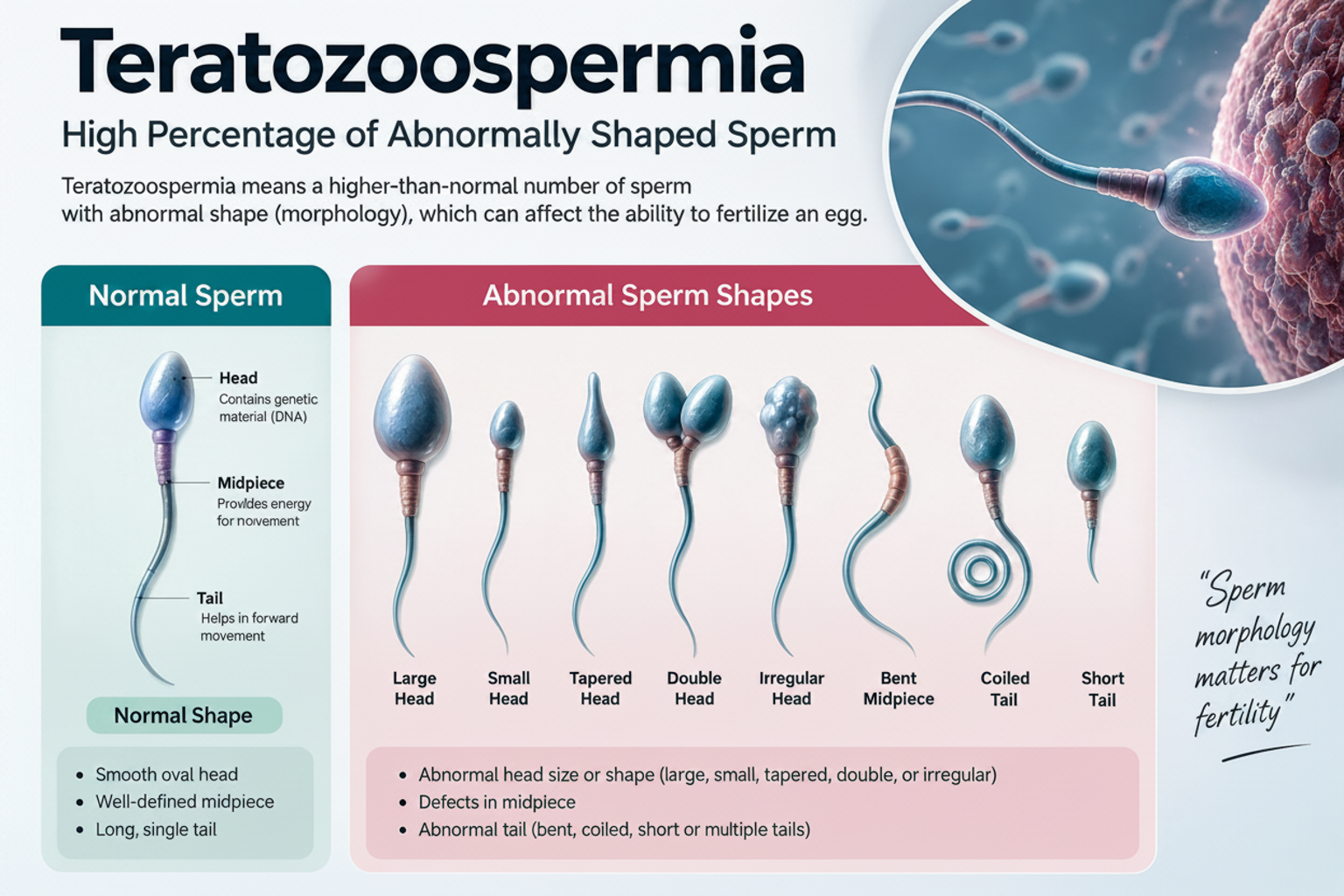
Teratozoospermia is the term used when the proportion of sperm with normal shape falls below the laboratory’s lower reference limit. Sperm shape is assessed under a microscope on a stained slide, and each sperm is judged on the head, the midpiece and the tail. A sperm is counted as normal only if every region is normal — which is why the “normal” proportion is low even in men who conceive easily.
In plain terms: the test is not asking how many of your sperm are damaged. It is asking how many are flawless. Those are different questions, and the second one has a much lower answer in every man.
The World Health Organization’s laboratory manual, sixth edition (2021), places the lower reference limit for normal forms at 4%, derived from the fifth centile of men whose partners conceived naturally within twelve months. In that same reference group of 3,335 men, the median was 14% and the 2.5th centile was 3% [WHO, 2021]. The limit therefore marks the bottom of a fertile population’s range — it is not a boundary between fertile and infertile.
Morphology is one of several parameters reported on a semen analysis, and it is interpreted as part of the wider male infertility evaluation rather than on its own.
Teratozoospermia is graded informally by severity, and the grading matters more than the label:
Pattern | Typical description | Clinical weight |
|---|---|---|
Mild / borderline | Normal forms slightly below the reference limit, other parameters normal | Usually low; often a laboratory-variation finding |
Moderate | Reduced normal forms with a mixed pattern of head, midpiece and tail defects | Interpreted alongside count, motility and the female evaluation |
Severe | Normal forms at or near 1%, often with a single repeated defect | Warrants closer evaluation; may signal a structural or genetic cause |
Monomorphic (one defect in nearly all sperm) | Globozoospermia (round heads, no acrosome), macrocephalic sperm, multiple morphological abnormalities of the flagellum | Genuinely causes infertility; genetic assessment appropriate |
Why Does Sperm Shape Matter for Fertility?
Sperm shape matters because form follows function: the acrosome on the sperm head carries the enzymes needed to penetrate the egg’s outer layer, the midpiece houses the mitochondria that power movement, and the tail provides propulsion. A structurally abnormal sperm may therefore be less able to reach, bind to and fertilise an egg naturally.
That is the mechanism. The clinical reality is more limited than the mechanism suggests.
The AUA/ASRM guideline on the diagnosis and treatment of infertility in men states that, with defined exceptions, none of the individual sperm parameters — concentration, morphology or motility — is highly predictive of fertility or diagnostic of infertility. The exceptions it names are azoospermia, complete asthenozoospermia, necrozoospermia and some types of teratozoospermia such as complete globozoospermia [AUA/ASRM, 2020].
The same guideline notes that risk rises with the number of abnormal parameters rather than the depth of any one of them. In its worked example, a man with an isolated morphology abnormality carries an odds ratio for infertility of roughly 2.5, while a man with low count, low motility and abnormal morphology together carries an odds ratio of about 15.
In plain terms: an abnormal morphology result on its own shifts the odds modestly. The same result alongside a low count and low motility is a materially different situation.
What Causes Abnormal Sperm Morphology?
Sperm morphology reflects the health of sperm production over roughly the preceding three months, so most causes act on the testis during that window.
Reversible or modifiable influences
- Febrile illness, including a high fever in the two to three months before the test
- Scrotal heat exposure — prolonged sitting, laptop use on the lap, hot baths, occupational heat
- Smoking, tobacco chewing, heavy alcohol use, anabolic steroid use
- Obesity and poorly controlled metabolic disease
- Certain medications, including some chemotherapy agents and hormonal preparations
Structural and medical causes
- Varicocele
- Genital tract infection or inflammation
- Prior testicular injury, torsion or undescended testis
- Endocrine disorders affecting spermatogenesis
- Oxidative stress, which is also associated with sperm DNA damage
Genetic causes Monomorphic teratozoospermia — where nearly every sperm shares one specific defect — is usually genetic. Globozoospermia, in which sperm have round heads and lack an acrosome, is rare, occurring in well under 1% of infertile men, and is frequently linked to deletions or mutations in the DPY19L2 gene [Kuentz et al., Human Reproduction, 2013]. These men are infertile in a way that mixed teratozoospermia is not, and they require a different treatment approach.
Idiopathic In a substantial proportion of men no cause is identified. This is an honest finding, not an incomplete evaluation.
Are There Any Symptoms?
Teratozoospermia has no symptoms. It is not associated with reduced libido, altered ejaculate appearance, altered semen volume or any change in sexual function. It is detected only on semen analysis, which is why a couple who have not conceived after twelve months of regular unprotected intercourse should have the male partner evaluated at the same time as the female partner — not afterwards.
Where an underlying cause exists, that cause may produce findings: a varicocele may be palpable or cause a dragging scrotal ache; an infection may cause pain or discharge. The morphology result itself produces nothing.
How Is Teratozoospermia Diagnosed?
Diagnosis is by semen analysis performed to WHO laboratory standards, with morphology assessed on a stained slide under oil immersion. Two points determine whether the result can be trusted.
First, one sample is not a diagnosis. The AUA/ASRM guideline explicitly cautions that semen parameters are highly variable biological measures. Because a full cycle of sperm production takes approximately three months, a result influenced by a fever or an acute illness may look entirely different on repeat testing. A single abnormal morphology reading should be confirmed on a second sample before any treatment decision is built on it.
Second, morphology is the least reproducible parameter in the andrology laboratory. It depends on staining technique, on the criteria applied, and on the assessor. Two competent laboratories can return materially different morphology percentages on the same sample. This is a recognised limitation of the test, not a reflection on any one laboratory, and it is the strongest single reason not to make an irreversible treatment decision on one morphology number.
Where morphology is abnormal, the evaluation that actually changes management includes:
Assessment | What it is looking for |
|---|---|
Repeat semen analysis after an interval | Confirmation, and the pattern of count and motility alongside morphology |
Clinical examination | Varicocele, testicular volume, vas deferens |
History | Fever, heat exposure, drugs, tobacco, prior surgery or infection |
Hormonal profile (FSH, testosterone) where indicated | Impaired spermatogenesis |
Scrotal ultrasound where indicated | Varicocele, obstruction, testicular pathology |
Sperm DNA fragmentation testing in selected cases | Sperm chromatin damage, particularly with recurrent pregnancy loss or repeated treatment failure |
Genetic evaluation in monomorphic teratozoospermia | Globozoospermia and related single-defect syndromes |
What Do the Results Actually Mean?
A morphology result should be read in combination, never alone.
Result pattern | Reasonable interpretation |
|---|---|
Low normal forms, normal count, normal motility (isolated teratozoospermia) | Modest independent effect. Natural conception and less invasive treatment remain reasonable. |
Low normal forms with low count and low motility (OAT) | The combination, not the morphology, drives prognosis. Evaluate for a treatable cause. |
Severe teratozoospermia with a single repeated defect | Investigate for a genetic cause before planning treatment. |
Low normal forms with recurrent pregnancy loss or repeated implantation failure | Consider sperm DNA fragmentation assessment as an additional test. |
Where morphology sits alongside a reduced count or reduced motility, the pages on low sperm count and reduced sperm motility set out how those parameters are evaluated in their own right, and sperm DNA fragmentation testing is discussed separately because it measures chromatin damage rather than shape.
“When the only abnormal number on a report is morphology, my first job is to slow the conversation down. Couples arrive believing they have been given a diagnosis. They have been given a measurement — and one of the least reproducible measurements in the andrology laboratory. I want a second sample, I want to examine the patient, and I want to see the female partner’s assessment in front of me before I say anything at all about IVF or ICSI. Treating a single percentage as a treatment decision is how couples end up in the wrong cycle.”
– Dr. Pranay Shah, MS (ObGy), Director & Chief Fertility Consultant
Does Teratozoospermia Require Treatment?
Teratozoospermia is not itself treated. What is treated is the underlying cause where one is identifiable, and the couple’s infertility where it persists.
Where a cause is found and is correctable — a varicocele, an infection, a drug exposure, significant heat exposure, tobacco or steroid use — addressing it is reasonable, and semen parameters are conventionally reassessed after around three months to allow a full cycle of sperm production. Improvement in the numbers is possible; it is not guaranteed, and the size of any benefit varies considerably between men.
Where no cause is found, there is no medication that reliably normalises sperm morphology. Antioxidant supplements are widely sold for this purpose. The evidence for a meaningful effect on morphology specifically, and on live birth, remains inconsistent, and they should not be presented to patients as a treatment that will correct the result.
Where the couple’s infertility persists, the treatment decision is driven by the whole clinical picture — the female partner’s age and ovarian reserve, tubal status, duration of infertility, and the complete semen profile — not by the morphology percentage in isolation.
When Are IUI, IVF and ICSI Actually Considered?
This is the question the morphology result usually raises, and it is where the evidence most often diverges from what patients are told.
Intrauterine insemination
Abnormal morphology has historically been used to rule couples out of IUI. A systematic review and meta-analysis of 20 observational studies found no significant difference in clinical pregnancy per IUI cycle between men above and below the 4% threshold, and none at the 1% threshold either [Kohn et al., Journal of Urology, 2018].
The nuance matters: this does not make morphology irrelevant to every IUI decision. Where the inseminated motile count is very low, morphology appears to retain some prognostic value, and the total motile count is generally the stronger determinant of whether IUI is worth attempting at all.
Conventional IVF versus ICSI
The most direct evidence comes from a secondary analysis of a randomised controlled trial of 1,064 couples in which the male partner had normal total sperm count and motility. The median normal-forms proportion in that trial population was 3%. No significant interaction was found between sperm morphology and the treatment effect of ICSI over conventional IVF on live birth, ongoing pregnancy, clinical pregnancy or total fertilisation failure [Pham et al., Human Reproduction, 2025].
The authors’ conclusion is worth stating precisely: conventional IVF should be the first choice for couples with normal total sperm count and motility, with ICSI considered in specific circumstances — particular severe teratozoospermia such as globozoospermia, or a fertilisation rate below 25% in a previous cycle. An earlier study reached the same practical conclusion, finding that isolated teratozoospermia does not affect IVF outcome and is not in itself an indication for ICSI [Keegan et al., Fertility and Sterility, 2007].
In plain terms: if the only abnormal finding on your report is sperm shape, current randomised evidence does not show that ICSI will give you a better chance of a baby than standard IVF.
Where ICSI is clearly appropriate is a narrower set of situations: severe monomorphic teratozoospermia such as globozoospermia, teratozoospermia occurring with significantly reduced count or motility, previous fertilisation failure or very low fertilisation, and cases where sperm are surgically retrieved.
Where the evidence sits
Intervention for abnormal morphology | Current evidence position |
|---|---|
Treating an identified reversible cause | Reasonable; benefit varies |
Conventional IVF for isolated teratozoospermia | Supported as first choice on randomised evidence |
ICSI for isolated teratozoospermia | Not supported as an independent indication |
ICSI for globozoospermia or severe monomorphic defects | Appropriate; often with assisted oocyte activation |
ICSI after previous fertilisation failure | Appropriate |
Uncertain. A Cochrane review concluded that randomised evidence neither supports nor refutes IMSI, with very low-certainty evidence and considerable uncertainty about live birth and miscarriage [Teixeira et al., Cochrane Database of Systematic Reviews, 2020] | |
Antioxidant supplements to correct morphology | Inconsistent evidence; not a reliable treatment |
How Is Abnormal Sperm Morphology Evaluated at Wellspring IVF?
Wellspring IVF & Women’s Hospital is an ART-registered centre (Reg. GS/AHD/024) in Satellite, Ahmedabad, led by Dr. Pranay Shah, MS (ObGy), with more than 15 years in fertility practice and over 6,000 successful IVF outcomes.
Semen analysis and morphology assessment are performed in the hospital’s own andrology laboratory, on the same premises as the embryology unit. The practical approach to an abnormal morphology result is:
- Confirm before acting. A single abnormal morphology reading is repeated after an interval before it is allowed to change a treatment plan.
- Look for a cause. History, examination for varicocele, and hormonal or ultrasound assessment where indicated.
- Read the report as a whole. Morphology is interpreted alongside count, motility and volume, and alongside the female partner’s evaluation — never in isolation.
- Match the treatment to the evidence, not to the label. Isolated teratozoospermia does not automatically route a couple to ICSI. Where ICSI or IMSI is recommended, the specific clinical reason is explained.
- Investigate the severe patterns properly. Monomorphic teratozoospermia is evaluated for a genetic cause rather than treated as an ordinary low-morphology result.
Couples travelling from across Gujarat are seen at the single Satellite centre, where consultation, andrology laboratory and embryology unit are in one location.
“A repeat semen analysis is not a formality in this clinic — it is often the test that decides. Sperm production runs on a roughly three-month cycle, so a fever, a course of medication or a difficult few months can sit inside a report and look like a permanent finding. Results move on retesting often enough that I am uncomfortable with any plan built on a single morphology figure. If a couple has been told that ICSI is their only option on the strength of one report, re-examining that report is the first thing I do.”
– Dr. Pranay Shah, MS (ObGy), Director & Chief Fertility Consultant
What Are the Limitations You Should Understand?
- Morphology cannot predict your individual outcome. It shifts probabilities across populations. It cannot tell any one couple whether they will conceive.
- The test is imperfectly reproducible. Laboratories differ, and assessors differ.
- Improving morphology does not guarantee pregnancy, and pregnancy frequently occurs without morphology improving.
- ICSI bypasses fertilisation; it does not repair sperm. Injecting a sperm into an egg overcomes a barrier to fertilisation. It does not correct DNA damage or a chromosomal abnormality carried by that sperm.
- The female evaluation carries at least equal weight. Age and ovarian reserve frequently influence the treatment decision more than the morphology figure does.
When Should You See a Fertility Specialist?
Seek evaluation if you have been trying to conceive for twelve months without success, or six months if the female partner is over 35. Come sooner, without waiting out the twelve months, if there is a known risk factor: a previous testicular injury, torsion or undescended testis, prior chemotherapy or radiotherapy, a palpable varicocele, a history of genital infection, or a semen analysis already showing severely reduced values across several parameters.
If you already hold a report showing abnormal morphology and have been advised that ICSI is your only option, a second opinion that reviews the complete evaluation — both partners — is reasonable before committing to treatment.
Talk to Dr. Shah About Teratozoospermia Treatment
Your Fertility Consultant
Our fertility specialists are committed to providing personalized, compassionate care with
the latest reproductive medicine techniques.

Dr. Pranay Shah

Divyesh Bhalodia

Urmi Chauhan
What Our Patients Say


A special thank you to Dr. Pranay Shah for his confidence, guidance, and the way he explained everything so patiently. His positive approach gave me so much strength, and today I am blessed with my baby.
Thank you to each and every member of the hospital for taking such great care of me and supporting me throughout this journey. Forever grateful. 💕

He is, without a doubt, the most patient doctor I have ever met. Of course, treatment can be done by many. What truly sets him apart is his maturity, the way he pauses, explains, comforts, and most importantly, seeks your permission before moving forward. You never feel rushed. You never feel unheard. You feel respected.
And the staff deserves equal appreciation. They handle even the most anxious and impatient moments with such calm grace and dignity that you slowly find your own heartbeat settling down. It feels less like a clinic and more like a safe space.
I wholeheartedly recommend him to anyone who overthinks, seeks reassurance, or simply needs a doctor who believes comfort is the first step of healing. With him, care begins long before the treatment does.

Highly recommend for their expertise, kindness and dedication. "Turned out dream into reality"



Our gratitude also extends to everyone in your clinic who offered a smile, reassurance, technical support, or a listening ear along the way. We feel incredibly blessed to have chosen your practice for our journey, and we will always cherish the precious gift you helped us receive.
Thank you, from the bottom of our hearts, for making our dream a reality.
800+ Positive Google Reviews
Frequently Asked Questions
Can I father a child naturally if my sperm morphology is low?
Yes, this is possible. Abnormal morphology reduces the probability of conception in each cycle rather than preventing it, and men with results below the reference limit conceive naturally. The exception is severe monomorphic teratozoospermia such as globozoospermia, which does prevent natural fertilisation. Your count, motility and your partner’s evaluation all affect the realistic outlook.
Does abnormal sperm morphology mean my baby will have birth defects?
Abnormal sperm shape is a structural description of the sperm, not evidence that a resulting child will be abnormal. There is no established basis for telling a man with mixed teratozoospermia that his risk of having an affected child is raised. Where a genetic cause such as globozoospermia is identified, genetic counselling is appropriate so that the specific situation can be assessed properly.
Should I go straight to ICSI if my morphology is only 1–2%?
Not on the morphology figure alone. In a randomised trial population where the median normal-forms proportion was 3%, ICSI did not improve live birth over conventional IVF in men with otherwise normal count and motility. ICSI becomes appropriate for severe monomorphic defects, for morphology occurring with significantly reduced count or motility, or after previous fertilisation failure.
Can medicines or supplements improve sperm morphology?
No medication reliably normalises sperm morphology. Where a specific cause is identified — infection, varicocele, tobacco or anabolic steroid use, heat exposure — addressing it may improve parameters over about three months. Antioxidant supplements are widely marketed for this, but the evidence for a consistent effect on morphology and on live birth remains inconsistent.
How soon should the semen test be repeated?
A repeat is usually arranged after an interval rather than immediately, because a full cycle of sperm production takes roughly three months and a recent fever or illness can distort a result. Semen parameters are recognised as highly variable, so confirming an abnormal morphology result before building a treatment plan on it is standard practice.
Does teratozoospermia cause miscarriage?
Sperm shape itself is not an established cause of miscarriage. Where recurrent pregnancy loss occurs alongside abnormal semen parameters, sperm DNA fragmentation is the more relevant assessment, because it measures chromatin damage rather than external form. The two findings can coexist without one causing the other.
Is IMSI necessary if my sperm morphology is abnormal?
Not routinely. A Cochrane review of randomised trials concluded that the evidence neither supports nor refutes IMSI, with considerable uncertainty about live birth. It may be discussed in selected situations, and the technique itself is described on the Wellspring IMSI page.
Related Pages — Male Infertility at Wellspring IVF
Related Insights & Articles
 How to Increase Sperm Count Naturally: A Fertility Specialist's Guide Quick Answer Yes, it is often possible to increase sperm…June 11, 2026
 Most men receive their semen analysis report as a printout of numbers — without anyone explaining what those numbers mean.…June 5, 2026
 Why IVF Fails: What to Do If Your IVF Cycle Is Unsuccessful Direct Answer IVF failure can occur for many…May 1, 2025

Understand Your Semen Analysis in Private
Your fatherhood journey is not over. It just needs a different path.